The Outbound Efficiency Framework
Read time: 18 minutesWritten by:
-

Eddie Reynolds
Founder & CEO
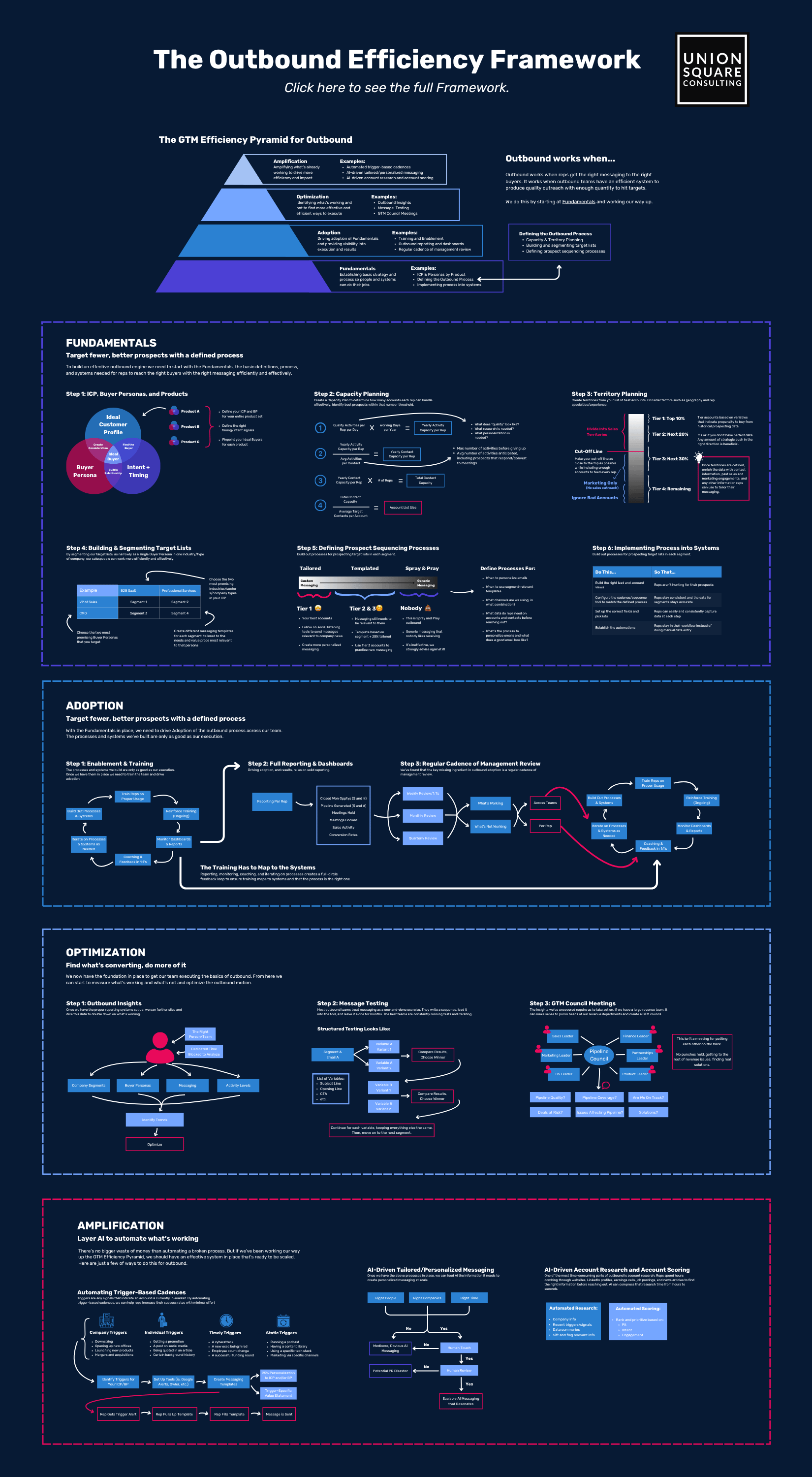
Download Infographic: Click here to download high-res PDF
Free Outbound Pipeline Inspection: Click here to learn more
Outbound Has an AI Problem
AI was supposed to fix outbound. For most teams, it’s made things worse.
Per-rep outbound volume has increased over 6x since AI tools hit the market. Monthly sends went from around 1,150 per rep to over 7,400. But reply rates dropped 38% over the same period, from 4.7% to 2.9%. (Source: Apollo and ZoomInfo outbound platform data Q1 2026)
We’re sending more messages to more people and getting fewer results.
Why is this happening? All of the outbound data coming out for 2026 validates what we’ve been seeing at USC in hundreds of B2B Tech companies: Most teams are layering AI on top of broken outbound processes and amplifying the damage.
So what does work?
- Target fewer, better prospects with a defined process
- Get the whole team executing it consistently
- Find what’s converting and do more of it
- Layer AI to automate what’s working
Outbound isn’t dead. It works when reps get the right messaging to the right buyers at the right time. And AI can absolutely help with that, if we build the right foundation first. There’s no bigger waste of money than automating a broken process.
Free Outbound Pipeline Inspection
LIMITED TO FIRST 5 QUALIFYING APPLICANTS
It’s time to stop guessing why outbound isn’t producing the revenue it should.
If you’re ready to find exactly where your outbound is breaking down and build a plan to fix it, let us show you how we do it.
This is v3.0 of the Outbound Efficiency Framework, refined over the years as the outbound landscape has evolved. This version reflects what we’re seeing in 2026, particularly the impact of AI on outbound and the data that’s emerged on what separates the teams that are producing results from the ones that aren’t.
In this framework, we’ll break down the components of an efficient, modern outbound system using the Outbound Efficiency Pyramid.
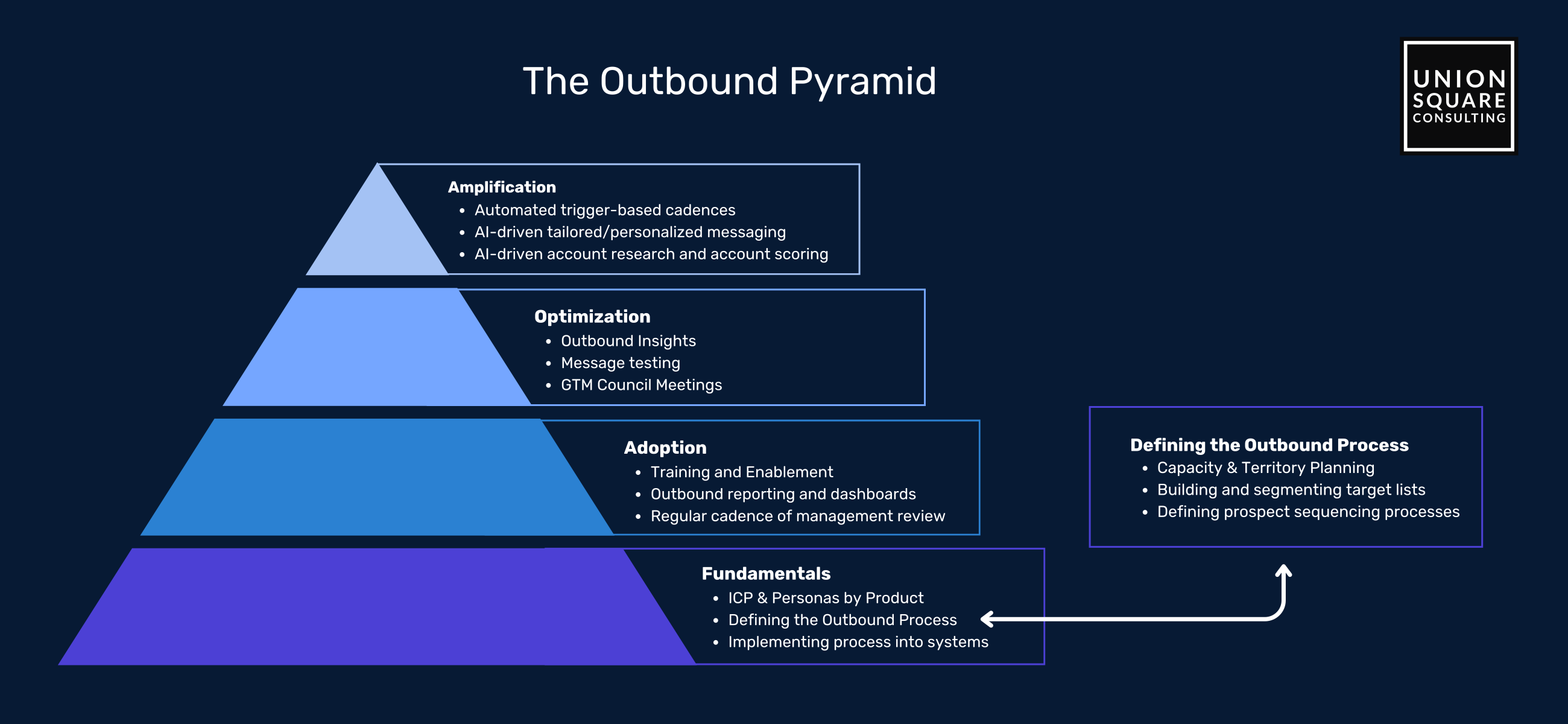
Fundamentals: Target fewer, better prospects with a defined process
To build an effective outbound engine we need to start with the Fundamentals, the basic definitions, process, and systems needed for reps to reach the right buyers with the right messaging efficiently and effectively.
There’s a reason we start here and not with AI and automation. The gap between top-performing outbound teams and everyone else comes down to targeting, process, and execution. Cognism’s outbound reps achieved cold call reply rates of 13.3%, nearly identical to reps calling warm leads at 14.4%. They credit verified data, ICP discipline, and structured process. The AI came later. (Source: Cognism)
Here are those Fundamentals.
ICP & Personas by Product
Teams with tight ICP targeting and verified contact data are seeing cold call conversion rates of 11.3%, more than four times the 2.7% industry average. (Source: Cognism)
Our Ideal Client Profile(s) and Buyer Personas define who is most likely to buy, easiest to sell, and who will be our best long-term customers. By pure definition, anyone we prospect that isn’t in our ICP and Buyer Personas will be a poor use of time. So, we need to carefully define this.
And if we have multiple products, we need to define our product set and the ICP/Personas for each product.
This will drive everything else we do in our GTM. Yet for some reason, most companies don’t go far enough here. They define ICP as an entire industry or set of industries and/or a wide revenue band. This yields tens or hundreds of thousands of target accounts, 100X what our salespeople can cover. By definition, they will NOT be targeting the absolute best accounts.
Instead, we need to carefully look at our existing clients and every data point we can access to define ICP as narrowly as possible. Look at the deals we’ve won. Better yet, look at our best customers over the long term and which were easiest to attract and serve.
What else can we use to describe these customers besides industry, revenue, and titles? The more granular we can get, the better prospects we can target and the better conversion rates, close rates, and LTV we will see from outbound.
Ideally we narrow down to the capacity our team has to work that list.
Defining the Outbound Process
Once we’re clear on our customers, we need to define the step-by-step process to convert those targets into meetings and pipeline.
This is where three components come together:
- Capacity & Territory Planning
- Building and Segmenting Target Lists
- Defining Prospect Sequencing Processes
Capacity & Territory Planning
Imagine our best sales rep, our rainmaker. We give her the best 2,000 accounts. She can’t cover all of them, though, so we have a number of problems:
- She’s not calling the best accounts in her territory
- Some of our best accounts aren’t being called at all
- She’s doing data analysis, instead of selling, to identify prospects
Is our best sales rep also our best data analyst? Is this where we want her spending her time?
Instead, we can do a Capacity Plan and figure out exactly how many accounts and contacts she can cover this year. Then we can identify the absolute best prospects within that number so she is laser focused on the prospects most likely to convert and close. We make her life easier and generate more revenue.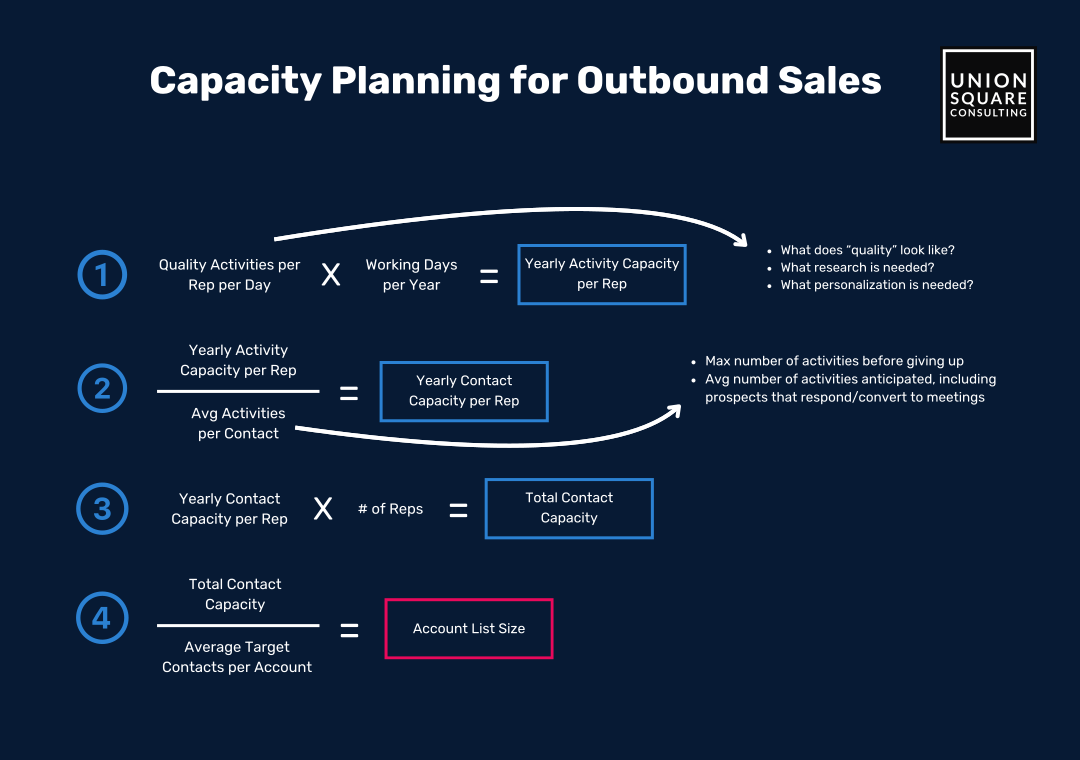
Building and Segmenting Target Lists
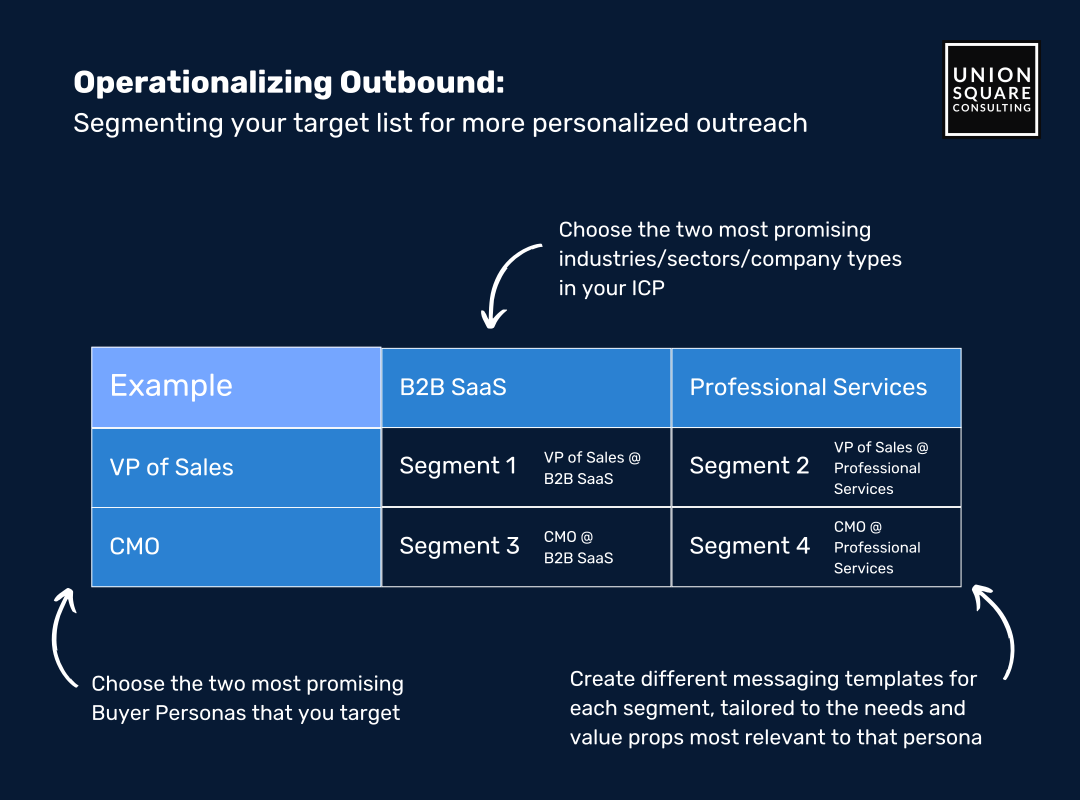
Now imagine our all-star sales rep is prospecting this morning. She calls the CFO in a B2B SaaS company first. Then she calls a VP of Sales in a manufacturing company next. Then she’s on to the CEO of a healthcare company. She’s a rockstar, so each message she leaves is a 10/10. But how easy was it?
What if, instead, she spent the entire day/week/month just prospecting into CFOs in B2B SaaS companies that were PE-backed and had $100M to $200M in revenue? How much better would her messaging be after the 5th contact? After the 50th? The 500th? How much faster would she work through the list while maintaining 10/10 messaging?
By segmenting our target lists as narrowly as a single Buyer Persona in one industry/type of company, our salespeople can work more efficiently and effectively. Just imagine what this does for our normal reps, our struggling reps, our new reps still onboarding.
The data backs this up. Research from Digital Bloom found that segmenting into cohorts of 50 or fewer contacts increases reply rates by 2.76x compared to larger, less targeted lists. (Source: Digital Bloom)
Defining Prospect Sequencing Processes
What’s the step-by-step process to prospect target lists in each segment and when do reps walk away?
We answer that by building out sequences and arming reps with clear steps and an efficient workflow.
- When to personalize emails
- When to use segment-relevant templates
- What channels are we using, in what combination?
- What data do reps need on accounts and contacts before reaching out?
- What’s the process to personalize emails and what does a good email look like?
One major gap we see often is data enrichment. Reps aren’t armed with enough information so they burn valuable selling time finding websites and social profiles, toggling systems to review past interactions with sales and marketing, etc. Or they simply skip this step and send out generic messaging.
This adds up fast. Sales reps spend only 28% of their week on revenue-generating activities. The rest goes to admin, research, and toggling between tools. (Source: Salesforce)
The right sequencing process removes that guesswork. It tells reps what to do and in what order, and it gives them the information they need before they pick up the phone or draft an email. Reps who have this spend their time selling. Reps who don’t have it spend their time searching.
Implementing Process into Systems
None of this matters if it lives on a slide deck nobody opens.
The process needs to live inside the CRM, the sequencing tool, and the rest of the tech stack so that reps can do their jobs efficiently and management can get visibility into execution via reporting.
Most mature businesses know what their outbound steps should be. Many do not have them documented, built into their workflow, or executed consistently by their team. Fixing that is the first step to building an efficient outbound engine.
What does this look like in practice?
- Building the right lead and account views so reps aren’t hunting for their prospects
- Configuring the cadence/sequence tool to match the defined process
- Setting up the correct fields and picklists to capture data at each step
- Establishing the automations that keep reps in their workflow instead of doing manual data entry
If the system doesn’t match the process, the process won’t stick.
******************************************************************
Adoption: Get the whole team executing consistently
With the Fundamentals in place, we need to drive Adoption of the outbound process across our team. The processes and systems we’ve built are only as good as our execution.
And the execution gap in outbound is enormous. The 2025 Ebsta x Pavilion GTM Benchmarks report, analyzing 4.2 million opportunities and $54 billion in pipeline, found that 14% of sellers generate 80% of revenue, with an 11x velocity gap between top and bottom performers. 76% of sellers missed quota in H1 2025. (Source: Ebsta x Pavilion)
Most of that gap comes down to consistent execution of a defined process. Here is how we close it.
Training and Enablement
Once we have the process and systems in place we need to train the team and drive adoption. But training isn’t a one-time exercise. We can’t run a 90-minute session and expect permanent behavior change. We need to reinforce training on an ongoing basis, by monitoring reporting and reminding reps of the best process to execute outbound.
New reps need onboarding that walks them through the sequencing process, the messaging playbooks, and the tools they’ll use every day. Existing reps need refreshers, especially when the process changes or when reporting shows execution is slipping.
One thing we’ve learned working with revenue teams: if the right process is harder to follow than the wrong one, reps will default to their old habits. So the training has to map to the systems. If reps are trained on a process that doesn’t match how the CRM is configured, they’ll ignore both.
Outbound Reporting and Dashboards
Driving adoption, and also results, relies on solid reporting.
- What does activity look like?
- How many meetings are they booking?
- How much pipeline is each rep generating?
- What are conversion rates from activities to meetings to pipeline?
With the right reporting in place, we can see which reps are executing and which aren’t. We can see what’s working and what’s not working with each rep and across the entire team. Coaching gets a lot easier when we have data behind it.
The reports we care about most in outbound:
- Activity volume by rep, by segment
- Meeting conversion rates (activities to meetings, meetings to pipeline)
- Pipeline generated by source, segment, and rep
- Sequencing completion rates (are reps finishing sequences or abandoning early?)
If we don’t have these, we’re managing blind.
Here’s why this matters: across B2B outbound teams, reps average 104 activities per day, yet only 18% produce a meaningful conversation. That’s 85 wasted motions for every 19 that matter. Without reporting that connects activity to outcomes, we have no way to know which 18% is working. (Source: Bridge Group)
Regular Cadence of Management Review
This is the piece most teams skip, and it’s the piece that makes or breaks everything else. We’ve found that the key missing ingredient in outbound adoption is a regular cadence of management review.
This can be as simple as weekly outbound inspection and coaching. Are reps following the sequencing process? Are they prospecting into the right segments? What does their activity look like compared to their peers?
If this is never done, it’s almost guaranteed the team will drift away from the process. They’ll fall back on old habits, cherry-pick accounts, and skip steps. If it is done consistently, over time, it’s almost guaranteed the team will follow whatever process is being inspected.
The Fundamentals and Adoption can be put in place extremely quickly and set the foundation for outbound. In many cases, this alone creates meaningful revenue impact before we even get to Optimization.
******************************************************************
Optimization: Find what’s converting, do more of it
From here, we have enough accurate, consistent data that we can start measuring what’s working and what’s not to optimize the outbound motion.
And there’s a lot to optimize. Win rates across B2B have declined to 19%, down from 29% just one year prior. Sales cycles have expanded to an average of 6.5 months, up from 4.9 months in 2019. And 76% of sellers missed quota in H1 2025. (Source: Ebsta x Pavilion)
In this environment, we can’t just execute the basics and hope for the best. We need to analyze the data, find what’s working, and double down. Here are a few examples.
Outbound Insights
Once we have consistent execution and regular review of the reports, we should have data we can trust. With that data, if we dedicate the right resources, we can analyze it to uncover what’s working, what’s not, and find ways to optimize.
We slice and dice the data to see which reps are generating the most pipeline and, ultimately, revenue. We look at different company segments, different buyer personas, messaging, activity levels, etc. to identify trends.
The first and hardest step here is blocking dedicated, protected time for the right person or people to review this data on a regular basis. This is where most teams stall. The reports exist but nobody has the time carved out to actually dig into them.
Once that’s in place, the insights start to surface. Maybe we’re converting at 2X the rate into one segment versus another. Maybe one persona responds to a specific type of messaging and another doesn’t. These are the kinds of insights that allow us to double down on what’s working and help our team narrow their focus to where we’re seeing the most success.
Message Testing
With data flowing and insights coming in, we can start testing messaging in a structured way.
Most outbound teams treat messaging as a one-and-done exercise. They write a sequence, load it into the tool, and leave it alone for months. The best teams are constantly running tests and iterating.
Here’s what structured testing actually looks like: pick one segment. Run two versions of the same email with one variable changed. Maybe it’s the subject line. Maybe it’s the opening line. Maybe it’s the CTA. Run it for two weeks, compare the results, and keep the winner. Then test the next variable.
If we’re prospecting into CFOs at PE-backed SaaS companies, we test messaging that speaks directly to their world. What’s resonating? What’s falling flat? Over time, our messaging gets sharper and conversion rates compound.
The key is one variable at a time. If we change the subject line, the body copy, and the CTA all at once, we have no idea what drove the improvement.
GTM Council Meetings
The insights we’ve uncovered require us to take action. If we have a large revenue team, it can make sense to pull in heads of sales, marketing, customer success, product, and/or finance to discuss what’s working to generate and close pipeline and what we should do differently.
This is the GTM Council Meeting. It’s a regular forum where leadership can review outbound insights, discuss what actions to take, and align on priorities. If marketing sees what messaging is converting for sales, they can create content that reinforces it. If product hears what objections keep coming up, they can address them. These conversations don’t happen naturally in most organizations. We need to create the forum for them.
******************************************************************
Amplification: Layer AI to automate what’s working
Finally we get to the shiny objects that excite us all: Automation, AI, and other advanced scaling concepts.
This is often where we want to start, but as we covered in the intro, the data on what happens when we skip the foundation is not encouraging.
Jason Lemkin and Kyle Norton noted at SaaStr AI Summit 2025 that only 2% of companies successfully implement AI-driven outbound, because most take a hands-off approach. The ones that work require weekly refinement cycles and deep involvement from revenue leadership.
But with the Fundamentals, Adoption, and Optimization in place, we should have something working. We should see our reps booking meetings and converting them to pipeline and revenue. Now, we can ask ourselves how to do this better and faster. Here are just a few of many ways we can do this.
Automated Trigger-Based Cadences
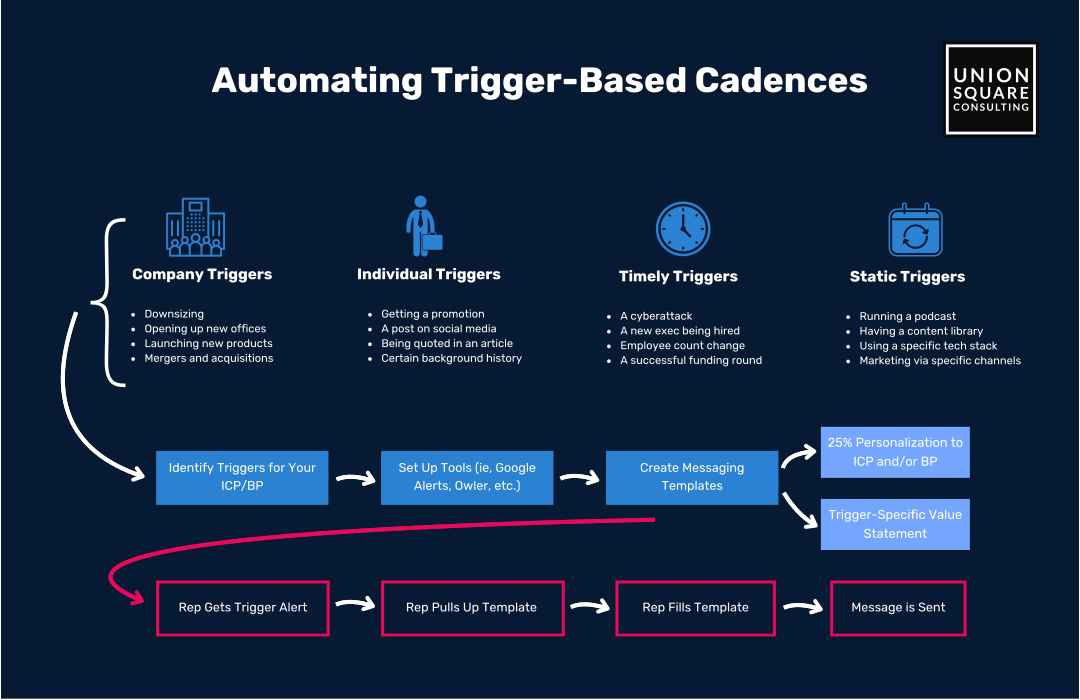
With the above foundation in place we’re chasing the right people in the right companies with the right messaging. But are we doing it at the right time? Triggers are any signals that indicate the timing might be right now.
- A prospect gets promoted
- A target account raises a round of funding
- A lead visits our website three times in a week
- A company posts a job listing that signals a new initiative
These are all signals that the window might be open.
Great salespeople spend a lot of time and effort searching for and tracking triggers. By automating trigger-based cadences we can take this heavy lift off their plates and help them work smarter, targeting the right people at the right time with minimal effort.
AI-Driven Tailored/Personalized Messaging
Most of us have already received hundreds of mediocre AI-generated sales emails. That’s why we saved this for last.
Once we have the process above in place, we can feed the AI the right people in the right companies at the right time with the right data and generate personalized messaging that actually resonates with our audience. These emails often still need a final personal touch, but AI can help us work better faster.
It comes down to inputs. If we give the AI a clean, segmented list with solid research data, relevant messaging frameworks, and clear buyer personas, the output is dramatically better than asking it to “write a cold email to this person.” Good inputs in, good outputs out.
AI-Driven Account Research and Account Scoring
One of the most time-consuming parts of outbound is account research. Reps spend hours combing through websites, LinkedIn profiles, earnings calls, job postings, and news articles to find the right information before reaching out. AI can compress that research time from hours to seconds.
With the right tools and setup, we can automate account research at scale. AI pulls relevant company information, identifies recent triggers, summarizes what a prospect’s company does, and surfaces the data points that matter most for personalization. This gives our reps a head start on every call and every email.
On the scoring side, AI can help us rank and prioritize target accounts based on fit, intent, and engagement signals. Instead of giving reps a flat list and asking them to figure out who to call first, we can surface the accounts most likely to convert right now
Putting It All Together
There’s a lot here and there’s a reason we work with customers for multiple years and/or they hire full-time RevOps leaders or entire teams.
But the good news is that getting the Fundamentals in place and driving Adoption can happen very fast. In just a few weeks if the team is small enough.
Optimization and Amplification can take years. In fact, we’d argue they’re never “done.” No team has the perfect outbound engine. But getting the basics in place can make a huge impact fast.
Where do we start? Identify the biggest gap.
- Is our ICP too broad
- Are reps drowning in too many accounts
- Do we have no visibility into what’s working
- Are we trying to automate before the basics are in place
Start with Fundamentals and Adoption. Get the basics in place, get the team executing consistently, and build the reporting to see what’s working. Then move into Optimization and, eventually, Amplification.
That’s the outbound engine. It takes work. But it produces real, sustainable revenue.
Free Outbound Pipeline Inspection
LIMITED TO FIRST 5 QUALIFYING APPLICANTS
It’s time to stop guessing why outbound isn’t producing the revenue it should.
If you’re ready to find exactly where your outbound is breaking down and build a plan to fix it, let us show you how we do it.