The Pipeline Management Framework
Read time: 13 minutesWritten by:
-

Eddie Reynolds
Founder & CEO
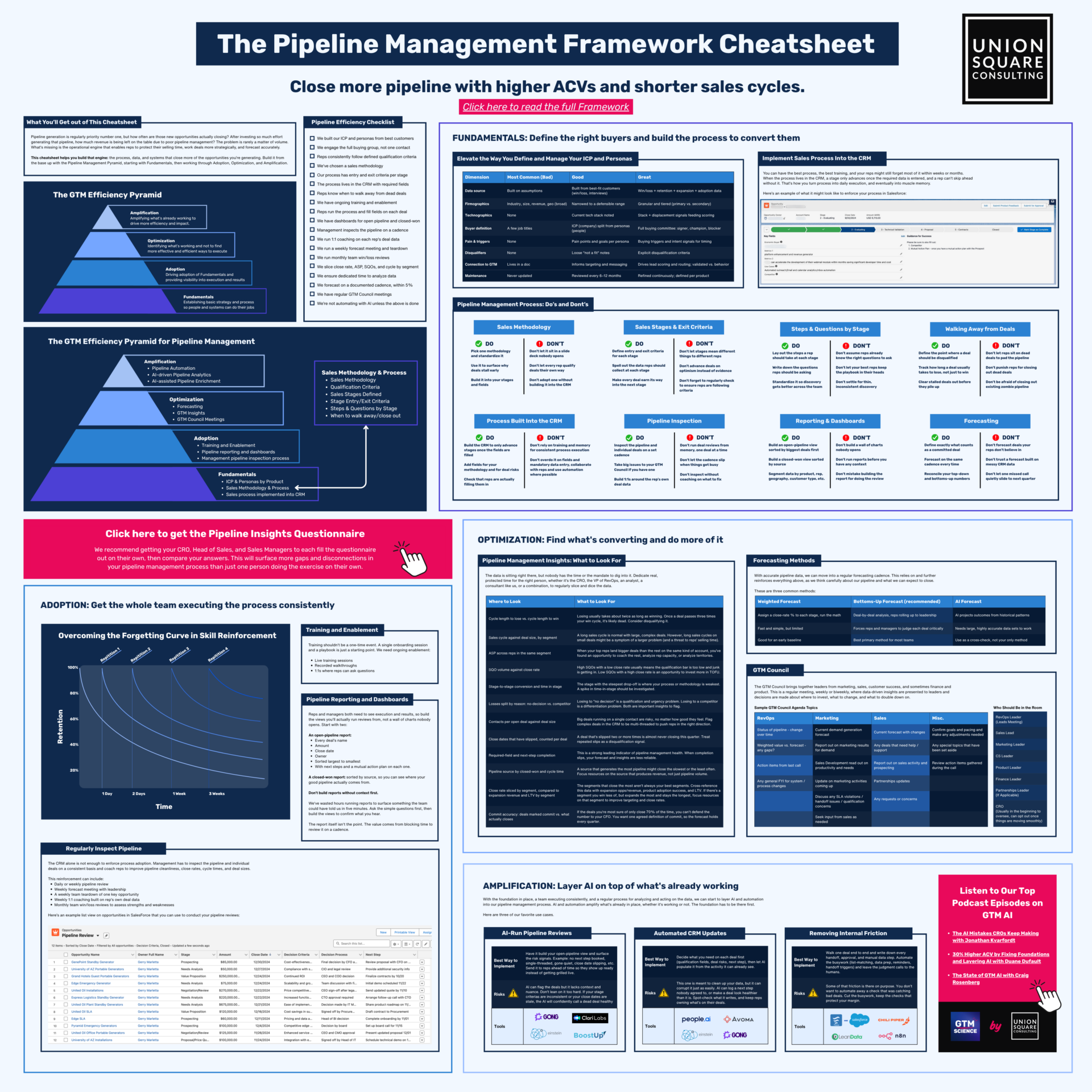
Download the Cheatsheet PDF: Click here
Pipeline Insights Questionnaire: Click here
Almost every revenue leader we talk with sees lead and pipeline generation as their #1 priority.
This is a poor investment when the pipeline management process is broken.
Most sales teams spend far too much time chasing deals they were never going to win, while losing deals they should have won, by skipping steps in the process.
Worse, management can’t see any of it happening, because the reporting is thin and deal reviews happen verbally, from memory, one deal at a time.
We see the same symptoms on call after call:
- They step on the gas and the car doesn’t move
- Marketing/SDRs generate pipeline that doesn’t close
- Reps are pushing deals every quarter and missing forecast
- Close rates, sales cycles, average deal sizes are all over the place
- Leadership aligns on new strategies but the team doesn’t execute
This isn’t a fringe problem. Gartner found that just 7% of sales organizations forecast with 90% accuracy or better, and 69% of sales operations leaders say forecasting is getting harder. (Source: Gartner)
Now picture the opposite. A team that runs pipeline like a machine. Each rep understands how to qualify deals, what steps to take at each stage of the process, and how to forecast accurately.
They know what they need to do to close more and bigger deals, faster. They know when to walk away to protect their precious selling time. Management can see the whole pipeline and coach each rep on the specific deals that need help.
Most importantly, sales AND marketing leaders can both see what’s working, what’s not, and where to put their next dollar.
We’ve watched this play out thousands of times, so we built the GTM Efficiency Pyramid for Pipeline Management to map it. This framework breaks that pyramid down so you can operationalize it.
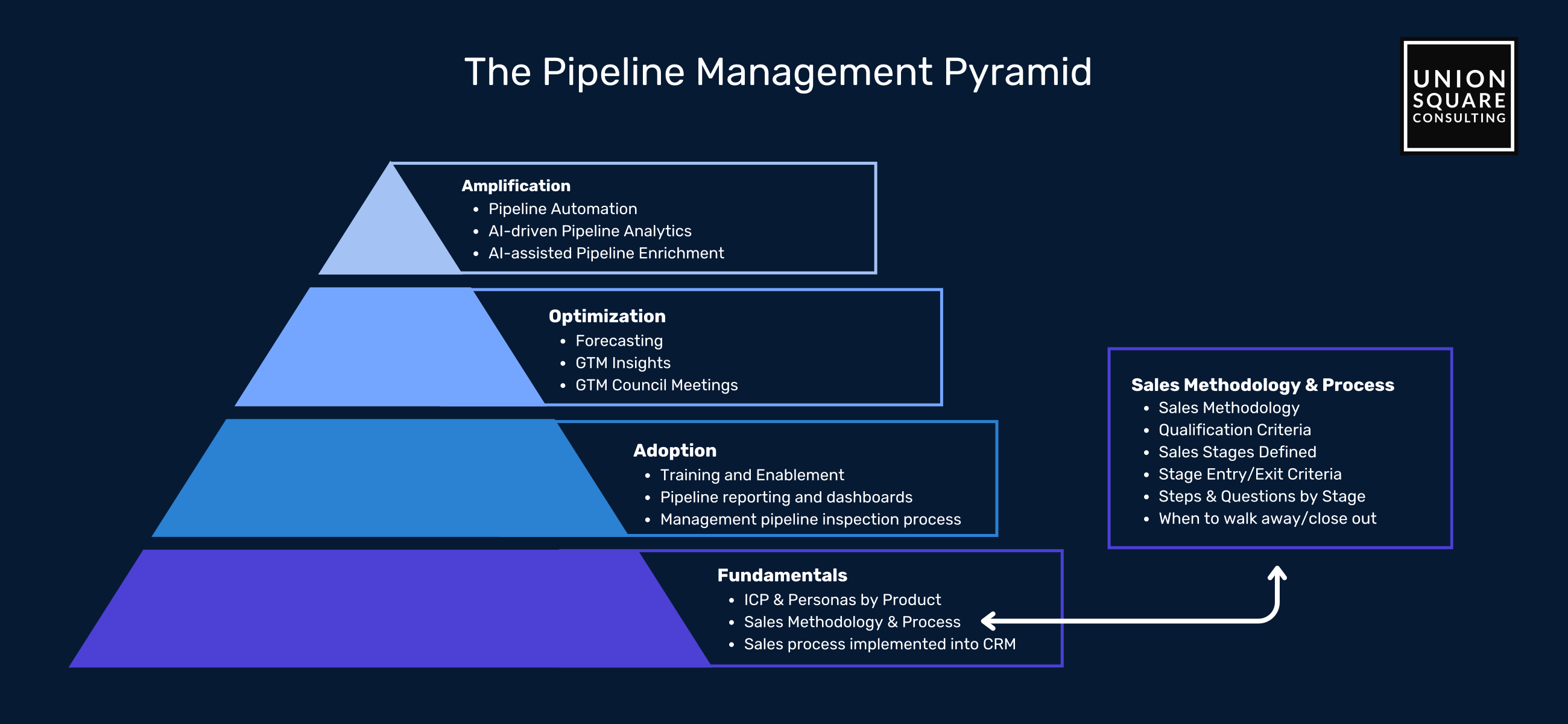
In this updated version 3.0 of the Pipeline Management Framework, we’ll cover how to:
- Get quick wins in weeks, not quarters
- Build a foundation that holds up as you scale
- Get real visibility into pipeline and forecasts
- Get alignment across sales, marketing and CS
- Identify what’s working, what’s not, what to do
- Optimize the entire pipeline management process
- Leverage automation and AI to amplify what’s working
This works whether your pipeline is in decent shape today or a complete mess.
Once you have this foundation in place for new business, you can extend the same process to expansion (and retention, to a limited extent) to tighten up the rest of your GTM engine.
Fundamentals
ICP and Personas by Product
Teams lose deals before the first call by going after the wrong companies and the wrong people. The ICP gets defined too broadly, choosing entire industries or large revenue ranges, without diving deep enough into their customer data to pinpoint the true ideal profile for each product.
Instead, look at your existing customers and figure out who your best ones are. Not just who bought, but:
- Who was easiest to sell
- Who stayed the longest
- Who expanded the most
- Who had the best adoption
Teams also miss the mark by not engaging the right stakeholders, leading to lower close rates, longer sales cycles, or smaller deals.
Gartner puts the typical buying group for a complex B2B purchase at six to ten decision-makers, and finds buyers spend only about 17% of the entire journey meeting with suppliers, split across everyone they’re considering. Winning over just one friendly contact doesn’t do it.
Before you touch the sales process, get specific about what you sell and who you sell it to.
Sales Methodology and Process
Most deals stall or die for the same handful of reasons. A sales methodology like MEDDIC exists to surface those reasons early, while there’s still time to do something about them.
A methodology on its own is a philosophy. It only changes behavior when you translate it into a defined process.
That means breaking the deal into stages, and for each stage spelling out:
- Stage definition
- Data to collect
- Entry and exit criteria
- Steps and questions
- When to walk away or close it out
A clearly defined process like this, driven by the right sales methodology, improves qualification, discovery, and deal strategy. All of that together protects your reps’ most precious resource: their selling time.
This is also what drives the workflow and reporting you’ll build in the CRM. Plenty of teams skip this step (or get lazy with it) and then wonder why the CRM gives management zero visibility.
Sales Process Implemented Into the CRM
You can have the best process, the best training, and your reps will still forget most of it within a few weeks or months.
That’s not on your reps, it’s just how memory works. The forgetting curve, first measured by Ebbinghaus and confirmed by modern replications, shows we lose much of what we learn within days unless something makes us use it again. So you need a system that reinforces the process, tracks it, and reminds reps what to do and when (this is also a crucial tie-in to the next section, Adoption).

Management needs to see it in real time in order to coach on it.
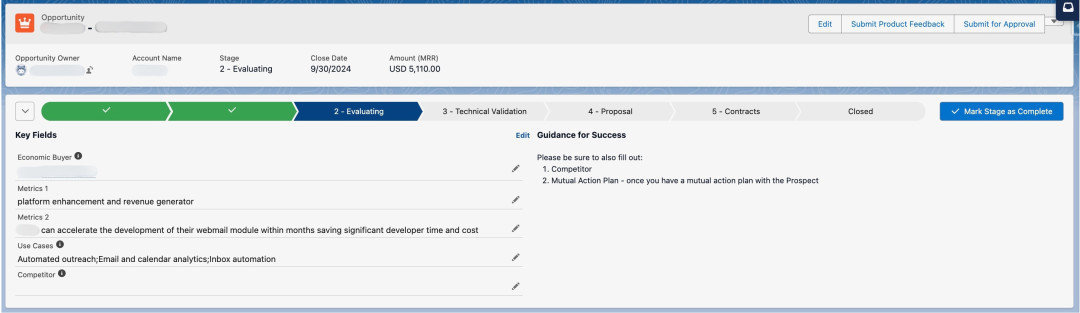
When the process lives in the CRM, a stage only advances once the required data is entered, and a rep can’t skip ahead without it. That’s how you turn process into daily execution, and eventually into muscle memory.
Here’s an example of what it might look like to enforce your process in Salesforce:
Adoption
Fundamentals get the process designed. Adoption gets the team to actually run it. This is the hardest job in sales leadership, and it’s where most of the value is.
Training and Enablement
A one-time rollout doesn’t change how people work once they’re back in the grind. It’s too easy to slip into old habits without consistent reinforcement (as we discussed above with the forgetting curve).
Ongoing enablement looks like:
- Live training sessions
- Recorded walkthroughs
- 1:1s where reps can ask questions
This is why it’s so important to implement the sales process into the CRM. Those checks and guardrails make it possible for sales managers to see at-a-glance whether reps are following the right pipeline management process, or if more coaching is needed.
Pipeline Inspection Process
Which leads us to Pipeline Inspections. The CRM alone is not enough to enforce process adoption. Management has to inspect the pipeline and individual deals on a consistent basis and coach reps to improve pipeline cleanliness, close rates, cycle times, and deal sizes.
If this never happens, pipeline (and forecasting) becomes a mess. That’s close to guaranteed.
If it happens consistently, the team will follow whatever process is being inspected. That’s also close to guaranteed.
This reinforcement can include:
- Daily or weekly pipeline review
- Weekly forecast meeting with leadership
- A weekly team teardown of one key opportunity
- Weekly 1:1 coaching built on rep’s own deal data
- Monthly team win/loss reviews to assess strengths and weaknesses
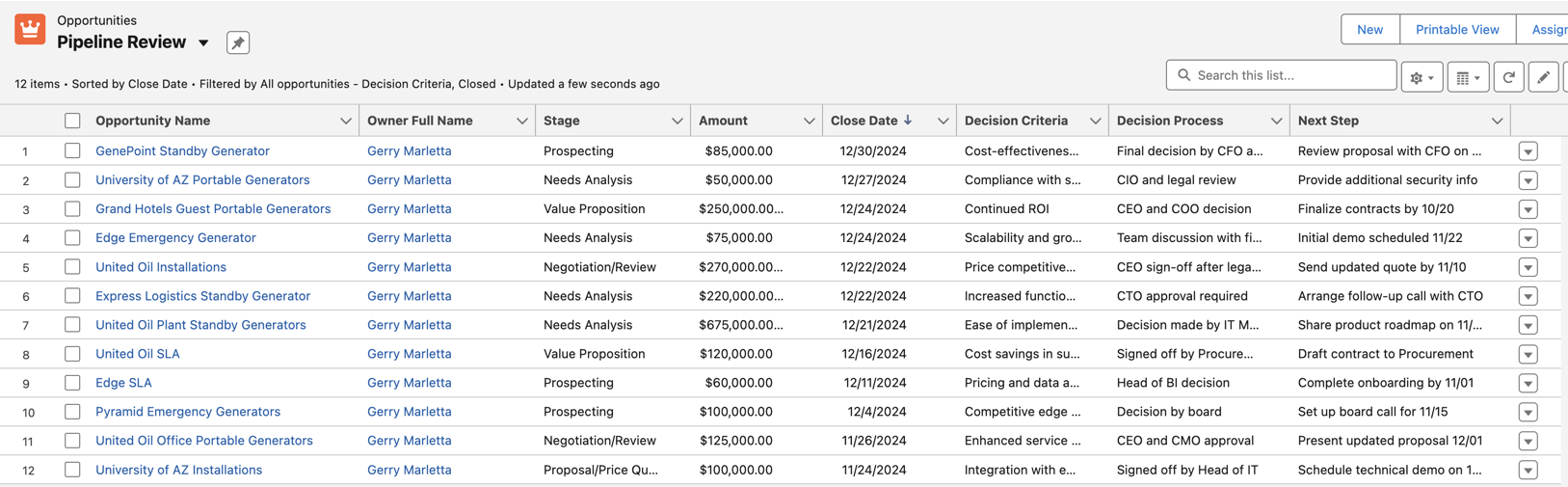
Here’s an example list view on opportunities in Salesforce that you can use to conduct your pipeline reviews:
Pipeline Reporting and Dashboards
Reps and managers both need to see execution and results, so build the views you’ll actually run reviews from, not a wall of charts nobody opens. Start with two:
An open-pipeline report: every deal’s name, amount, close date, and owner, sorted largest to smallest, with next steps and a mutual action plan on each one.
A closed-won report: sorted by source, so you can see where your good pipeline actually comes from.
One thing we’ve learned the hard way: don’t build reports without context first.
We’ve wasted hours running reports to surface something the team could have told us in five minutes. Ask the simple questions first, then build the views to confirm what you hear.
The report itself isn’t the point. The value comes from blocking time to review it on a cadence.
*Everything outlined so far can be achieved in days or weeks! It can take multiple deal cycles to optimize from here but the foundation, the fundamentals and adoption, can be achieved extremely quickly.
Optimization
Once the team executes consistently and management reviews the data regularly, you have data you can trust. Now you can use it.
GTM Insights
With clean data, go deeper than the standard reports. Look at the metrics that tell you where the process is working and where it isn’t:
- Close rate
- Average sales price
- Number of SQOs generated
- Average sales cycle
Most teams don’t go deep enough here to uncover valuable insights.
Slice this data by rep, team, product, geography, and customer type, then compare. That’s where you find the rep who closes enterprise but stalls in mid-market, or the product that drags the cycle out.
One insight most teams miss is how long it takes to lose, not just to win.
Track your average cycle to a lost deal alongside your cycle to a win. Our rule of thumb is that losing takes about twice as long as winning, and once a deal runs past three times your winning cycle, it isn’t closing, it’s just sitting there. That number tells a rep when to stop spending time and disqualify, which protects the selling hours your win rate depends on.
It takes real time and GTM expertise, but it’s how you get more revenue per rep at a lower CAC.
Related: The GTM Metrics and Insights Framework
Forecasting
With accurate pipeline data, you can move into a regular forecasting cadence. This relies on and further reinforces everything above, as you think carefully about your pipeline and what you can expect to close.
Before any method works, the team has to agree on what a committed deal actually is. Ask three reps and you’ll often get three different answers, which creates a domino effect of inaccuracy.
Write down one definition of a commit, with clear criteria every rep applies the same way. When commit means one thing across the team, the rollup becomes a number you can trust and defend.
There are three common methods:
Weighted Forecast: Assigns a percentage close rate to each stage in the pipeline and runs simple math to produce a forecast. This method is straightforward but limited.
Bottoms-Up Forecast: A deal-by-deal analysis, beginning with sales reps and rolling up to leadership. This approach is recommended as it prompts reps and managers to assess each deal critically.
AI Forecasting: Uses AI to project outcomes but requires large sets of highly accurate data to be effective.
Combine them and you can usually get within 5% of actual bookings.
GTM Council Meetings
The above tells you what’s happening, but not necessarily what to do about it. Especially when the data surfaces a complicated issue that touches multiple departments.
This is where a GTM Council comes in. A GTM Council brings together leaders from sales, marketing, CS, product, and any other team that touches revenue. The goal is to work through the big issues and opportunities affecting revenue generation and retention, and to decide where to put more resources or where to pull back.
Not every company needs one. It earns its place once the GTM team is large and the strategy is complex enough to need cross-functional alignment, usually north of 150 people. (That’s Dunbar’s number, the rough ceiling on how many relationships a group can hold before it needs more structure to coordinate.)
Related: Creating a GTM Council
Other resources:
Make a Copy: Suggested Attendees and Agenda Sample
Download: GTM Council Data Checklist
Amplification
This is the part everyone wants to start with. Automation, AI, agents, etc. They all amplify the foundation underneath it, whether that foundation works or not.
We’ve talked to some of the smartest CROs running some of the most successful GTM orgs today who have repeated the same mantra: AI should be the last thing you focus on in GTM.
You can listen to some of our favorites conversations on this here:
- The AI Mistakes CROs Keep Making with Jonathan Kvarfordt
- 30% Higher ACV by Fixing Foundations and Layering AI with Duane Dufault
- The State of GTM AI with Craig Rosenberg
Once your GTM foundations are in place, here are some of our favorite use cases for amplifying pipeline management.
AI-Run Pipeline Reviews
Instead of building the review by hand, AI pulls deal data from the CRM, call recordings, and email, then flags the deals in trouble before the review even starts. This was Craig Rosenberg’s favorite use case on the podcast.
Have it build your open-pipeline view and surface the risk signals. For example: no next step booked, single-threaded, gone quiet, close date slipping, etc. Send it to reps ahead of time so they show up ready instead of getting grilled live.
Automated CRM Updates
Every analysis in this framework depends on all reps consistently/accurately filling in the CRM, and we all know how that can go. Newer tools auto-log activity and update deal fields straight from calls, emails, and meetings, so the record reflects reality without a rep typing it in.
Decide what you need on each deal first (qualification fields, deal risks, next step), then let AI populate it from the activity it can already see.
Removing Internal Friction
On our podcast, Jonathan Kvarfordt shared his own data: more than 70% of what stretches a sales cycle is internal, not the buyer. The deal is ready to move and the team is in the way. Cut that out and you shorten the cycle, handing reps their selling time back.
Walk one deal end to end and write down every handoff, approval, and manual data step. Automate the busywork (list-matching, data prep, reminders, handoff triggers) and leave the judgment calls to the humans.
Where to start
There’s a lot here. We frequently work with teams for years on perfecting their pipeline management, and plenty more hire RevOps leaders and teams to own it. But you can’t fix all of it at once, and you don’t need to.
A great starting place is to fill out our Pipeline Insights Questionnaire: Click here to get it.
We recommend getting your CRO, Head of Sales, and Sales Managers to each fill the questionnaire out on their own, then compare your answers. This will surface more gaps and disconnections in your pipeline management process than just one person doing the exercise on their own.
The general rule is to start at the bottom of the pyramid. Get the Fundamentals and Adoption in place for new business pipeline first. For a small team, this can be completed in a matter of weeks.
Optimization and Amplification take longer, and honestly they’re never finished. No team has a perfect engine. Getting the basics right is what makes the biggest, fastest impact.
From there, extend the same process to expansion, where the gaps are usually just as big and far less watched.
For help planning and executing any part of this process, come talk to us.