
Build the Foundation for AI in GTM
Read time: 7 minutesWritten by:
-

Eddie Reynolds
Founder & CEO
SaaStr just launched an AI SDR that outperformed all their human SDRs in just two weeks.
Jason Lemkin recently shared an article explaining all of this. You can read it here.
How is this possible when everyone else already tried and failed to build an AI SDR last year? In his article, he pointed out a number of key differences.
Two key differences really stood out to me:
- They built (and rebuilt) their foundation
- They put a lot of time and effort into building it.
The first point is something we’ve been preaching at USC for a long time. We can’t just hire an AI dev to build something, press the button, sit back and watch the money roll in. This is exactly what a lot of folks did last year and every one of us received a lot of mediocre emails as a result.
In this article, we want to focus on the first point, building the foundation, and outline specifically how to do this. We want to share the foundation we’ve seen with hundreds of GTM teams that makes, or breaks, any initiative, be it human or AI-led.
Let’s dive into the components.
We Need Full and Accurate Data
For SDRs, whether human or AI, they need to be pointed to the right prospects and trained on what works and what doesn’t. If we feed them junk, that’s the output we’ll get. Jason summed this up well.

For any area of GTM, we need to make sure we have full and accurate data to train the AI. This requires a lot of work but it will make or break our end results.
We Need Process to Get the Data
Jason said they had opportunities that were never logged in Salesforce and AEs that never used the system properly. What does that mean?
We have to have a clear definition of an opportunity to say, objectively, whether or not Salesforce is missing any. We have to have a clear process defined and documented to say whether or not our AEs followed that process in the system properly. In other words, we need to know what data they should have collected in each step of the process.
If we have clear definitions and processes, we can go back to our records and, potentially, identify anything we’re missing. More importantly, we can fix things going forward so that the AI has better data to analyze and produces better results, in this case, more meetings and pipeline with the right buyers.
We’ve outlined a lot of these processes in the Fundamentals of our GTM Efficiency Pyramid and broken them down into Pipeline, Outbound, Inbound, and CS. Here are the first two.
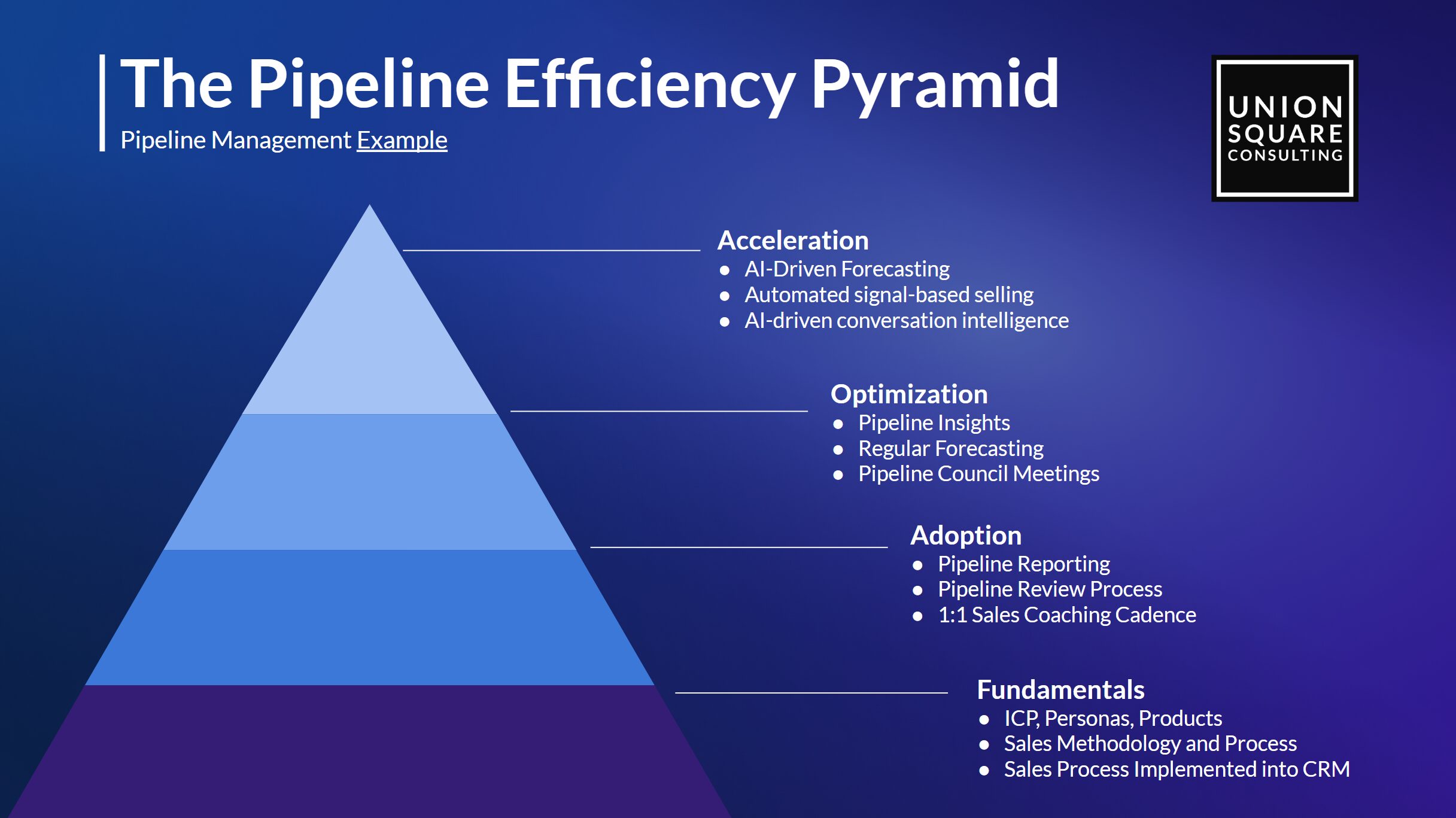
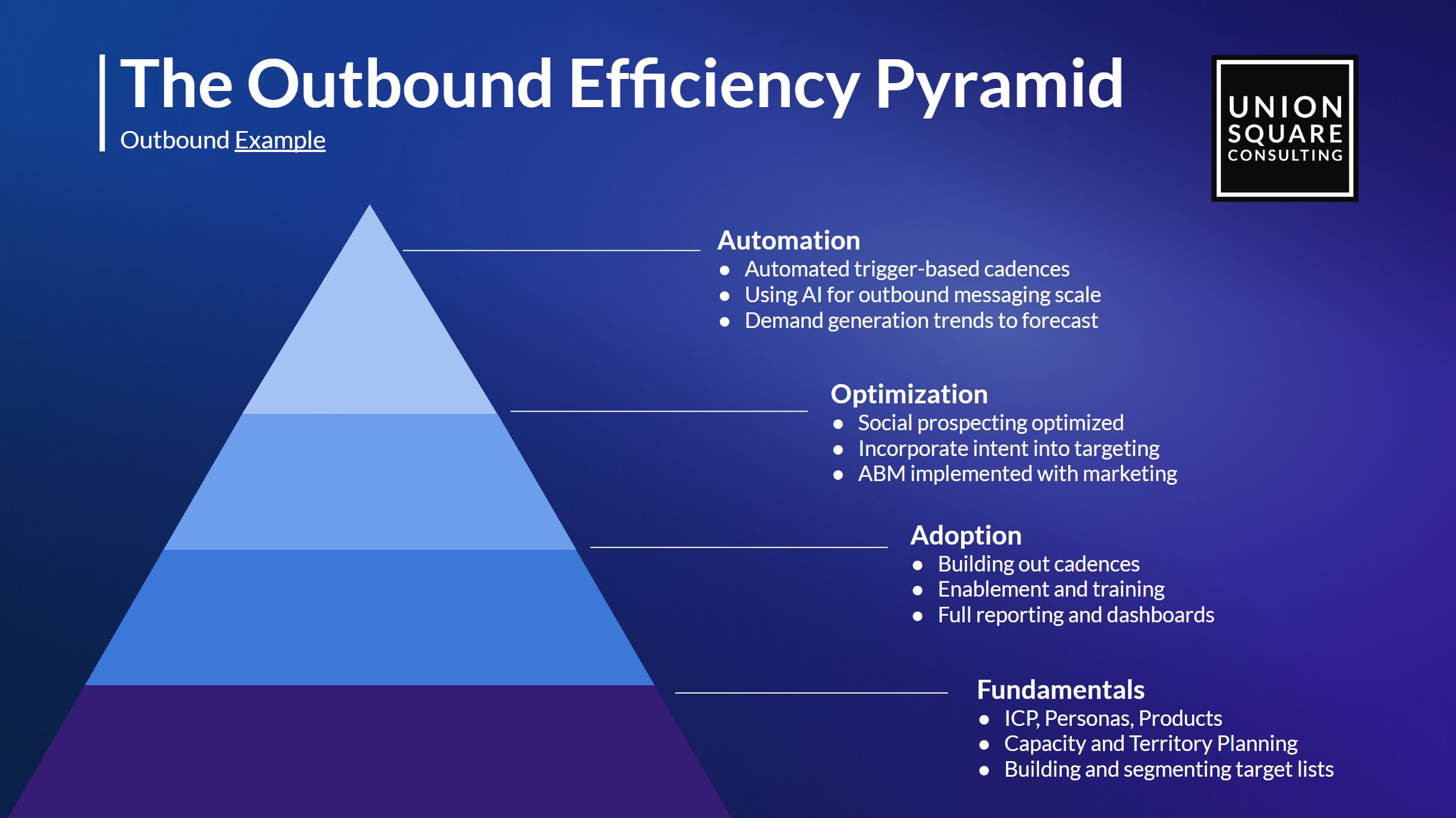
As you can see, the Fundamentals tell us what deals meet the criteria to enter pipeline and what targets meet the criteria to prospect them. These are critical questions to answer to train and enable both human and AI SDRs, or any aspect of the sales process.
Drive Adoption of the Process
In some cases, once we’ve defined our process, we can go back and find the data to fill in the gaps. I’ve done this myself many times but it’s a massive investment of time, it’s often only possible with small data sets, and it’s only possible with available data.
It’s possible for one person to manually clean up 100 opportunities. It’s not possible to do that with 10,000. It’s possible to use tools like ZoomInfo or Clay to backfill industries and revenue, but it’s not possible to backfill competitors and reasons lost if we never asked or never recorded the answers.
This is where process adoption becomes paramount. We have to decide, as a GTM team, what data is critical for us to operate and analyze our business and build systems to maintain that data. We have to decide what steps our team should take, what questions they should ask, and what data they should record in order to drive the most revenue possible with the most accurate critical data.
This starts with defining the process and building that process into the tools, the CRM, the marketing automation tool, the sales cadence tool, etc. It also involves building reports on the metrics and data that matter. Most importantly of all, it requires management to review those reports and hold the team accountable to executing the process.
Optimizing and Accelerating the Process
Once we’ve built that foundation, we can start to optimize and then accelerate it. AI is an analytics engine, first and foremost. If we feed it the right data, it can tell us what’s working, what’s not, and help us optimize what we’re already doing.
In the case of an AI SDR, it can help us identify better targets, better segments, and better messaging by looking through our historic data to see what worked and what didn’t. This is what we mean by optimization and the bullets we have listed in our graphic are just a few of many ways to do this.
Given Jason’s experience, it’s hard to imagine his team wasn’t already doing a lot of this manually, before AI. Either way, it’s critical to optimize the process before accelerating it.
Once we’ve done that, an AI SDR is a perfect example of accelerating a solid process. We’ve built the foundation and we’re now ready to execute better and faster. Our AI SDR has everything it needs to start writing and sending emails. Jason very clearly pointed out how much humans were still involved though. It’s an AI Copilot (which we wrote about here) not something you push the button on and then check back on in a week.
Implementing the Foundation
This is a lot and it overwhelms many people. Where do we even start?
I like to start with the end in mind. In the case of an AI SDR, it’s pretty clear. We want to generate more new business, by generating more pipeline, by generating more meetings with the right people via outbound. This is a clear mandate and it focuses our energies a lot more than “We need to clean up our data so we can have better insights.”
I often ask people if they want to generate more new business or more NRR and then peel back the layers into closing vs. pipeline, inbound vs. outbound, etc. to narrow in on a specific use-case to improve first.
Jason pointed out they got this done in two weeks. It really can happen that fast if we have a lot of the fundamentals in place. If we don’t, these processes can be defined, put in place, and adopted, in just a few weeks as well, at least for a specific use-case like doing outbound on one team.
The key here is clarity of goals and priorities.
If you’re looking for help here, this is something our team has done many, many times, and we’re happy to walk you through the process on a free call. Then you can do it yourself and/or hire us to help. Reach out today if you’d like some guidance.