
GTM Ops First 90 Days Playbook
Read time: 9 minutesWritten by:
-

Eddie Reynolds
CEO & Founder
Starting a new role as a CRO or GTM Ops leader often means inheriting a broken GTM Engine with immense pressure to fix it yesterday. When I’m not creating content like this, I spend the bulk of my time talking to these operators and the CEOs and PE investors putting pressure on them to deliver.
Often these conversations feel like whack-a-mole. Pipeline management needs work. Outbound isn’t converting. Inbound leads aren’t getting follow-up. Customer Success isn’t tracking health and never knows when churn is coming. The list goes on.
The instinct is to tackle all of it. To show value quickly by fixing everything we see. Unfortunately, this is a recipe for failure.
What actually works?
Pick 1-2 specific areas in GTM and focus on the fundamentals. Design a repeatable process and drive the team to execute it consistently. This is the best anyone can hope for in 90 days. It’s also a monumental improvement to GTM.
The first 90 days aren’t about how much we build. They’re about proving we can drive real operational change for the organization. Let me break this down.
Step 1: Pick The One Thing
Use the GTM Ops Decision Tree to Prioritize
We’ve talked about the GTM Ops Decision Tree before. You can read more about it here, but here’s the basic idea. If we could only fix one area of GTM, what would it be?
Would we improve New Business or Net Revenue Retention? Depending on the answer to that question, we go a layer deeper. Pipeline Generation or Pipeline Management (Closing) and Forecasting? Retention or Expansion? We keep going until we land on a specific area in GTM we can tackle. Maybe it’s Outbound. Maybe it’s Sales Handoff and Onboarding.
Regardless, we have a single tangible priority. When we do this with clients, we often have two priorities, often complimentary to each other, such as Pipeline Management (Closing) and Outbound, and if the sales team is small/simple enough, we can likely tackle that in 90 days.
If, however, we have an SMB team, MM team, ENT team, and 15 different products, we might need to narrow our focus a bit more if we want to make tangible progress in 90 days. (That or we need more ops resources to do all this work!)

Step 2: Assess the Fundamentals
Outline the specific things to fix within our top priorities.
Okay, so let’s run with the above example. We want to generate more pipeline via outbound and close more of the deals we’re working. What specifically needs fixed?
To answer this, we need to assess each step of the process, starting with the ICP and Buyer Personas that define who makes it into our pipeline and outbound prospecting lists. Then we need to look at the processes for outbound prospecting and pipeline management to see how well they’re defined, built into our systems, reported on, and executed.
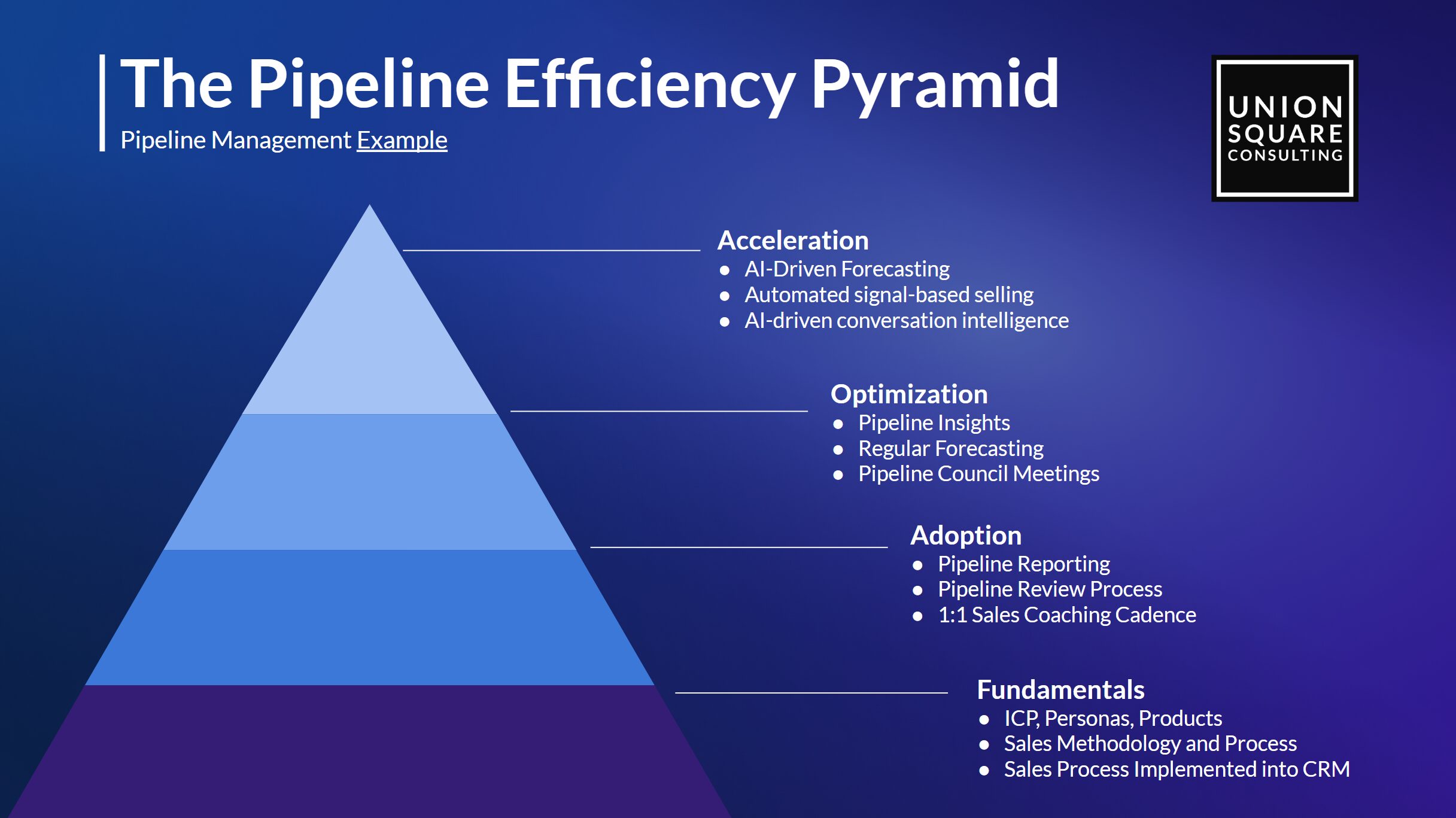
We’ve built the GTM Efficiency Pyramid to help visualize this and share specific examples. Our Foundation is the first two layers of this pyramid, the Fundamentals, which tell us the basic definitions and process, and Adoption, which is driving our team to consistently execute that process and produce accurate data we can analyze to eventually see what’s working and what’s not (which we will get to later, in the Optimization stage).

You can read more about each of these in the GTM Efficiency Pyramid or in even more detail in the Pipeline Management Framework, the Outbound Efficiency Framework, or the Modern Inbound Framework.
But, running with our example, here’s a preview of Pipeline Management and Outbound.
Pipeline Management
Outbound
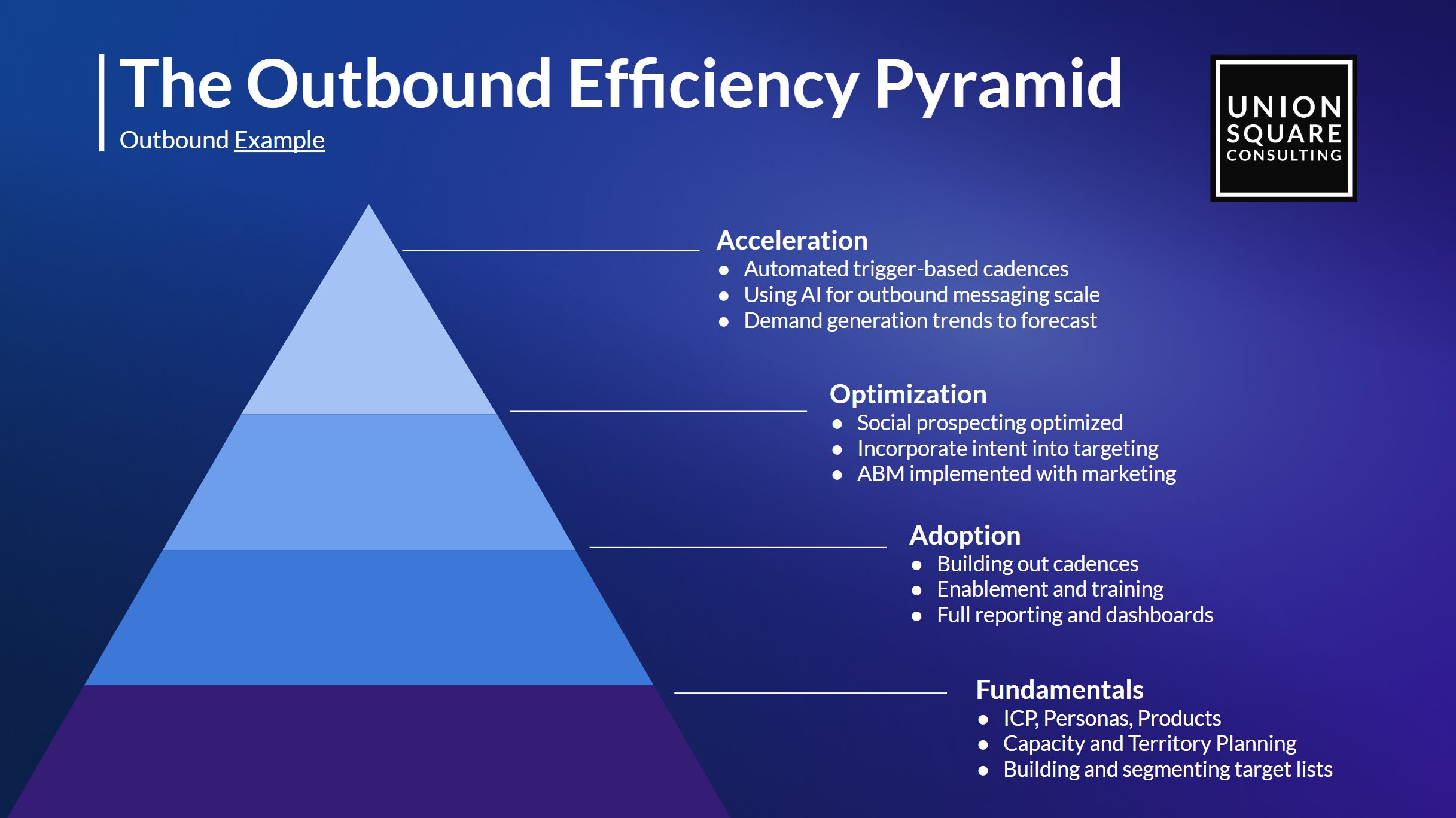
It’s impossible to list every element of these in a simple graphic but we’ve tried to hit on the most important points. We have a +150 point checklist we look at ourselves and offer a free assessment to anyone that’s interested. Click here if you’d like to book a call to discuss it.
Caution: Choose Priorities Carefully
Balance what’s best for the business and best for your job security.
Let me be real for a moment. Just like a politician that can’t change the world if they don’t get elected, you can’t revolutionize GTM in your new organization if you don’t have a job next quarter. I’m going to share two opposite bits of advice here and caution you to balance them wisely.
What’s best for the business long term? NRR: Retention, then Expansion
I would love to have the luxury of only thinking 10 years out. Unfortunately, just like a fulltime hire, I have pressure from each and every client to deliver and, in my own business, I won’t be here in 10 years if I run out of cash before then. So, we have to find a balance.
With that said, it’s pretty obvious that NRR should be the top priority for every recurring revenue business, starting with retention. If retention is good, it means new business is bringing in the right customers. If it’s not, then we have no way of knowing if we are even targeting the right ICP, making the entire foundation of our New Business motion shaky.
By extension, if we have strong retention but expansion isn’t working, it could be a broken process or that we are attracting customers we can’t expand. We will never know which until we get our fundamentals in place.
What’s best for us short term? New Business: Pipe Gen, then Closing
Unfortunately, if you’re a CRO or VP of GTM Ops and all you’re hearing is “We need more New business pipeline!” you’re not alone, especially in this climate. I’ve had thousands of these conversations and it feels like 90% of them land on pipe gen.
The major issue I see here is that if we don’t have a strong Close Rate, if reps create opportunities and move them into the pipeline without any consistent qualification, then we can’t even measure our pipe gen efforts accurately. When we say “We refined outbound and just created $50M of pipeline” people just roll their eyes and think “Yeah, cool beans. Is any of it going to close?”
Finding the Balance
As someone faced with this dilemma nearly every day, here’s how I thread the needle. I push for NRR where I can but I don’t die on that hill. If the CEO wants to spend money bringing in customers today just to churn them tomorrow, we can address that next quarter and/or whenever we’ve built more trust.
But, when push comes to shove on pipe gen, I push hard to find a balance. If we’re not closing deals, let’s fix the foundation of pipeline management, the basic process to qualify and close deals, and fix the basics of outbound in the first 90 days. Let’s get to a point that we can look at reports for outbound and pipeline, see that the team is executing, and actually trust the data. This is all possible in 90 days.
Step 3: Build a GTM Ops Roadmap and Get Alignment
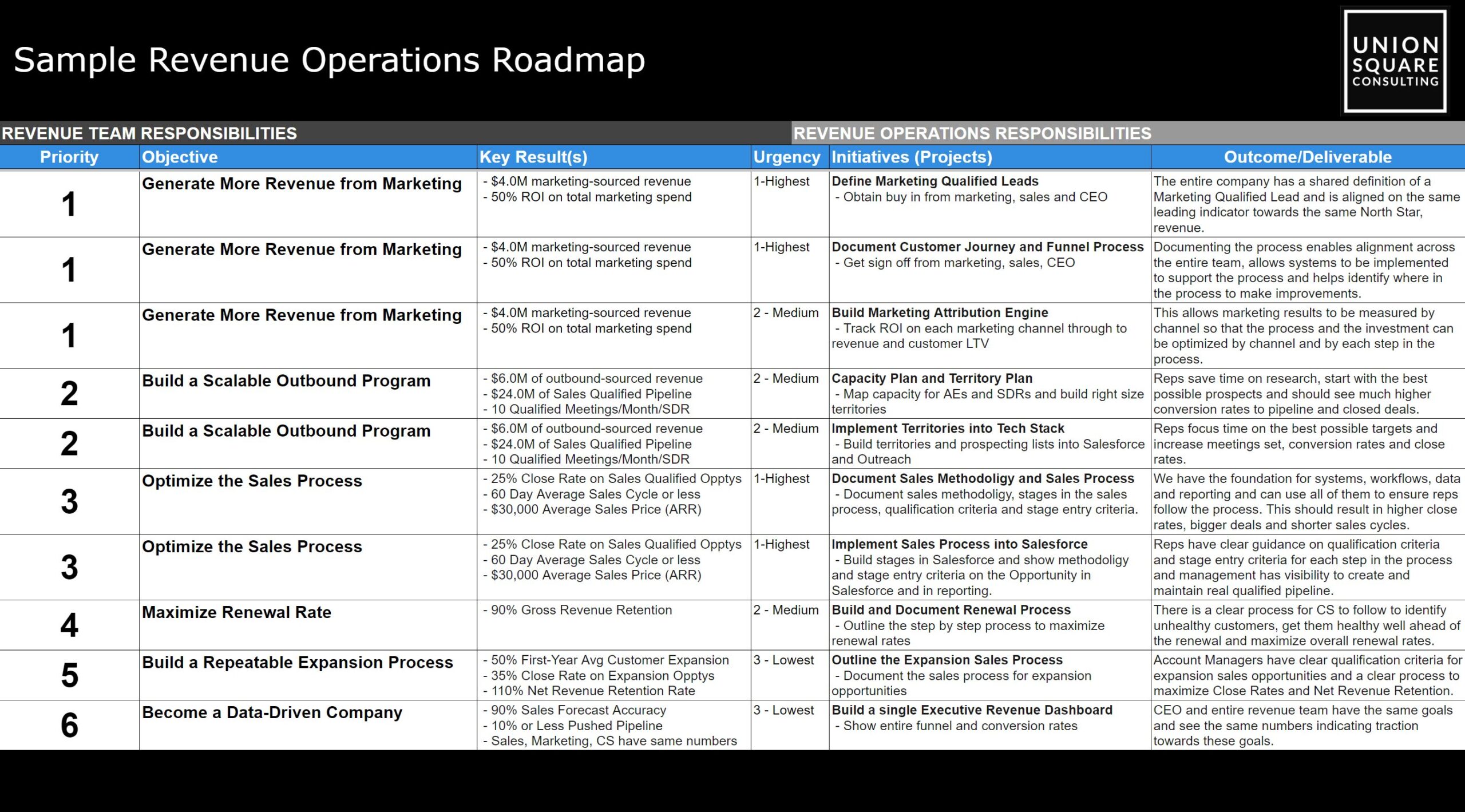
The next step is to build a GTM Ops Roadmap and get everyone aligned on the goals and the specific initiatives in GTM Ops to achieve those goals.
For our example, we might want to generate $50M and/or 500 Sales Qualified Opportunities and improve Close Rate from 10% to 20%. To achieve this, we might need to redefine our ICP, Buyer Personas, Territories, Outbound Prospecting Process, and our Sales Qualification and Sales Process.
We might not see a change in pipe gen and Close Rate within those 90 days, so it might be helpful to set some more immediate metrics, such as X number of outbound meetings booked, or X number of pipeline reviews completed by first-line management.
Either way, what’s most important here is to get this down on paper and get aligned with all revenue and ops leadership. This allows GTM Ops to push back on the inevitable flood of requests by saying “This isn’t on our roadmap for the quarter so we need to put it in the backlog or push back our timeline for the roadmap. Which would you prefer?”
Step 4: Execute: Sprint Planning and Reporting
How to actually make impact in the first 90 days
The last step is simply to execute. One way I like to think about this is sprint planning. Another is reporting.
Sprint Planning
Let’s think about all of the above as the first sprint or two and assume a sprint is two weeks. That’s how we like to do things with our clients at least. In the first 2-4 weeks we can usually go from “Hi, what’s your name?” to “Okay, we all agree on our priorities and plan for the quarter!” and we can often put out a few fires at the same time.
In fact, we often have 90% of the above done after the 2nd or 3rd meeting with a client, prior to even contracting with them, and when we actually start working together we’re just filling in small gaps. Once we get going though, it’s helpful to plan each sprint and get laser focused on the most important tasks to accomplish our goals. There are always fire drills that come our way in the meantime, but if they inhibit this plan we push back and make sure the ELT is aware of the sacrifice necessary to react to every new request.
Reporting
Another way I like to think about this is via the lens of reporting. Put more simply, we can build a Pipeline Report in 5 mins, but our goal is to get to the point that everyone actually trusts that report. We want to get there in 90 days.
Same for outbound. If we’re still sitting here in 90 days saying “We can’t really see what reps are doing with outbound.” or “Reps still aren’t doing very much outbound.” then we have failed at our mission.
This is very achievable in 90 days if we stay focused and if management is 100% behind these initiatives. However, it’s also extremely easy to get sidetracked and wake up a year later still not having achieved this.
One reason is that reporting is driven by accountability and accountability is driven by management, not by the reports themselves.
If you want some help driving these fundamentals in your organization and making serious impact in your first 90 days, book a call with us here and we can talk about how we can support you.
Ready to Grow Your Revenue?
Bring us on as your Strategic GTM and RevOps Team, for help with Growth Planning,
GTM Process Design, Reporting/Data Insights and Systems Architecture.