
Is the 10x AE Actually Possible?
Read time: 6 minutesWritten by:
-

Rachael Bueckert
Marketing Manager
What if a single mid-market AE could carry a $10M quota?
It sounds nearly impossible, or at least ridiculous. But that’s exactly the question Hayes Davis asked in a viral LinkedIn post that sparked heated debate. He wasn’t trying to stir the pot. He was running a thought experiment: If AI is really going to 10x productivity, what would that actually take?
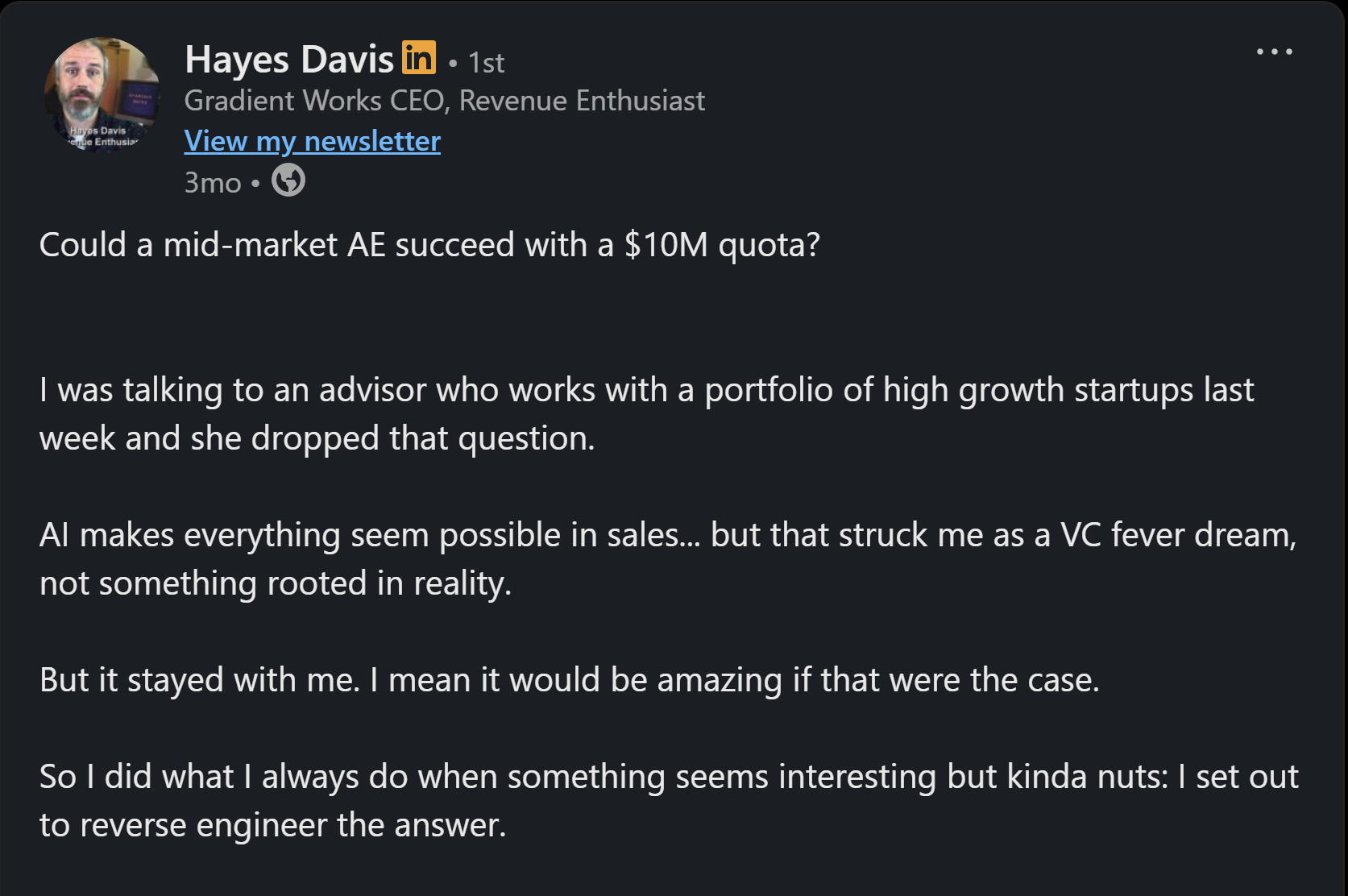
That question forces a level of specificity that most AI conversations lack. Because once you put a number on it—$10M, one AE—the math either works, or it doesn’t.
And the implications are worth paying attention to.
Not because you’ll end the year with a $10M rep.
But because unpacking what would need to be true reveals where the real performance gains actually are, and what AI can realistically help us fix.
Who better to help us unpack that than Hayes himself? He joined us on the podcast to break it down, and in this newsletter, we’ve pulled together the sharpest insights from that conversation.
Listen to the full episode on Spotify here or Apple Podcasts here.
You can also check out Hayes Davis’ own newsletter here.
The Thought Experiment: Three Models
Hayes approached the 10x AE question like an engineer. “Let’s work backwards. What would have to be true to make some kind of outlandish outcome happen, like a $10 million quota for a mid-market AE?”
He modeled three paths to explore what it would actually take:
- 10x the activity
- 10x the deal size
- 10x the efficiency
“I actually thought the answer was gonna be, you can’t really have a rep like this at a $10 million quota. Then, I came away after doing the math feeling like this is within the realm of the possible, and I’ll just spoil it here, in that efficiency realm.”
But the value of the exercise wasn’t just in finding the answer. It was in breaking down why the other paths fail, because that’s where the hidden constraints, flawed assumptions, and biggest efficiency leaks reveal themselves.
Model 1: 10x the Activity
Hayes calculated what it would take to brute force your way to 10x results. The answer? “You probably need to do something like 1,800 touches per day.”
That volume is only possible with AI. But even then, it falls apart.
“You just can’t do this many touches a day and have it work for you because you can’t do it efficiently,” he said. “It’s probably the death knell of the activity-10x motion.”
Legal restrictions on AI calls, LinkedIn’s terms of service, and the limits of AI-generated outreach make the whole model shaky. And that’s before you even get to the problem of actually running that many meetings.
Model 2: 10x the Deal Size
The next model asked: What if we just sold bigger deals?
But raising ACV from $50K to $500K or $1M fundamentally changes the game. “You’re not selling to the same kind of companies, you’re not doing the same types of things,” Hayes said. “Maybe you can double or triple that number… but it’s not a mid-market transaction anymore.”
Worse, the volume of meetings doesn’t go down. “You would probably end up having to hold a lot more higher stakes meetings throughout a slightly longer sales process.”
So the math gets worse, not better.
Model 3: 10x the Efficiency
This is where things get interesting.
Hayes modeled what would happen if you kept the AE’s deal size and workday the same, but dramatically improved how efficiently they work the right accounts, convert them to opportunities, and close them.
The most important shift? Targeting.
“One of the biggest bottlenecks in sales is the accounts that you work in the first place,” he said. “If I’m actually not working on the right accounts, all that’s wasted.”
He also modeled a jump in opportunity creation rate from 10% to 20%, which slashes the volume of touches needed. “If every activity I do is more effective because it’s probably reaching somebody who’s more likely to have the problem that I’m solving… that would reduce the number of touches down to something that is semi-superhuman, like 300 touches a day.”
Where AI Fits In (Realistically)
The viable path wasn’t automation or avatars. It was leverage.
And that’s where AI plays a real role; as a co-pilot, not a replacement. Not sending emails for us, but teeing up the right accounts and preparing us for meetings.
Hayes believes AI could give reps something he called “deal omniscience.”
“Most reps forget stuff. They lose context. They don’t follow up in a way that they should. They forget that this person is often the background important decision maker and they should reference that person.”
He imagines a system that supports reps through every step: pre-call prep, real-time assistance, and post-call follow-up, so that more of our time actually goes toward selling.
The Hardest Variable: Win Rate
In his model, Hayes raises win rate from 20% to 50%, the part that drew the most heat online.
He knew it was controversial. “The gist of the feedback on that is like, oh yeah, a $50,000 ACV with a 50% win rate in SaaS just doesn’t happen.”
But he stood by it. Not by cheating definitions, but by doing two things right: work only the most qualified accounts, and execute flawlessly on each deal.
“All of those things together should probably yield material increases in win rates. Is it 50%? I don’t know. But I think it’s kind of sad that the prevailing standard in SaaS is something south of 20%. I think we could do better than that.”
Takeaway: It’s Not About a $10M Rep
Hayes wasn’t arguing that you should (or could) expect a $10M AE.
But the thought experiment reveals something deeper: where most teams are wasting effort, and where the greatest gains are hiding.
Precision over volume.
Better qualification. More disciplined disqualification. Sharper execution. (All things we help revenue orgs achieve). And AI as a tool to multiply, not replace, the things reps do best.
That’s where the real 10x lives.
Ready to Grow Your Revenue?
Bring us on as your Strategic GTM and RevOps Team, for help with Growth Planning,
GTM Process Design, Reporting/Data Insights and Systems Architecture.