
Measuring CAC Payback by Lead Type/Channel
Read time: 7 minutesWritten by:
-

Eddie Reynolds
Founder and CEO
CAC Payback is one of the best ways to assess whether or not we have “Profitable Efficient Growth.”
If CAC Payback is under a year, we’re earning back our sales and marketing spend within 12 months and making a profit, at least on a gross margin basis, within the same year. But if CAC Payback is over a year, it means we’re spending more to acquire customers than we’re making from them each year. Our only path to profitability then is either improving CAC efficiency or relying on high NRR. Either way, taking more than a year to recover acquisition costs puts us in a weaker position.
This is not new information to most CROs, CFOs, and revenue leaders. However, CAC Payback suffers from the Blended Funnel issue we’ve talked about before. We could have an incredibly unprofitable channel or type of lead we’re generating, and not see it because another channel or type of lead is profitable enough to make up for it.
This creates two massive problems for our business:
- We’re wasting money generating unprofitable leads
- We’re wasting opportunity not generating more profitable leads
In other words, we could cut budget on the unprofitable leads to double down on the profitable ones and drastically improve our profits and revenue growth at the same time. Let’s talk about how we analyze this.
CAC Payback Formula
Here’s the formula for CAC Payback in case you’re not familiar. It’s also listed in our GTM Metrics Index.
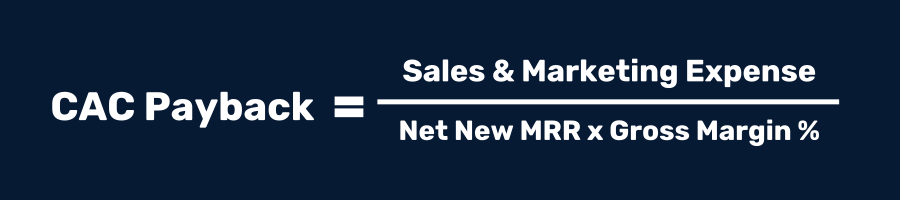
CAC Payback is measured in months and tells us how many months it takes to recoup our cost of sales and marketing via the gross margin we get from the Net New MRR we closed.
As an example, say we spent $24M in a year to generate and close $2.5M of Net New MRR and our Gross Margin is 80%.

This means, each month we are earning $2M in Gross Margin ($2.5M x 80%) and if it costs us $24M to generate this business, it will take us 12 months to break even. If we retain and grow these customers beyond 12 months, we can get a return on our investment. If we churn them before 12 months, we are burning capital and have a negative return.
Simple enough. Now, how do we break this down by Lead Channel or Lead Type?
Define Lead Buckets
The first thing we need to do is define our lead buckets.
These could be any type of leads segmented by:
– Channel
– Lead Source
– SMB vs. MM vs. ENT
– Industry
– Geo
– Etc.
What matters most is that we believe there’s a real and measurable difference between the buckets in a category, and that we can actually measure it. We need to be able to measure the costs for that bucket accurately and/or measure the MRR or Gross Margin % for that bucket as well.
We can divide all sales and marketing costs and revenue by the number of leads in each bucket, but unless something meaningful separates those buckets, we’ll just end up with the same CAC Payback across the board.
So let’s break this down.
Measuring CAC
Channels and Lead Sources are a bit more obvious. Assuming we have attribution that is decent enough that we kinda trust it, we can split costs and revenue accordingly. We can see what we spent in marketing on each channel or lead source and how much MRR we closed from each.
We might need to assume our costs of sales and Gross Margin % by using averages across GTM, but if our marketing spend and Closed Won MRR is radically different from one to another, this can be extremely valuable insight.
SMB vs. MM vs. ENT may be tougher. We could divide the total cost of marketing by lead and assess cost based on the leads in each segment. Sales costs would likely be easier to break down as we have different teams and we can divide their time by inbound vs. other activities and assess their total cost accordingly.
Industries, Geos, etc. would be harder unless we have dedicated marketing and/or sales for those segments. If not, we’re left with our total CAC simply being divided by the number of leads in each area. This may still be valuable if we can measure MRR and Gross Margin differently for these.
For example, if our CAC is $100 per lead for both software and professional services (because we have no way of seeing those costs separately), we might assume they perform equally. But if software customers generate $150 in gross margin per lead and professional services only yield $75, because conversion rates, or ASP are different, then CAC Payback looks very different.
Measuring MRR and Gross Margin
This is obviously much simpler. We just take the total MRR we closed in a given time period for each category. We can quickly and easily slice and dice categories like this so long as we have the data on their Channel, Lead Source, Segment, Industry, etc.
Gross Margin may be harder. We can apply a blanket Gross Margin % to that MRR if we can’t measure or see a different margin for different types of customers. We could, for example, look at the number of customer service tickets, or the cost of implementation, or the CSMs assigned to each account to assess different levels of Gross Margin if we believe there might be a material difference, but this is some pretty advanced financial analysis and not where I would start.
Doubling Down vs Cutting Back
Now that we’ve assessed our CAC Payback by different types of Leads, we can take a step back and decide what to do about it. Our first step is to make sure we have a solid follow-up process. We wrote about this in detail in our 9 Steps to Improve Lead Conversion newsletter and our Inbound Framework. If our follow-up process is broken, the fastest and easiest way to significantly improve CAC is by fixing it.
If/when follow up isn’t the issue, we should cut investments on the types of leads that aren’t converting by not sending them to sales and/or cutting marketing budget to generate those types of leads. This then frees up sales and marketing to double down on the leads that are converting profitably.
If we’ve freed up actual budget, we can move that budget to the Channels, Lead Sources, etc. where we’re seeing the best conversion. If we’re freeing up resources, we can route better leads to them to generate more revenue and margin with the same people.
One thing to note: We do need to be sure we have room to double down and that a particular channel, lead source, segment, industry, etc. isn’t so tapped out that increasing investment will yield decreasing returns.
How GTM Ops Can Help
Phew, that was a lot of finance. I don’t talk about it often, but I studied finance (and a lot of accounting) in college and spent ten years in banking and private equity before moving into SaaS. I love this stuff. But some of it falls more into the world of accounting and FP&A than what I’d typically expect from GTM Ops.
That said, I can speak for my team. Our VPs of RevOps have strong financial backgrounds and have often reported directly to CFOs. They know enough to be dangerous, and in most cases, that’s enough.
Whether it’s our team or yours, GTM Ops should be able to support this kind of analysis by making sure the right data is being tracked. That means clean attribution, well-defined segments, data enrichment, and a consistent lead process.
Finance needs a clear view into sales and marketing costs, with the ability to break them down by team, channel, or program. When both sides are working from clean data, they can connect the dots, figure out which leads are driving real profit, and identify which ones to cut back.
Ready to Grow Your Revenue?
Bring us on as your Strategic GTM and RevOps Team, for help with Growth Planning,
GTM Process Design, Reporting/Data Insights and Systems Architecture.