
What It Really Costs to Grow: Benchmarking GTM Efficiency
Read time: 7 minutesWritten by:
-

Eddie Reynolds
Founder and CEO
There’s so much talk about GTM Efficiency these days (especially from us) but we don’t have a widely accepted way to measure it. How do we know if our GTM Engine is more efficient than it was last year? How do we know if it’s more or less efficient than other companies?
We need an objective way to measure and benchmark it. CAC Payback comes close but it ignores NRR and the costs to achieve it. LTV:CAC is bullshit (we’ve written about this here). And, our Sales and Marketing spend, as a percentage of revenue, doesn’t really tell us about today’s efficiency.
This is why I was excited when I first started seeing David Spitz talking about the GTM Efficiency Ratio. In this article, I want to break this down, take it a step further, and share some benchmarks. In other words, I want to answer two simple questions.
- What does it cost us to grow ARR or Gross Margin by another $1?
- How does this cost compare to other software companies?
Measuring GTM Efficiency
Let’s start with the formulas. We need objective measurements to answer these questions.
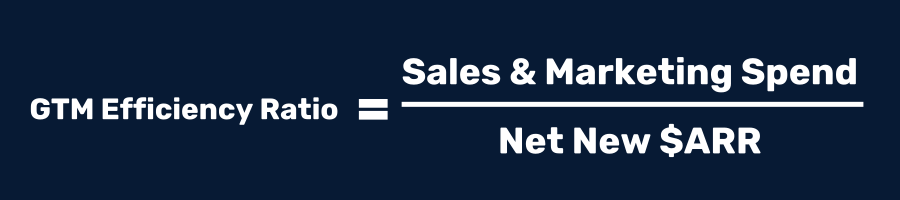
We’ll start with David’s GTM Efficiency Ratio. It measures all sales and marketing spend, including the cost of renewals, expansion, etc. to grow overall ARR. More specifically, it looks at all costs to grow revenue, as a percentage of the total growth in revenue, all new business and expansion, minus churn.
It answers the first part of our first question.
What does it cost us to grow overall ARR by $1?
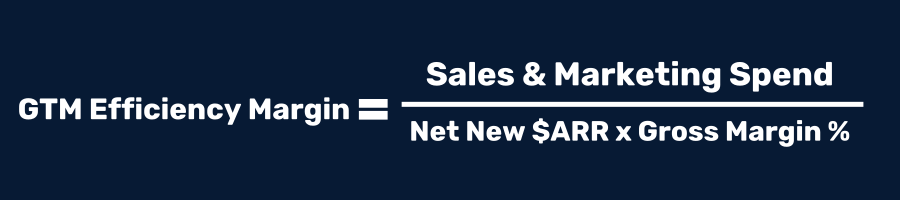
The only thing this is missing is our Cost of Goods Sold, which is our cost to serve customers. To address this, I created another formula called the GTM Efficiency Margin, to show those same costs, over ARR minus COGS, which equals our Gross Margin.
This answers the second part of our first question.
What does it cost us to grow overall Gross Margin by $1?
Why This Matters
As CROs, CMOs, VPs of RevOps, or CEOs, we’re often hyper focused on doing whatever it takes to grow revenue. That feels like the job, but it’s not really. In reality, we are stewards of capital. We’re responsible for building the engine that turns $1 into $2 for our investors.
If we’ve built an engine that costs only $0.50 to grow Gross Margin by $1.00 in a year, we will have investors banging on our door, asking to double down their investment, as they should. However, if it costs us $10.00 to grow Gross Margin by $1.00, then they’ve made a poor investment in us.
We owe it to them to improve their return on investment and, if we can do that really well, we can ask for more, enriching them and everyone else in the company.
So How Do We Stack Up?
This brings us to benchmarking. We’ve talked before about how benchmarks need to be taken with a grain of salt. Another company may find it easier to grow ARR and Gross Margin because they have a better product and/or a better TAM. We can’t control that, at least not in GTM, and not in one year.
Additionally, in this case, we don’t have perfect data. David was kind enough to share some metrics from public companies for the last 12 months ending in Q2 2025. We can see how much they grew $ARR and Gross Margin, but we can’t be sure whether or not costs to retain and grow customers are included in their sales and marketing numbers. Regardless, it’s what we have so we’ll get what we can from it.
We’re much better off benchmarking against how we performed last year, to determine if, when, and where we’re improving. But, with that said, it can be helpful to know what’s normal in other companies.
Looking at the benchmark data, we see the following.
The Median company spends:
- $2.07 to grow ARR by $1
- $2.67 to grow Gross Margin by $1
- It takes them 32 months to “pay back” their S&M expense
Top Quartile companies spend:
- $1.49 or less to grow ARR by $1
- $1.94 or less to grow Gross Margin by $1
- It takes them 23 months to “pay back” their S&M Expense
Bottom Quartile companies spend:
- $3.15 or more to grow ARR by $1
- $3.89 or more to grow Gross Margin by $1
- It takes them 47 months to “pay back” their S&M Expense
Here’s the full data set:


What Does This Tell Us?
We’re told we need a CAC Payback of 12 months on New Business. Let’s say we’re the median company here and we have that CAC Payback. We’re spending $1 in sales and marketing to get $1 back in Gross Margin within the next 12 months. This is great. However, we’re losing 63% of that Gross Margin from NRR!
In other words, even if we’re crushing it in New Business, our overall GTM is costing us 2.67x what we want to spend to grow margins and it’s taking us almost three years to recoup our investment.
If we’re Palantir, on the other hand, we’re spending $0.67 to get $1 back in 12 months, recouping our investment in just 8 months. In other words, we can pour money into our entire GTM Engine and just print money on the other end. Would it surprise you to hear the company is up 361% in market value in the last 12 months?
If we’re in the bottom quartile, on the other hand, we spent $3.89 to grow Gross Margin by $1 and will need almost 4 years to recoup those sales and marketing expenses. Put more simply, it’s costing us a lot of money to grow revenue and margins by a small amount. We don’t have an efficient GTM Engine, or at least it’s not working efficiently in the markets we serve.
Net net, though, what this tells us is that it’s getting more expensive to grow revenue and margins. Looking at a slightly different data set from BenchSights, we can see companies cut S&M Expense as a percentage of revenue quite a lot since 2021 but the cost for that extra dollar of ARR has gone up 60%, from $1.24 to $2.00!

What Do We Do About It?
With all that said, what do we make of these numbers? Using our worst examples, changes have to be made. But even if we’re in the top quartile, or top decile, it doesn’t mean we’re as good as we can be.
These metrics only show us the 100,000 foot view. To improve efficiency, we need to dive deeper. We need to look at our New Business and NRR independently. We need to look at each segment of our business (SMB, MM, ENT), geography, product, type of customer, channel, etc to determine where we have profitable efficient growth and where we’re burning money.
If we’re Palantir, maybe we don’t need to worry about it and can just keep growing like crazy. If we’re not performing as well, we need to look at every dial in GTM to see where we can turn the knobs to grow revenue and margins more with less cost.
This is something we see again and again and again. Even companies that are performing well have massive leaks in their GTM Engine and we can drive substantially more revenue and margin, at a lower cost, by improving our GTM Efficiency. Check out the GTM Efficiency Pyramid for more on how to do this.
Ready to Grow Your Revenue?
Bring us on as your Strategic GTM and RevOps Team, for help with Growth Planning,
GTM Process Design, Reporting/Data Insights and Systems Architecture.