
What’s Working in Outbound in 2026
Read time: 7 minutesWritten by:
-

Rachael Bueckert
Marketing Manager
Resources in This Newsletter:
What’s Working in Outbound in 2026?
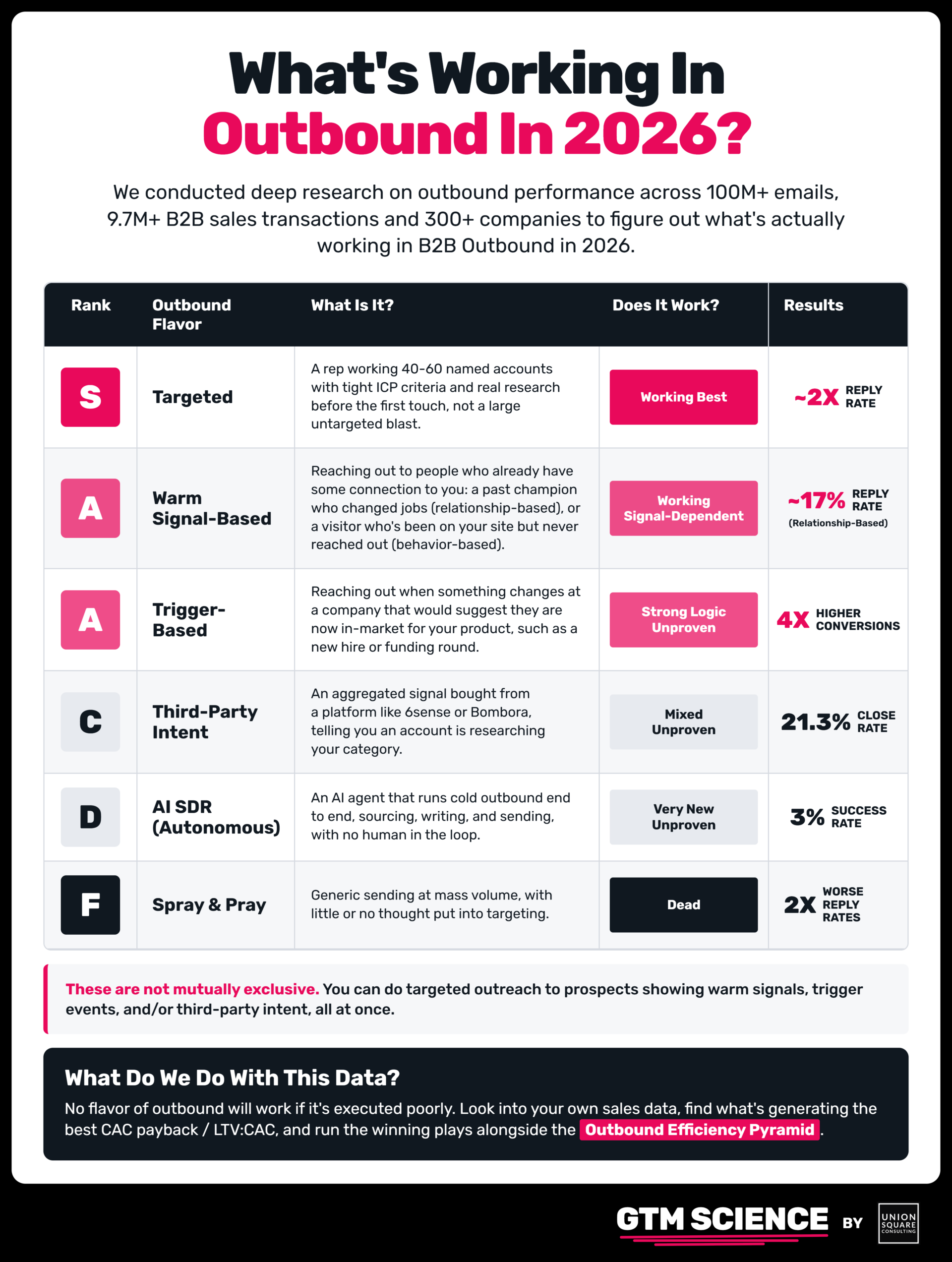
We get asked this a lot, especially after every update to the Outbound Efficiency Pyramid. So we did deep research on the topic across a huge swath of industry reports, covering 100M+ emails, 9.7M+ B2B sales transactions, and 300+ companies, to bring you an answer.
Here’s a summary of each common Outbound tactic, and whether it’s working:
- Targeted Outbound
- Depends on your targeting method and execution
- Warm Signals
- The data says yes, but the exact size of the lift depends on which signal
- Trigger-Based Outbound
- The logic is strong, the data is entirely vendor-sourced
- Third-Party Intent
- The data says yes, but whether it justifies the platform cost depends on your execution
- Autonomous AI SDRs
- The jury is still out, with virtually zero credible studies or data yet available
- Spray & Pray
- Definitely dead
But the details are where things get really interesting.
The most striking thing we found was how much of the data circulating on outbound performance is fabricated or unreliable: vendor-to-vendor citation chains, folklore without a traceable source, one widely cited “independent audit” that listed its return address as 1000 Fiction Ave, San Francisco.
“Fiction Ave”? Really?
We’re looking at you, LeadPipe.
Real, usable data does exist. Here’s what it actually says.
Targeted Outbound is Working the Best
By targeted outbound, we mean a rep working a list of, say, 40-60 named accounts, with tight ICP criteria and real research before the first touch. This is opposed to large, untargeted blasts to mostly unvetted prospects.
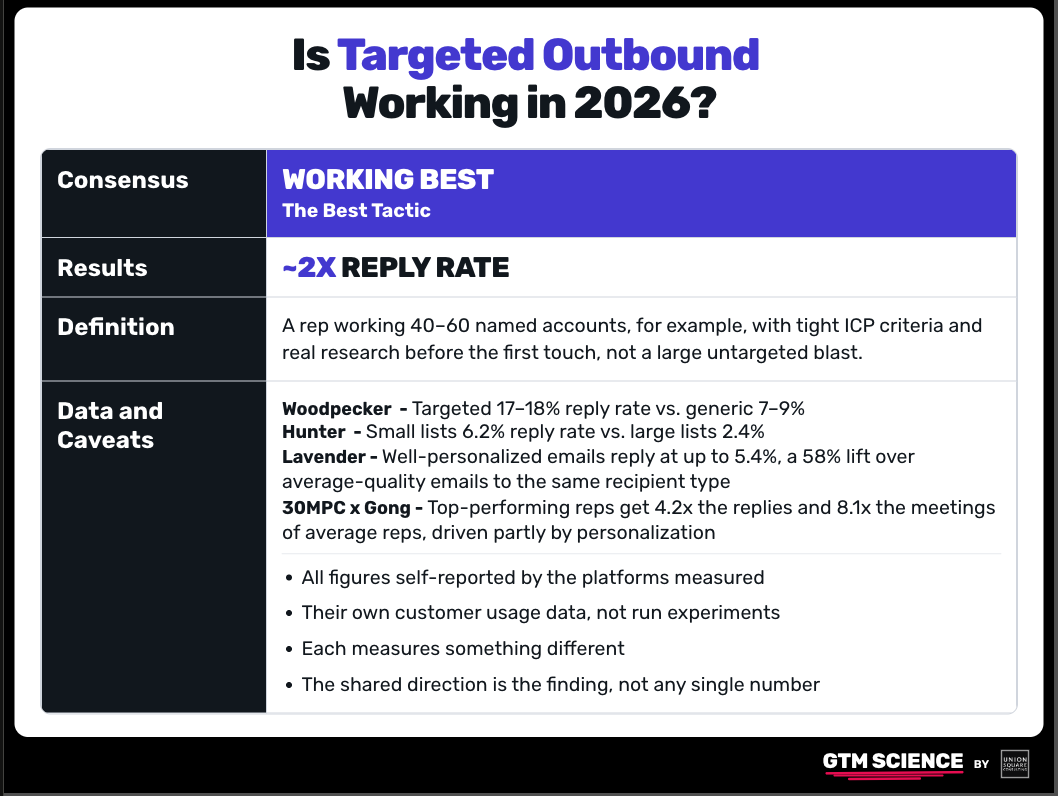
The data on this is consistent across sources: personalized, targeted cold emails reply at 17–18% against 7–9% for generic sends. A campaign of 100 tightly targeted prospects generates roughly the same total replies as a much larger generic blast at a tenth of the volume, with less spam risk and more positive replies. Hunter’s 2026 report, from 31 million emails, found that tight sequences of 21–50 recipients reply at 6.2% vs. 2.4% for sends of 500+.
Unsurprisingly, the best AI-assisted teams (the ones using AI to research and personalize, not as autonomous SDRs) are booking up to 3x the revenue per rep. AI is making targeted outbound better, not replacing it.
Need help identifying how you can better operationalize and scale targeted outbound? Check out our Outbound Pipeline Inspection (it’s free).
Warm Signals Work Depending on the Signal
Warm/signal-based outbound is reaching out to people who have already shown some kind of interest or already have an established relationship with your company.
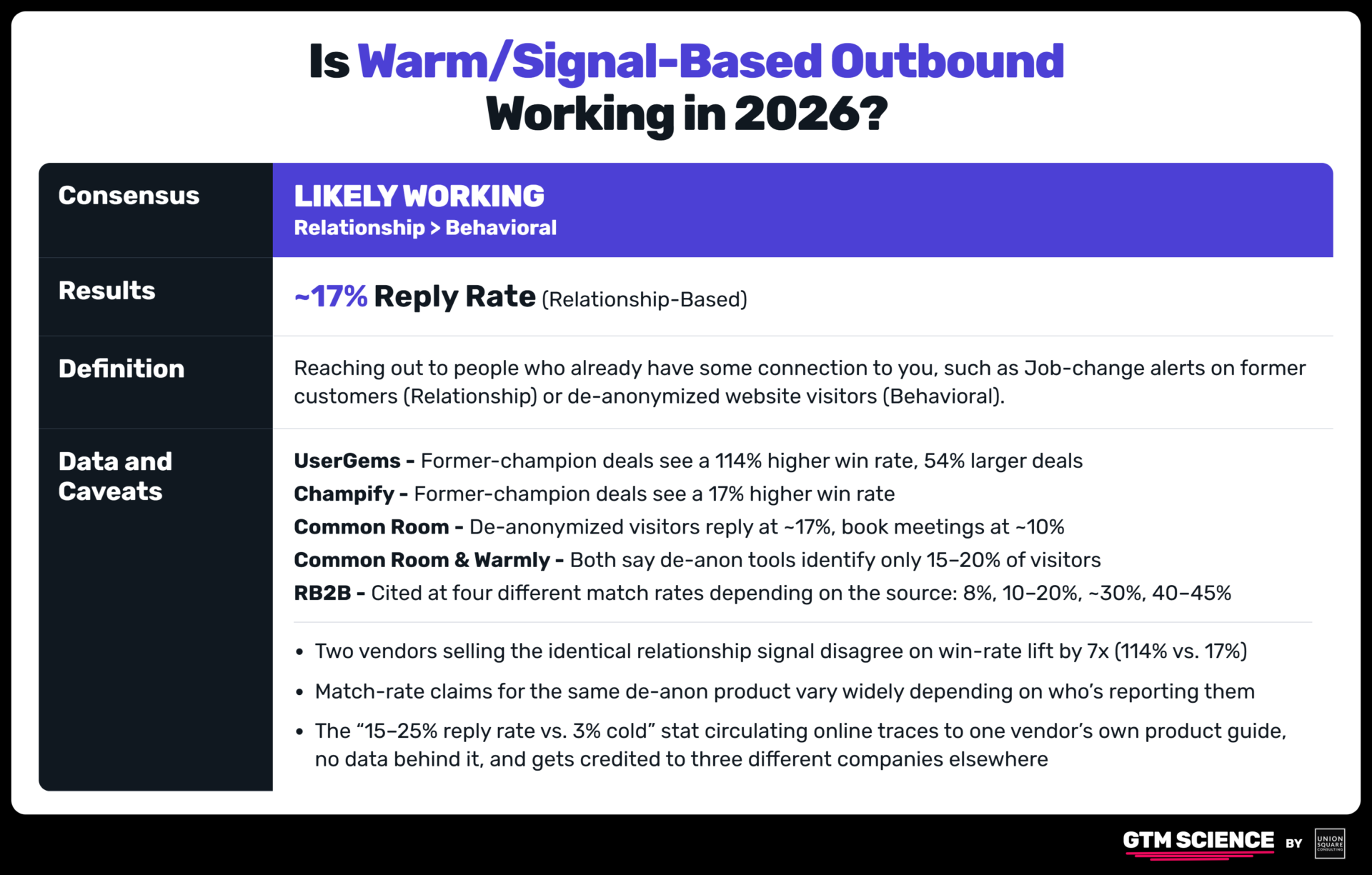
There are two ways an outbound prospect shows a “warm signal”, with very different evidence behind each.
- Relationship-Based
A past champion or buyer who changed jobs and landed somewhere new. This is your best-case scenario.
UserGems reports 114% higher win rates and 54% larger deals on opportunities with a returning champion. Champify, a direct competitor selling the same signal, reports 17%. Two vendors, same claim, a 7x gap in the lift number. The direction is clearly right. Don’t build a forecast on the specific multiple.
- Behavior-Based
This includes first-party signals such as web de-anonymization. For this, we only found vendor-sponsored studies and datasets.
De-anon tools identify 15–20% of visitors at best. There’s a decent chance it outperforms cold outreach, but the real constraint is whether you can identify the visitor in the first place.
Trigger-Based Outbound: Intuitive Logic, No Credible Data
Trigger-based outbound is reaching out when something changes at a company: a funding round, a leadership hire, a hiring surge, a tech stack migration.
The logic is arguably the most intuitive of any tactic on this list.
The data behind it is a different story.
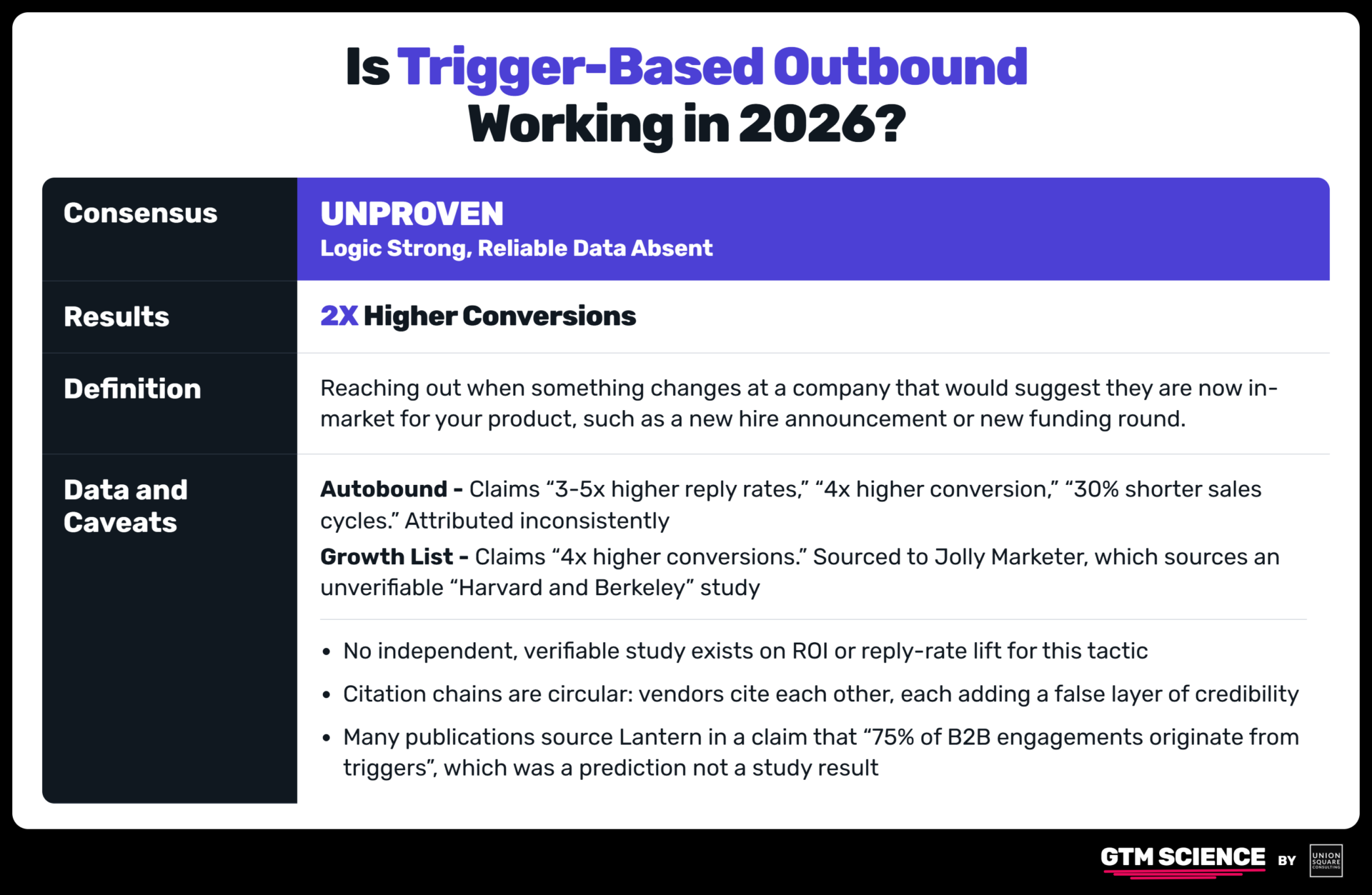
Every number we found traces back to a vendor’s self-reported results, an unverifiable academic attribution, or circular citation chains where vendors cite each other, each adding a layer of apparent credibility. One widely repeated stat, “75% of B2B engagements originate from triggers”, was a prediction, not a study result.
Should you time outreach to trigger events? Probably. It costs nothing to do it manually. Should you pay for trigger-detection tooling on the strength of these numbers? Nobody has proven the ROI, so you’ll have to test it for yourself.
Third-Party Intent Has the Same Problem
Third-party intent is the aggregated signal you buy from a platform like 6sense or Bombora that says an account is researching your category. The logic is the same as every other signal play: all else equal, a company showing intent is probably more valuable than one that isn’t.
But “probably more valuable” is not the same as “proven ROI,” and nobody has crossed that gap.
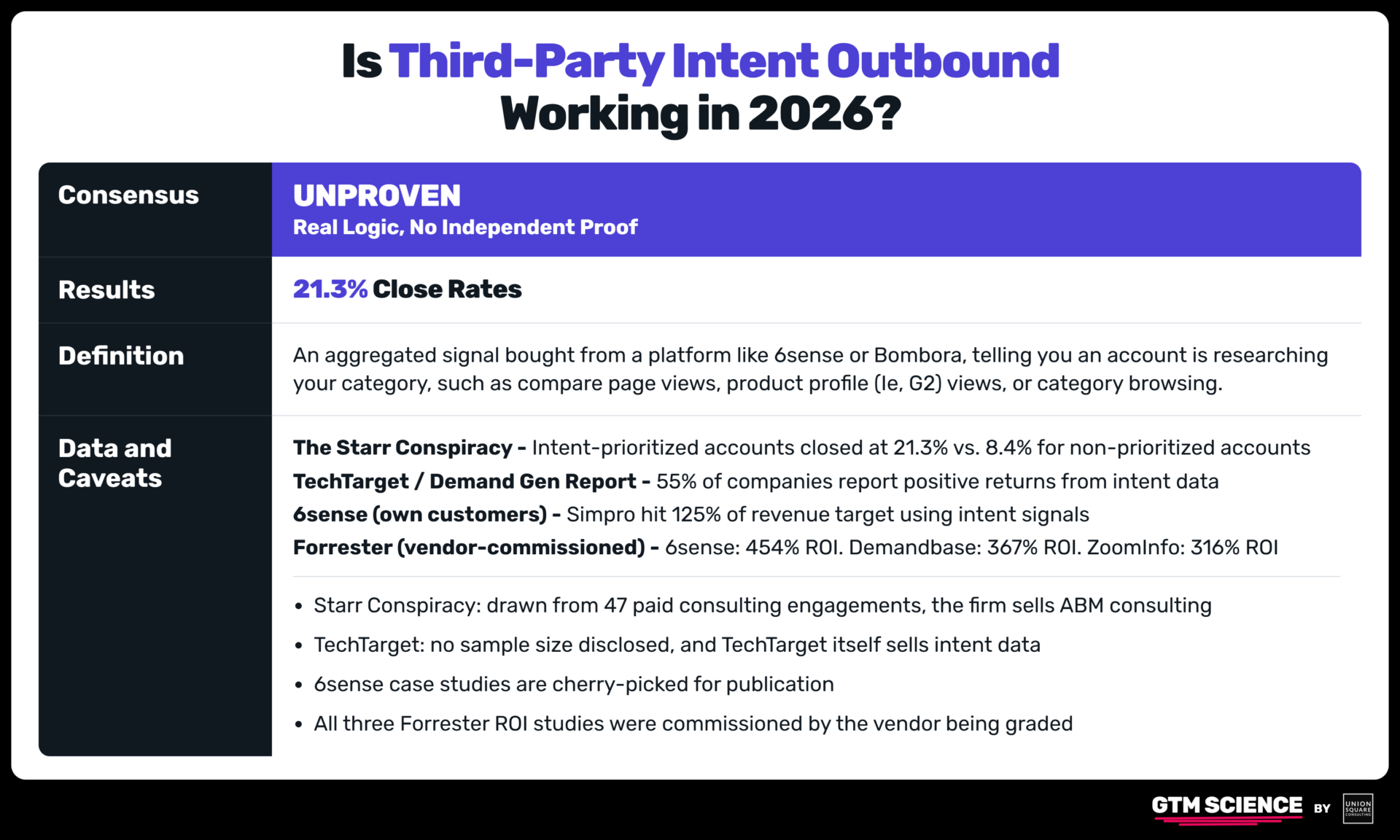
The headline ROI numbers (6sense’s 454%, Demandbase’s 367%, ZoomInfo’s 316%) all come from Forrester studies each vendor commissioned about its own platform. We couldn’t find a single independent 2026 study on intent-driven outbound not published by someone selling intent data.
The verdict: if you want to buy intent data, buy it. But measure it yourself: CAC payback and LTV:CAC for intent-sourced accounts versus accounts sourced without it. No vendor can tell you whether it will outperform the targeted outbound you’re already running.
Autonomous AI SDRs Are Most Hyped, Least Proven
The fully autonomous AI SDR, the agent running cold outbound end to end with no human in the loop, is the most hyped outbound strategy on this list. Even though there are virtually no credible studies or data yet available on it, the information we’re seeing points at a high failure rate.
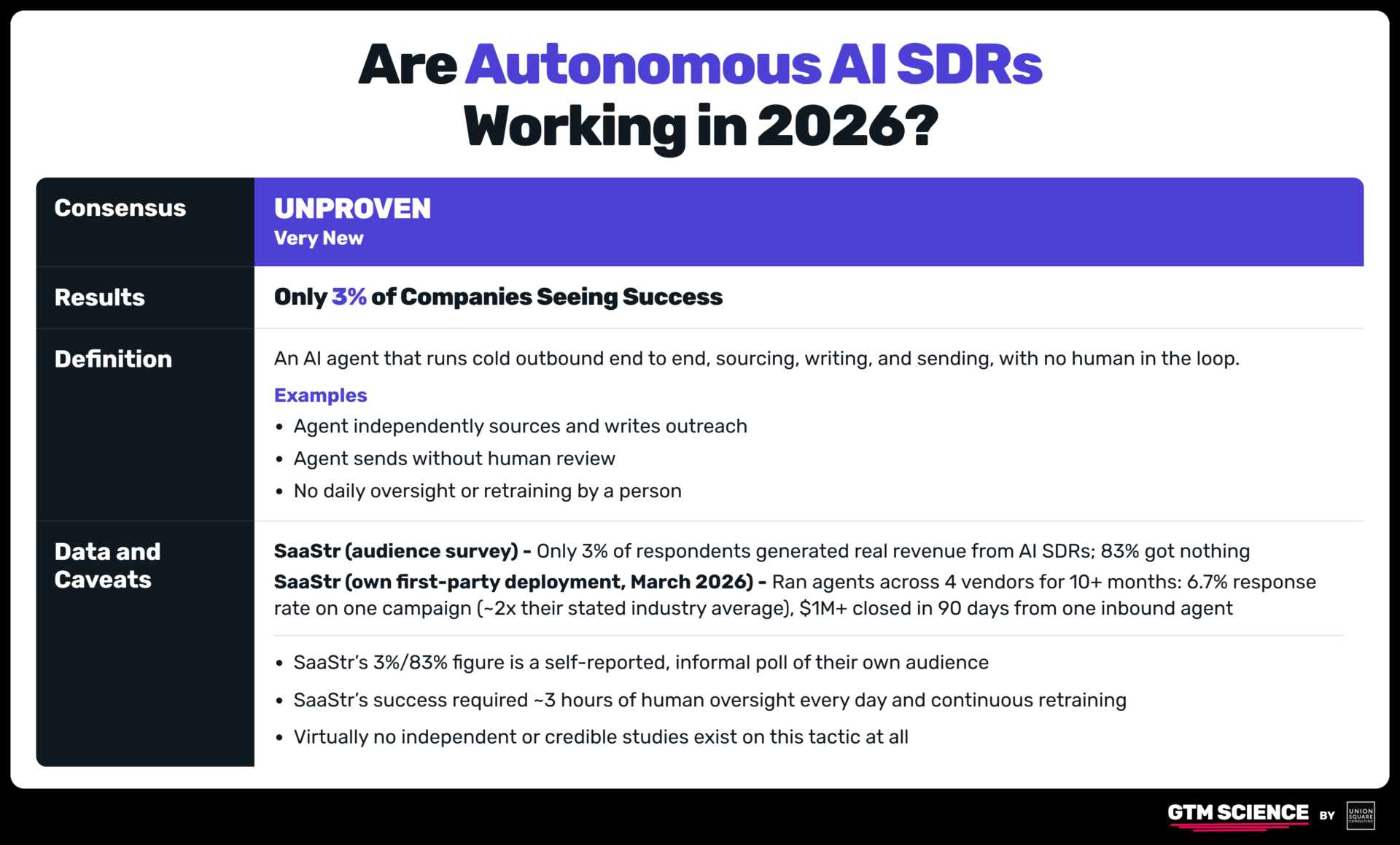
Only 3% of companies in a SaaStr survey generated real revenue from AI SDRs. 83% got nothing.
SaaStr also ran their own deployment across four vendors for 10+ months and did see real success. The catch: it required nearly 3 hours of human oversight per day, continuous retraining, and deliberately tight campaigns.
Spray & Pray Is Dead
Generic sending at volume gets half the reply rate of targeted outbound, sometimes significantly less. AI made sending trivial, which made the broken motion run faster and cheaper, burning pipeline and sender reputation at scale.
Actions to Take Based on This Data
Note: The tactics discussed here are not mutually exclusive. You can do targeted outreach to prospects showing warm signals, trigger events, and/or third-party intent, all at once.
Treat these strategies as a hypothesis to test against your own business. No study out there right now, vendor-sponsored or otherwise, is going to be able to answer whether a dataset will be worth the license fee for your motion.
Want to try it? Try it. But set your experiment up for success, first.
That means doing two things:
- Measure properly: It’s dollars in against dollars out. Pull CAC payback and LTV:CAC for whatever you’re testing, and compare it to what you’d get without it.
If you can’t cleanly separate that data yet, use the cruder version: how many emails does it take to generate a meeting, how many meetings turn into a sale, by outbound strategy. Not perfect, but closer to the real answer than a reply rate.
- Execute properly: You can’t expect any outbound tactic to work if you’re not executing your outbound motion properly to begin with. It’s the same reason a gym membership does nothing for someone who walks on the treadmill for ten minutes and gets a milkshake on the way out.
Before you can say something is or isn’t working with outbound, make sure you’ve read through the Outbound Efficiency Pyramid and have at least Fundamentals and Adoption implemented.
If you want a second set of eyes on how you start executing outbound more effectively, take a look at our free Outbound Pipeline Inspection.