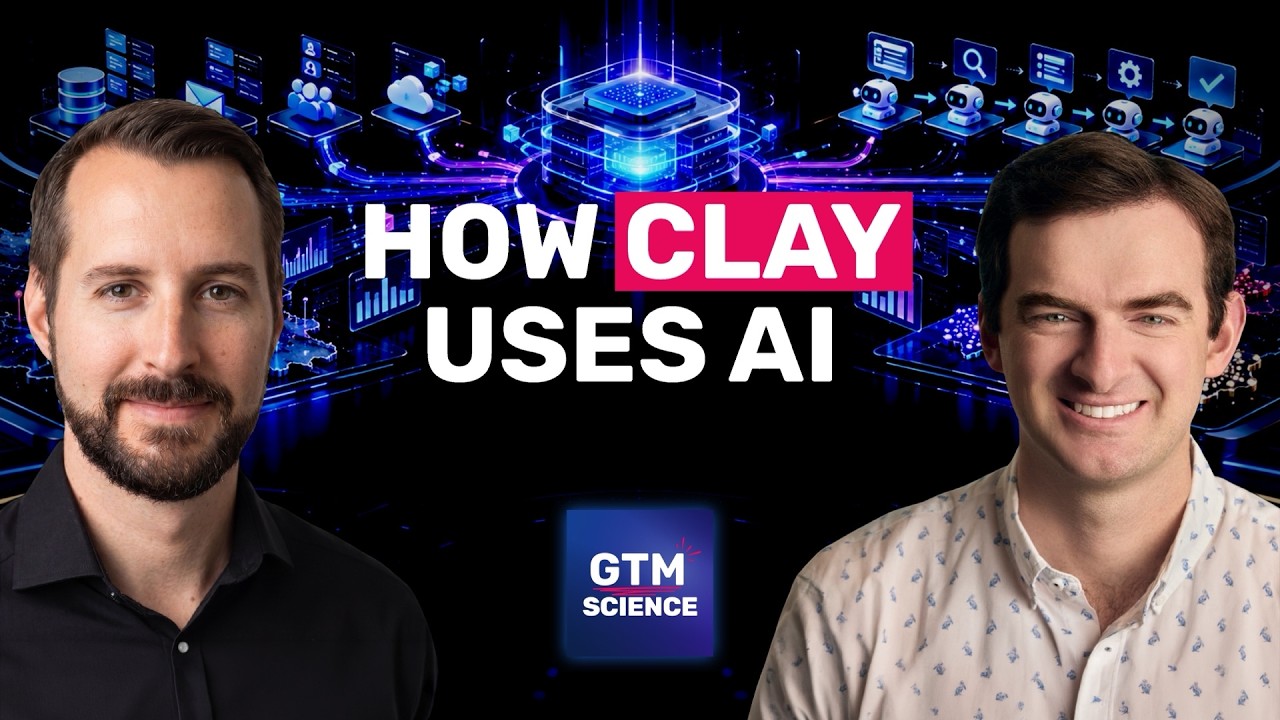
EDDIE0:01All right. Today we are going to talk about how Clay leverages AI in their own go to market. Our special guest today is every Berry head of go to Market Engineering at Clay. Thanks for joining us today.
EVERETT0:13Hey, Eddie. It's awesome to be here.
EDDIE0:16So this is not going to be some veiled pitch to buy clay. We're obviously going to talk about how clay uses clay, but we want to talk more broadly about how they're using AI to drive revenue, which is going to include their own tools and other tools that many of you out in the market are using. And we're going to talk about best practices for how they target customers and how they are driving revenue inside of clay.
EDDIE0:40Specifically, we're going to talk about account agents, dynamic territories, go to market loops, and maybe some other things as the conversation progress progresses. So again, Everett, thanks for joining me today.
EVERETT0:52You bet. This will be fun. These are all topics that are near and dear to my heart.
EDDIE0:57Awesome. So what I'm going to do is I'm going to do two things. I'm going to start with the definitions so that our audience can quickly understand what we're going to go over and what all these terms that I just dropped mean. And then before we actually get into the details, I want to talk about the foundations of what companies need in order to make go to market AI work before we just start solutions and saying, hey, here's some cool stuff, here's some cool stuff that you guys can build.
EDDIE1:18So let me start with the definitions. What is an account agent?
EVERETT1:24Right. So for a long time in clay and and our use of agents generally, we were doing one off tasks. So this would be something like go research a company and come back with an ICP definition for that company, or go research an account and find recent social posts that they've made. And there's a lot of these sort of tasks within go to market that you can give an agent that it will go accomplish that and come back and then basically die.
EVERETT1:52And that was because in broad strokes, the models that were underlying and the underlying things powering these agents, that's what they could do. They were they were able to kind of process that much context and stay focused on a task for that long, and that was a good use of them. But the latest generation models are much more capable.
EVERETT2:15They're much more goal oriented. They can they can digest and work with much more context, although not as much as context as they are marketed to work with. And we can talk about that and they can make much higher level decisions. And that is something that I think sometimes gets lost, is is the and is not captured well by benchmarks is the reasoning.
EVERETT2:37And just raw intelligence of the models has been increasing. So you can give them kind of increasingly confusing pieces of data or contradictory information, and they will reason through them in a better way. And so taking advantage of those improvements, and certainly I'm very focused on, on as more and more capable models come out, how can we do more with them?
EVERETT2:58Account agents are very long running agents. They run for weeks and weeks and months and might even at some point run for a year. And they work on a specific account. So let's say I'm prospecting into Databricks or something. And account agent is monitoring Databricks continuously for changes in their business, changes in their personnel, hundreds of different signals that might potentially make them make it a good time to reach out to them now with a certain message to a certain person.
EVERETT3:28And the account agent is also maintaining the context of all the interactions that we're having. So let's say we get a first call book. Let's say historically we've had like 30 different calls with Databricks, with different groups. What actually happened in those calls? What's relevant now was something that was mentioned in those calls six months ago. Suddenly relevant now, especially because there's one other signal has kind of occurred.
EVERETT3:48So an account agent can maintain long running context and account and then make recommendations and take action on that account based on sort of how it's how it's constructed. And so this is sort of another class of agent that is much more powerful and different than the typical kind of agent that we think about and go to market, which is often still today being used for like one off tasks.
EDDIE4:10Awesome. That's an incredible explanation. And then it gives me an easy way to queue up, like why I wanted to dive into the foundations. Yeah. So I'll give you a softball here. So if I'm working in like a traditional B2B SaaS company and like Salesforce is an absolute mess and we don't have our HubSpot connected. And then we've got like Gong over here and that's not connected.
EDDIE4:29We've got all these like just absolute massive data. We don't have a rev ops team. This accounting agent you described, we should just be able to pull that over the weekend. Right.
EVERETT4:39So so so this is this is the piece that Clay has long kind of focused on. And that I think is important is the agent, despite it being very powerful is only as good as the context that you give it. And I'll take the opportunity now to note out on this context when. No problem. But most agents models today are marketed with these very long context windows, 500,000 tokens or million tokens or so on.
EVERETT5:04But in practice, the amount of tokens that a model can fit into its context window that it can use and understand, all of them is something more like 150 or 200 K. And if you talk to software engineers that use coding models, they will tell you this. They will use lots of different techniques to, for example, clear the context window every so often.
EVERETT5:27So so the LM doesn't become confused about what's in the code base or what features it's already implemented, and so forth. And so the same is true of go to market and to put some numbers behind this. And I was doing the math on this one. An hour long sales call that's like recorded and gone. The transcript from that call will take up about 50,000 tokens.
EVERETT5:46So that means if you have a more complex account and you've had 6 or 8 sales calls with that account, that and you just do the naive thing and load all those transcripts or calls into your agent that will flood the window, and the agent won't be able to actually understand anything more about the account, or it will get confused when you add new data to it and so forth.
EVERETT6:07So it's actually like a really nasty and pretty interesting engineering problem to figure out. How can we insert the most valuable pieces of context into this agents window so that the agent can make the right decisions about, about and about something. And so in the situation that you described where I've got, you know, HubSpot and gone and Salesforce, you might naively say, okay, I'll just connect the agent to via an MCC to all these different systems, and it'll kind of figure it out in practice that, at least with today's models, does not work very well.
EVERETT6:37You need to kind of carefully construct the context that a model works with then. And that's where a lot of our focus internally is, is managing that context is is summarizing calls, pulling out the relevant parts of the call, aggregating signals, squashing down, you know, thousands of first party product events into summaries of, of trends and usage and things like that, so that when we give a model all that information, we can be as effective as possible with the context, and then the model can make better decisions from there.
EVERETT7:08Now, within all that, there's some sort of assumptions that might not hold for the next generation of models. So the next generation models might truly be able to leverage an entire 1 million context window. They might truly be able to decide what context to insert into that window. And and what we see with models is each successive generation needs less and less scaffolding, as we say.
EVERETT7:30But with today's with today's cutting edge models, fable and 5.6 and and others, that ability to have infrastructure that allows you to very strictly define what the model knows and what it works on, especially over time, as you have these long running models that will just naively add more and more stuff to their context. Window is actually, in my opinion, the most critical part of making making the model work.
EVERETT7:57It's much more important than the tasks that you give it, or like how you kind of prompt it.
EDDIE8:03That's super interesting and not where my head was at. What I'm thinking is, is that, you know, we've got to connect the sales activities in Salesforce with maybe like the outreach activities and outreach with the email activities and HubSpot with like past emails that are stored in Gmail. And we've got different naming conventions and record IDs and all these things.
EDDIE8:24And so traditionally, it was a massive endeavor to try to just match this data so you could make it all work together. And now, like, it's really easy for me to see not being nearly as technical as you, that tools like Claude can, can put that data together in a more meaningful way. But you still have to, like, really set the foundations to enable that to happen, because it's not magic.
EDDIE8:46And it can't just connect all this disparate data and just like, get in your head and figure out that, like, I don't know why I always use this example because I used to work in finance, but like, how do you know that G. Sam is the same as Goldman Sachs? G Sam stands for Goldman Sachs Asset Management. I only happen to know that because like I worked in the industry.
EDDIE9:03But how would a computer know that.
EVERETT9:04Yeah. You know and that that is actually the problem with that is a challenge of giving sales reps broad based MCP access to different tools. Is that is that when you do that, you're relying on the model to do things like deduplication accounts, and the model will have no understanding of how the company thinks about duplicating accounts, why there are even duplicates in the first place, why industry specific terms mean the same thing.
EVERETT9:30So that is all that is all context that you have to supply the model through either direct management of the context or no, or tools that you give it. So, so the model can use its reasoning capabilities to build on top of that. What doesn't work is just kind of expecting the model to be able to reason through all the things that are going on in your go to market stack, with no kind of like prior information about about what should be happening or what's in there.
EVERETT9:57And, you know, in general with this stuff. I mean, I've been excited about it because it does feel to me more and more like an engineering problem. And so I really do try to take inspiration from what software engineers are doing with Llms. And if you talk to them about how they use it, it's all the same problems that a large codebase needs to be chopped up in order for an LLM to understand it.
EVERETT10:19Lems have trouble adding features to large codebases, not just because there are not as good at coding, but just they actually don't. They actually can't understand everything that's happening in the in the code base. Llms are much better at starting from scratch and building a feature from scratch in a contained way. So I look to the things that software engineers are doing, which I generally consider them to be, you know, six months to a year ahead of us and go to market with their usage of these things and then try to sort of like apply that thinking to, to the problems that we're working on.
EVERETT10:51And, and so that then leads you into this, all these other areas that you need to get right, orchestrating your data on different tools. That's one that you mentioned, having an amazing data foundation, first party and third day third party data. That's one that you mentioned. And then actually being able to execute the decisions that agents make. That's another topic.
EVERETT11:10But but but that's another critical piece. And so I think like our focus has internally been on getting those pieces right. And then as new generations of models have come out trying to get them to do higher and higher level tasks, you know, it started with, can you write an email? Then it's can you build a sequence? Then it's can you outbound and respond to a person full cycle?
EVERETT11:31Can you book a meeting? Can you take the meeting? Can you do an entire sales cycle? Those last two are not are not our frontier, you know, capabilities. But but that's how we're thinking about it. And so we want to leverage the models to use their intelligence in the right way. But we're very aware that, like the model is only as good as sort of the universe of things that it can see which which really is determined by what you shove in that context window.
EDDIE11:55Love it, love it. Well, cool. Well, we got a lot of ground to cover here. We're going deep already. Yeah. We take this back to dynamic territory. So just to recap, we've got an account agent that is scouring a particular account, looking for all these signals and all this information that could influence how salespeople approach trying to break into a prospect account or even working an existing account.
EDDIE12:15Correct me if I got that wrong. That's right. And then we've got dynamic territories, which I'm assuming is going to help tell us which accounts we should be focused on. Tell me a little bit more about dynamic territories.
EVERETT12:27Yeah. So the maybe I'll just start with the territory problem in general. It's it's a thorny one in today's market, especially if you're a certain type of company that's growing quickly and your ICP is changing and things like that, because there's good reasons to kind of set territories once a year and, and let the A's go to work.
EVERETT12:53You know, for example, if your sales cycles take more than a year, it's a little crazy to to move your territories around frequently because you're you might end up moving people out of their territory in the middle of a deal, or as they're kind of finally making progress in PGE into an account. The other problem with territories is the companies within them.
EVERETT13:14Even if your segments are set, the companies within them are changing. And so like I, I sort of jumped on the opportunity to meet cursor in late. I think it was like December of 2024 when they were very small. But I was aware that they were growing extraordinarily quickly, and we had data on them from Clay and some insight from our engineers that this was like really going to be a huge thing.
EVERETT13:39And so even though they only had 30 people, which would put them honestly outside of our qualification criteria for for even taking a meeting with our sales team, we jumped on them. And, you know, today they're they're a big, important customer for us. And they've really, really, you know, grown their go to market with clay and leverage a lot of the stuff that that we have.
EVERETT13:59But that's because that's because they started using us, you know, right at the beginning as they were building out their go to market. And so today, cursor segment looks like much different than the segment that it would have started in in only only 18 months ago. So the companies are constantly changing. And then the, you know, the accounts are constantly changing and the company itself is constantly changing.
EVERETT14:20So this is this is a very this is a very a tricky, tricky situation. The other the other third piece to this that's tricky is it's not always easy to observe yourself making progress in an account in my experience. So I've had a lot of interactions with customers where like we didn't know it from our from our data that we have on our customers, but they tell me later.
EVERETT14:43Hey, after that one meeting, we actually really started to kick things into gear on this internally. And you didn't hear from us for three months, but we were like really gearing up to to work with you guys. And then when we reach back out, we were like excited to continue the conversation. And and if in that three month period we did a territory reshuffling, suddenly the context and the sort of relationship that had started with that customer that we couldn't observe that that was working has been shifted.
EVERETT15:09And, you know, someone brand new to the account on the, on the line. So, so these are all like very, very tricky, tricky problems. So how do we think about this now? Well one thing is that you can when you cut a new set of territories. And we just did this actually from from July into August was kind of like our half year H1 to H2 transition.
EVERETT15:34So we cut a new set of territories for everybody. Actually, what we did is we looked at basically the growth of our sales team and expected growth of our sales team, and the changes in the changes of the mix of pipeline that we were seeing. Clay, when I joined and I was leading our sales team, I was fortunate to be almost entirely in that.
EVERETT15:53And so actually, we we didn't even really focus on pipe generation. We were like a demand capture team. And our problem was about trying to speak to the right customers and qualifying people aggressively to sort of make the most of our small, most small sales team.
EDDIE16:07The wonderful place to be, by the way.
EVERETT16:09Great, great place to be. But inbound is kind of a curse, right? If it dries up a little, you don't control your destiny, etc. you want to get to a place. Generally for most companies where you have an outbound motion that you kind of rely on, and that's where that's what Clay is working on now. And so when we when we record villa territories, we looked at the fact that there are now three distinct pipeline sources of clay.
EVERETT16:31There's inbound partner LED and and outbound. We look to the fact that we are now operating in multiple geos, and then we actually carved a ton of exceptions for people that were making real progress on accounts. We gave them additional time to close those accounts or in some cases in this work, to actually surprisingly well, we were we would make a determination of like, look, you have to close this by the end of July, or else it literally is going to someone else.
EVERETT16:55I don't care if it's on, you know, the doorstep of the, the CFO or something like that. And so and so we were kind of careful to, to, to reassign things in that way. And then the other thing we did, which we have done less historically, but it's becoming more important now, is we put a lot of emphasis on the momentum that particular account in the territory has.
EVERETT17:18So not only is the company growing quickly, but are they kind of growing in a way that makes them a good fit for, for clay, like for example, are they investing in multiple products and AI driven products? We know that clay is super helpful for companies that basically are have horizontal platforms with lots of inbound. And so if a company is beginning to show signs of life in that way, and many of the AI companies of today are, you know, that's a more of a strategic account for us than just saying, hey, this account has 5000 employees, therefore it's a it's an enterprise or a strategic account.
EVERETT17:53So to summarize, basically the the territory like Ricard piece was in this iteration. This is our third, I think our third territory car driven much more by, by our own growth plans and by much deeper signals on where customers are headed and trying to actually project, where is this account going to be in terms of its state of interaction with clay in 3 or 4 months?
EVERETT18:19And then the last thing we did was look much deeper into our own sales cycle and, and tried hard not to yank accounts from people that were legitimately making progress. It was just like it was a little hard to see in the data.
EDDIE18:31So and I mentioned this in our prep call, and I ended up writing and publishing this article on the AI driven, continuously improving ICP and did a lot of research on this. And then like we built it for ourselves as well. And I think one of the forks that we ran into in the road is like, how often do you want to iterate on this?
EDDIE18:50Right? And so if we're talking about territories, you make a great point for having territories last for an entire year. But within those territories, if we're talking about just outbound SDR, we're talking about an outbreak list, a sequence or a cadence. The question is, is like, as you get these new dynamic signals, there's a new person hired in the organization, there's new round of fundraising, there's some other signal that's really relevant for your particular product that you're selling.
EDDIE19:19How often do you want to sort of revisit that target list or territory plan or account score? And curious what your thought was, but I was talking to Gerry, who runs our our consulting team, and we kind of landed on, well, why don't we at a maximum, why don't you revisit that every sequence if you're going to run a sequence for 30 days and you called the person like three times, and then now all of a sudden this other account is hotter.
EDDIE19:47I mean, it depends on how hot it is, right? That does present a challenge. But like, should you see the sequence through before giving up? You know, yeah.
EVERETT19:54We do this. There are multiple ways to do this. But what we do for this particular problem is we don't really revisit the list of outbound target accounts per se, or at least in the way that you described. But what we do monitor very carefully is we rely on our marketing engine to. If I'll give you an example, Clay launched an Ads product that is really a for performance marketing teams, which is which is a new persona for us.
EVERETT20:22We traditionally work with operations teams. So the performance marketing piece is is kind of a new persona, a new type of sale for us. And then we rely on our marketing engine and our ABM campaigns to generate demand from an inbound form, fill or product signup perspective for those new types of products that we have. And then and then it's our on our inbound router that is truly if that is truly segmented to where reps get accounts added to their books, if someone shows up and they are like a fit for that territory that that rep has, then what we do is as that new account and new persona makes its way through our sales
EVERETT21:00process and ends up being, you know, potentially being closed, we run lookalikes against that and we collect we collect account lookalikes on our, you know, let's say it's let's say performance marketing team at Spotify shows up, right. Which Spotify, first of all, you know, generally consider a consumer business. Second of all, it's a new persona we haven't seen before.
EVERETT21:22So two kind of flags for us that we wouldn't normally consider when we were carving territories. Let's say that deal makes it all the way through to the finish line and and is successful. Our lookalike engine will then pick that up and enroll more accounts and personas that look like that into our marketing funnel, and then we will push more people through our marketing funnel and hopefully get them to book and route them to a use through that way.
EVERETT21:44So it's not a direct record of the territories, but but through a marketing engine picking up and it look like engine picking up new things that we weren't previously selling to, we do end up putting new personas into our into our reps books. Then every six months or so when we do an actual record, we will go back and look at that data and add more accounts that fit those new personas that are kind of inbound and lookalike engine has been picking up.
EDDIE22:12I think that makes a lot of sense. And I'm asking this question just purely out of curiosity, because it's something I'm thinking through as well, is like, what if you have a super hot account? And again, like it depends on your company and your ICP and your product, what that means. But let's say they just raised round of funding.
EDDIE22:28They just hired a bunch of they just created a performance marketing team. They just hired a bunch of go to market engineers where they never had that before. And it's just like gone from zero to hot. On top of all of that, you know, they're consuming all of your content. They're all over your website.
EDDIE22:48At what point does that create a trigger where your team is just like, oh, like yesterday, we didn't want to talk to these guys. And right now, like we want to call them first. The first people we want to call today.
EVERETT22:58Yeah, yeah. You know, like generally speaking in that situation it is in practice. What happens is that account will probably already be in someone's book. Like most likely it's true that there might be this there might be some new industry that catches on the clay like, you know, I don't know, like like hotels or something catch on to clay.
EVERETT23:20And it's like suddenly hotels are all over our website generally signals or something for some reason, but generally that type of situation occurs. It doesn't just occur in a vacuum. It occurs because that person is actively receiving marketing from clay, and they're in our funnel somewhere. They're likely in our book somewhere. And so those signals should result largely in that account, just kind of becoming a like red hot account in someone's book.
EVERETT23:43Now, I'll grant you, there are some times when often just due to like maybe like a scoring mishap or something, we have an account that is maybe not carved, or maybe an account is being held for like a future rep to join and they start exhibiting tons and tons of signals. We will, in fact send that into our team to take a look and see if it should be assigned into someone's book.
EVERETT24:05But that process requires a manager approval, and it's a delicate process because you you don't just want to create a sales culture where it's random. How a hot account gets, gets kind of assigned work that actually creates a bigger problems potentially, than not working the account in my experience. And and so and so we will still have our team like take a look in that in that situation.
EVERETT24:33But I would I would say like in practice that situation is occurs rarely on an account that is just completely outside of our universe. Because again, like when someone is exhibiting signals and really interested in the product, it usually doesn't happen in a vacuum, at least for our kind of like mid-market and above criteria. It usually happens because they're actively enrolled in our marketing already, and so we have an eye on them, even if maybe the rep isn't actively working them as hard as they're working some other account in their book.
EDDIE25:06Yeah, that makes a lot of sense. So maybe I'm thinking about an outlier example here. And it's like, well, if your ICP is like, you know, companies that have raised their series D, well, they got their series A, B and C first. So they're probably on your radar. And you know, we're not going to end up having time to go deep on the foundation stuff.
EDDIE25:22But this like goes into having that data layer. Because what you're implying and correct me if I'm misinterpreting this, is that you have all of your foundational data across all of go to market, not just inbound or outbound or partners, but also ABM all tied together. And when that company raises their series A and then their series B, and then they hire a performance marketer and then they hire a go to market engineer, you have a system that is ingesting all of those signals, and then you're deciding, when do we start marketing to them?
EDDIE25:53When do we start selling to them? Do they make it into a reps territory? All of that is happening dynamically so that you avoid the exact situation I just described, just popping up out of nowhere.
EVERETT26:05That's right. Yeah. So I promise I wouldn't pitch too hard. But just so the audience knows, audiences and account agents are the two pieces that are doing this. So audience is collecting all the data, aggregating the signals and so forth. Account agents are the ones looking at that, at that, at that slow accumulation of signals and making decisions of like, is this the right time to engage and so on.
EVERETT26:26And, and those are running across our entire universe of accounts and, and they're there. You know, today we don't really have them like automatically prospect. We still we will flag them to the appropriate sales rep or SCR. But but that combination you're exactly right. That's what's happening. And then and then I like that sort of framing because it actually gives the GTM ops team or the GTLM engineering team a roadmap of what's important to work on.
EVERETT26:55So on the one hand, you want to be finding more data and more unique ways to get data and and learning from, you know, explanations from customers of how they found out about you and why they chose Clay and so on, and jesting that into your data system. And then, on the other hand, you want to be learning from experiences that reps are having, taking calls and qualifying meetings and booking prospects.
EVERETT27:16Are the agents actually making good recommendations. And and I would think most people when they first set a system like this up, they will find that the agents don't really make good recommendations. You have to kind of iterate on it like pretty much continuously and just sort of expect that that's going to be part of the part of the overhead here.
EDDIE27:34And this is where you're leading into the go to market loop. Right.
EVERETT27:36Right, right. But but but so, so then the kind of two tasks that GTM engineers are are find more data sources, connect them in and then and then find more, find ways to tweak the agents or the agent system so that it performs better.
EDDIE27:56Yeah. And so you're not like, I don't mind you having a little bit of a plug for clay. Like that's obviously why you came on sort of making valuable for the audience. And so you're not only using clay data, you're also using the data from your marketing engine. You're using the data from your sales transcripts. You're using data from across your go to market.
EDDIE28:13Org, pulling that into your tools so that you can get an idea of like, okay, you know, we see these signals through Clay's data that this might be an ideal customer for us. And I always start marketing to them. And I've got these marketing signals. And it's not sitting in some disparate system, not talking to the system that decides what territories are assigned.
EVERETT28:35That's right. Yeah. So just to make this concrete, you know, when we when we when we see accounts, we have accounts. All our accounts are rolled in ad audiences for us. So, so they're being they're seeing ads on LinkedIn, meta, Google. And actually they're seeing some display ads to through this sort of like light DSP that we have.
EVERETT28:55And once they start engaging with those ads or they do activities that are driven by those ads, they they kind of get elevated in terms of importance inside of our system, and they get marketed to more aggressively. They get they get, you know, maybe some lifecycle marketing and or in the extreme case, they and str actually really like latches onto them and begins to kind of kind of try to book a meeting and so and so and so.
EVERETT29:18Yeah. And you can imagine how all of these pieces, there's this like iteration that's happening that we think that we either it's this generation of agents or models maybe, but probably next generation. The decision making will get to the point where the model will be able to decide what next iteration should happen. Do we need more data? Do we need a different a different message, a different persona?
EVERETT29:42Do we need to kind of tweak how we're scoring these signals? And the the models will increasingly play a role in kind of like tuning and refining a lot of these looping processes that run within go to market. And quite frankly, I also think of outbound as a looping process. I think one reason I haven't worked is they don't capture the kind of experimental, you know, a B testing nature of a really good SDR.
EVERETT30:07And so but perhaps a learning loop within go to market could and could alleviate some of that from, from humans need to do that. So so yeah, you're absolutely right. Like basically my whole thing is get the primitives in place and build the loop with you in the middle. And then are there ways that you can then remove yourself from the loop and get to a higher level of existence or abstraction or whatever, where you let the agent run the loop or the model run the loop, and your main task was actually to kind of build the the harness for the loop.
EVERETT30:41And, and again, like I'm completely plagiarizing from how I see software engineers using LMS, but I but I but it's very inspiring how they are continuously navigating to kind of higher levels of abstraction and building code. And I think we can do the same and go to market.
EDDIE30:57Yeah, I think that it's a really good point. I wish I could remember exactly what he said, but the CEO of outreach posted something and he was like, okay, so you're going to vibe code this solution on the weekend, right? And then he's like, well, what about this? And what about this? And what about this? And what he's going through is he's like, do you remember the post?
EVERETT31:16Well, I also got I think I personally been roasted by the CEO of User Gems for, for vibe coding, something on LinkedIn that I posted. So I'm familiar with the general vibe of this post. Yeah.
EDDIE31:27Well, where he was going with this is he's like, okay, you vibe coded something over the weekend, but now you need to like run it through QA user or UAT. You need to like get feedback from users and then like you need to iterate on it. And then he's basically just taking you down this path of an actual engineering team.
EDDIE31:44And as he explains this, you're like, well, that's right. So like, I can vibe code this thing over the weekend, but then I need to put it in users hands, and then we're going to get all this feedback for all the things that are broken, and then we're going to have to fix those things that are broken. And then we eventually need to bring it back to a go to market loop that you're talking about.
EDDIE32:00And if we do all of those things, then we've become an engineering team, right?
EVERETT32:06Well, you know, so my take on vibe coding within go to market is, is I differentiate between UIs and back end number one for back end and and sort of infrastructure. My view is that you should not vibe code that if you're not a software engineer, I actually do believe that it's less about can you read the code and understand what's going on and more about, can you architect something in the way that a true software engineer would for backend?
EVERETT32:34And why is that? Why is it harder for back end and front end? That's because in back end, it's much harder to know if things are working correctly on the front end. On the other hand, if the button you know does what you want, then you can more or less say, okay, this is like this works. And so and so in go to market.
EVERETT32:51It's an interesting place for this because so much in the back end is already built. You have Salesforce, you have snowflake. Play has a bunch of different infrastructure pieces that we offer customers. And so and so the back end is somewhat taken care of or completely taken care of. And then the front end actually I think does need to change quite a bit.
EVERETT33:10And this is why vibe coding and go to market is exciting because, you know, every different company has a different way that they want their reps to prospect. And every different rep wants to prospect a little bit differently. Every different sales manager wants to do things a little bit differently. They want to see different data. They want to have different primary signals.
EVERETT33:27They want to have the layout and different hierarchy. The SMB team is trying to rip through accounts as possible. The majors team strategic team is trying to build very deep org charts and research accounts deeply. So the end UI and display of data that go to market teams need, especially on the sales side, ends up being like very custom for for everyone.
EVERETT33:52And then there's a lot of like feedback that these sales folks generate. They say, oh, I want this instead of that, I want this instead of that. And it's kind of like, yeah, like you're the sales expert. You know, we should respond to your feedback and make those changes as fast as we can. That's where vibe coding is very powerful.
EVERETT34:06But again, even in this scenario, normally you have a non engineer helping maintain that UI. I, you know generally would stray away from having a non engineer maintain some back end system or production system or you know I certainly don't think people should for example vibe code or orchestration systems. I think that is like the road to hell basically.
EVERETT34:27But but so I have a little bit more of a of a, you know, let's segment the task and the type of user that is doing the vibe coding within go to market take versus kind of blanket saying, you know, you're not going to buy code because you're basically like recreating an engineering team. I don't think that's quite true.
EDDIE34:47Well, I think the point that I was trying to make and the thing, the thing that I took away is, is like, it's fine to vibe code something over the weekend, but if you want to turn that into something that actually has impact and go to market, you have to go through these cycles, right? That's not going to be enough.
EDDIE35:01And so if the only thing you do is if I put it over the weekend and then you just release it to users and it's like, good luck, let me know how it goes. It's probably not going to like have a massive impact on your revenue. Well, perhaps.
EVERETT35:12But you know, some of the reason those cycles exist is because in the past, making changes to software was expensive. And now it's like, that's true, cheaper than water, basically to the point where, you know, if you look at like how cursor builds product, they have closed loops where users of cursor submit tickets and agent kind of like works with them on the support queue files, a linear ticket, an engineering agent picks up that ticket, pushes a change, a testing agent reviews the change deployment to production and and it's like literally user requests and bugs get resolved automatically by by Christmas coding agents and and so you know, we don't have that kind of that's
EVERETT35:50more of an engineering thing. We don't have something like that instead of go to market. But what we do have is like is like, hey, this isn't working. Okay. Let me fix it for you in an hour and then you'll have a new version. Tell me if it's working. And so I think some of the viewpoint that, like you need to have all this scaffolding around building software, it comes from the world where actually developing software was expensive and that is just no longer the case.
EVERETT36:14It is, it is. It is cheap to write and produce working software. I will grant you that producing like low maintenance, like high availability back end software, in my opinion, is different than the process I'm describing. And especially if you have different distributed systems stands that you're dealing with. But but I think the user acceptance testing, etc. steps that you had to go through when it took weeks and weeks and multiple engineers to make a change, that world is is is is gone.
EDDIE36:46Yeah. I mean, you raise a good point. I mean, just the speed with which you can build things is is incredible. So I hear you there and I don't want to keep harping on this, but I think that there's probably a huge spectrum between like, yeah, proper engineering team that's building a tool like outreach and like some sales guy, the vibe coded.
EDDIE37:02One of the solutions you and I are discussing, like over the weekend by himself with no coding experience.
EVERETT37:07Yeah. And look, I think I think, you know, this is where I go back to if this is what we can do and go to market, imagine what software engineers can do with these same tools. And in fact, it's true. You all the software engineers at Clay have teams of agents working on stuff. They're shipping an incredibly high rate.
EVERETT37:22There's there's I've actually at clay are like reliability. And the speed of our tool has gone up because Allens are really good at optimizing performance. And the engineers are sort of sitting there and observing all these things and managing everyone, everyone being agents that they're managing. That's not how we're building tools and go to market today or how we're really operating our our teams, although I think we will actually get there in some, in some contexts.
EVERETT37:48And so, you know, there's a there's a truth to what the outreach CEO is saying, where, where you're you're not going to be able to replicate a team of engineers with non engineers. And I'm actually saying the same thing. I agree with that. I generally above the belief that when it comes to things outside of the UI, that that divide, coding something and not being a software engineer is not the right idea.
EVERETT38:12I just think going to go to market in particular, and I think for you in particular, if you have a back end you can rely on on data engineering problems that are already figured out. There are some places where, you know, an operations person can build a very nice, functioning app that they kind of maintain with pretty low overhead that their sales reps use well.
EDDIE38:32And the irony is, is that's where I'm going with this, right? I'm in a way, trying to pitch my own book and say, like operations people, like the folks I have on my team can go and take down these things because they're not going to just vibe coded over the weekend. They're going to keep iterating until they get to like, you know, success.
EDDIE38:47But I don't want to like hardcore pitch my team either. So let's get back to the.
EVERETT38:53CDC, ID. Come on.
EDDIE38:55It's in there, man. There's show notes. There's links. There's all kinds of stuff, right? Don't worry. We'll promote ourselves. There'll be they'll be like a little call to action insert in them. Know this podcast somewhere. But I want to make sure the audience gets value. And so let's go back into the go to market loop. And I think this is one of the things that I'm most interested in.
EDDIE39:14And you touch on the str. Right. And I wanted to make a joke and I'm like, man, I'm going to offend everybody. And unjustifiably so by saying like, good says, are there any good says. And there obviously are. But one of the biggest problems I have with the entire profession of stars is like first and foremost, like, what are they being measured on?
EDDIE39:32And so if we take an STR and we say, your job is to book meetings, and then that human being, the data they have access to is the meetings that they're booking, then they're not optimizing for the end goal of generating revenue. And then they end up getting promoted into becoming an AI where they no longer make cold calls and they never learn how to, like, make cold calls that like generated revenue to begin with.
EDDIE39:52And it's just this vicious loop right now. If we take this back and we talk about an AI agent doing outbound or some other tool, it's the same problem if we only feed them the data of, you know, this is the email that went out and this is how like the response rate. Well then we're not going to get optimized performance.
EDDIE40:07Right. So I'm going to argue that we need to see actual revenue and actual pipeline and all these other things that are going to influence what's working in this use case of an email. Tell me a little bit more about how you think through this.
EVERETT40:19Well, I have one overall thing on this, which is there has been a lot of focus within go to market of automating. You know, what does straight do? I am increasingly of the belief that that's sort of the wrong approach and that the the place where like end to end automation is going to first be felt and go to market is actually going to be more like the sales engineer role.
EVERETT40:41And it's similar to math and coding, where, you know, when I was growing up, it was like you were good at math and coding. You were like, I'm set for life, you know, like, but actually what turned out was that the models became really, really good at math and coding first, and they're actually not very good at writing and maybe getting worse at writing in recent iterations.
EVERETT41:01And they're maybe not very good at like humanities and, and morals and doing the right thing and aligning and quote unquote. And I actually I actually think that is likely to happen for go to market to where the people that know a lot about the product, about how the API works, about they can do really good demos, that portion is actually going to be the first domino to fall.
EVERETT41:22And you can, you can I can actually see a world where where we are having like demo agents join calls or demo to people that that show up and maybe the rep is on the call and they're asking, saying, you know, hey Clay, demo agent like, like does our API support workflows and the demo agents could be able to answer any kind of product question that someone has, like, much better than than probably even the best sales engineer at Clay now, the sales engineer still has a role in the sense that they are probably going to be maybe like monitoring like teams of these demo agents, and they're going to be doing higher level tasks.
EVERETT41:57And so it's not so much a like replace the sales engineer as like that. Just that particular job in today's sales function, I think might be the first to fall. And then bringing this back to Stars and Acres, I actually think that that is a pretty safe role. In fact, you can see this in companies that are considered very, you know, AIG and rippling is hiring more stars.
EVERETT42:20OpenAI is hiring stars, anthropic hiring stars. So Clay is hiring stars. And the reason that all these companies are doing that is because there's there's in a world where AI can write all the emails that you want to send all day, the dial is still protected, that it's only something a human can do, actually protected by law. Basically, showing up in person to events is is protected.
EVERETT42:43Having deep relationships and building trusting relationships is protected. So those and then to some degree, although this is something that I'm thinking is might be a second or third domino to follow. The experimentation nature of being a great STR is today protected. But again, my suspicion is that the an LLM inside a loop, maybe next generations LLM will be able to kind of be very effective at running experiments and deciding what to do.
EVERETT43:14But for today, those aspects of being a great, great STR bear much there. And quite honestly, I would say it makes the role more fun because I mean, look, making $50 a day might not be the most fun thing, but but when you get someone on the line and they're excited and they're interested and and and you, you meet them at an event and you set up you set up meetings like that is kind of fun.
EVERETT43:39And that feels like success. And if you can do more of that and less of the, you know, finding contacts here and sequencing them here and this and this and this that, that is a, I think, a positive change for everyone.
EDDIE43:53Yeah. I mean, I couldn't agree more and I don't know if I share this with you when I reached out and we prepped for this, but I've spent my entire career in sales. The only job I ever had that wasn't in sales was a brief stint as a VP of ops in my last job, and then starting this company where I spend most of my time selling or marketing more so these days.
EDDIE44:11And so I completely agree with you. And then how do you turn that into a closed loop? Right. So we've got these stores that are now doing higher order functions. And actually I'll tell you like a side story, just for a moment, when I interviewed at Salesforce, I asked them if I could be a BDR because I was coming from finance and I first worked in commercial banking and investment banking.
EDDIE44:31And when I worked in commercial banking at Wells Fargo, like the top dogs, like in Colorado where I was based, were called business development officers. And so instead of being traditional bankers, where they would like, manage a relationship, they would go like whale hunting and they would bring in these massive accounts and they might do like the first loan or what have you.
EDDIE44:50And then they would hand it off to a traditional banker and then go like hunting for Wales again. So I told the recruiter at Salesforce, like, I want to be a BDR. And she starts laughing at me and she's like, you've been in sales for like ten years. At this point, I think you're a little overqualified for that job.
EDDIE45:04But like, I always loved I always loved the Hunt. Like, I think that that's a really fun aspect of the job. But like when it's a higher order function. And so if you go and take the job and I also raise capital for private equity funds where you could argue and there are people making seven and eight figures in those jobs, and you could argue they're basically says, because at the end of the day, the investors that are going to write a check for $50 million, they want to talk to the managing partners of the fund, not the sales guy that got the meeting.
EDDIE45:34And so you can have, like, extremely high order functions of this job. And as you do that, it's like, well, let's take the research and automate that. Like let's take the initial messaging and now we've got the messaging. And so I can see a world where we feed the the machine, the messaging that ultimately goes out where the STR, the A has, you know, personalized that message or tweaked it or what have you.
EDDIE45:58Yeah. And then we're looking at the outputs, the meetings, the pipeline, the revenue and then feeding that back into the engine to say, well, these are the emails that ultimately resulted in a driving revenue, and these are the ones that did not. How do you look at that problem?
EVERETT46:12Yeah. The I have to say, I my main philosophy on outbound is I'm in the kind of the, the camp of the list is the message, which is something I've picked up from working with agency owners. That is, particularly folks like Eric and Jordan Crawford, along history with those guys with Clay and before and and my perspective on outbound changed a lot when I began to understand that the most effective outbound in the world is typically actually the pre-work of which accounts, which signals, which people.
EVERETT46:44Why are we reaching out now versus later? Have they been warmed up or is it completely cold, etc.? And actually the the text that you put in the message ends up being a little bit of a secondary, a secondary thing. And so when I think about the loop, I think the, the main iteration stages will happen on the targeting of the outbound versus.
EVERETT47:07Yes, I think there will be some iteration on the message in particular. But you know, look, I think, I think, I think that there is a finite universe of like problems that different roles are solving and there's a finite universe of value props that Clay is pitching. And so and so a reasonable effort in putting that stuff together, but targeted at the right person at the exact right time.
EVERETT47:29It can be more effective than like the best message in the world, but kind of like mistimed to the wrong person or on account, etc.. So I think the iteration that the agents will a lot be doing is actually more on the personas and targeting that are being sequenced in the campaigns versus the versus necessarily the messaging. And I generally think most companies have, you know, a few snippets of copy that they just kind of know, like work better than almost everything else that they've tried.
EVERETT47:58And and what you'll generally do is take those bits of copy and, you know, mix, personalize the the sort of like customer facing part of the message, the, you know, like, hey, Everett, you're dealing with this, this and this problem. I'm guessing that part of the message you'll personalize that a little bit. But what you're pitching, as long as you have aligned it very well with what signal and what person that what account and for what reason, that that part will be the part that I think people, the agents will, will loop over.
EVERETT48:30And then you can imagine basically what the STR is potentially doing is if they've got a book that they're prospect prospecting into, they're almost managing kind of like agent resource allocation across their book and kind of like tuning how those, how their agents are, are booking meetings for them or getting in contact with people for them so that they can align, you know, things that they're learning in the phone or extra context that they have, that the agent doesn't have with with what, what the agent is, is doing.
EVERETT48:57So so yeah, that's a long winded way of saying that. I think there are actually kind of like deeper, more interesting pieces around the data that is backing up what is who is being prospected, in addition to the message that the agents will will loop on.
EDDIE49:13That's such a hot take. And I really love that, because it's like whale hunting is only good if you're actually shooting at whales. And if you're shooting at rabbits, like, it doesn't matter. It doesn't matter how accurate your shots are. Like you're just not going to bring that much that many pounds of of whatever you call it back, you know, like, and I can't tell you how many.
EDDIE49:36It's not just how many. It's like every job I've ever had. There's just this massive problem that we're not. And I know we're, like, totally pitching Clay's book right now, but there's just such a massive problem that we are spending so much effort targeting the wrong accounts in sales and marketing.
EVERETT49:52Yeah. And, you know, that's where that's where I also will kind of like, you know, I play we kind of speaking more of internal processes versus versus our own product. But we try to really basically not do cold outbound like we try to basically have accounts warmed up to some degree. And and generally for other companies, if you have an ability to put together your funnel in a, in a cohesive way, that that is like a very helpful thing.
EVERETT50:22And then there's all these loops you can run. Ads are already something that is looped quite heavily, actually. We don't we don't maybe think of it like an AR loop, but but the ad optimization engines that meta and so forth are running are, are, you know, looping over copy and targeting and so forth in order to get clicks and impressions and, and, you know, at the same at by the same token, when a company is creating its own ad audience and to upload to those platforms for retargeting and then running campaigns against them, that is a loop that they can be building as well.
EVERETT50:54And so there's a bunch of little places within the funnel that I think will have like pretty effective loops running. And then the bigger question for me is like, at what point will we get to kind of like more of an organization like revenue engine loop that I think is is a little bit away. At least it's, it's it's one of those things where if we if you believe that models, successive generations of models are going to be doing higher and higher order tasks than you would arrive at the point where there will eventually be a model which can generally kind of like loop in a maybe slower, more.
EVERETT51:35I'm almost picturing like a big, like a big monster, like rolling over or something, but it will loop into like a sort of a more organization level way through how the company is developing its go to market and, and do that. But that capability isn't even even on the horizon today, I would say. And we're sort of expecting models to keep improving in the way they're improving now in order to get there.
EDDIE51:57This has been awesome. We're a time. So thank you for joining us.
EVERETT52:01You're welcome. This is you ask a question. So this is a lot of fun.
EDDIE52:04It just comes from like genuine curiosity. I'm just sitting here thinking like man, like, can we just sit down for like four hours? And I'd be like, solve every single problem I can think of in a go?
EVERETT52:15Well, look, if I could, if I could, I think, I think maybe I should close by saying, you know, walking the walk on this stuff is much harder than talking to talk. So everything that I've just described, we are sort of in the throes of trying to get working at Clay, and some of it is and some of it is not there yet.
EVERETT52:32So but, you know, that's that's kind of where the fun of all this is. I've been really, really just happily surprised by how much go to market has become this and this engineering problem in a lot of ways. And for folks like me at least, it's been it's been a really a fun ride.
EDDIE52:47Yeah, absolutely. Well, where can people find you?
EVERETT52:50Yeah. So I'm on LinkedIn all the time. LinkedIn.com. Barry, you can also just email me at. And then I have kind of a lame account. So I'm not going to tell you what it is, but it is there if you if you find it. But I generally respond to DM's and emails across all platforms and love nerding out about this stuff.
EVERETT53:10So yeah, please, please anyone out there get in touch and let's jam.
EDDIE53:15Cool. Well, thanks for joining me today.
EVERETT53:17Cool. Thanks, Eddie.