EDDIE0:00excited about all these fancy new AI tools.
EDDIE0:02have been excited about analytics and using data and analyzing the data to find ways to improve go to market for a long time.
EDDIE0:09so we put both of those things at the top of the pyramid. And the reason for that is those things don't work
EDDIE0:14you don't have the foundation in place.
EDDIE0:15the data in our our pipeline is junk, if our reps don't know what a qualified ideal is or when to enter it into the CRM,
EDDIE0:23when we layer AI and analytics on top of that,
EDDIE0:27are going to have,
EDDIE0:28limited
EDDIE0:28benefits, right?
EDDIE0:29so the first step and go to market is to say, like, what are our basic steps?
EDDIE0:33And this
EDDIE0:33so the
EDDIE0:33got your team like executing consistently and you're just not dropping balls that you would otherwise drop, because people are just skipping steps that
EDDIE0:40leadership knows they shouldn't skip, but they just haven't been able to, like,
EDDIE0:42a repeatable process that people are executing
EDDIE0:44consistently.
EDDIE0:49Welcome to go to Market Science, the podcast for crows and revenue leaders scaling mature B2B companies.
EDDIE0:55There's an art and there's a science to go to market and we're obsessed with the science.
EDDIE0:59In this podcast, we share tangible, actionable playbooks from the trenches,
EDDIE1:03what we're learning, working as go to market strategy and DevOps consultants for our clients here at Union Square, Consulting
EDDIE1:08and candid conversations with revenue leaders in the market that have been there.
EDDIE1:12If this podcast delivers value, we'd love a five star rating and a follow. Now let's get into it.
RACHAEL1:21Welcome back to Go to Market Science. I'm Rachel Baker and I'm here today with Eddie Reynolds, our CEO and founder. And today we're talking about the go to market efficiency pyramid framework V 3.0. So well first of all, hey, Eddie, how's it going?
EDDIE1:37It's going well. How are you doing?
RACHAEL1:39Very good, very good. All right, Eddie, so give us a breakdown of what the pyramid is and how to use to help revenue leaders. And kind of like why we've evolved it into this third version.
EDDIE1:49Awesome. Happy to dive into that. So first, if anybody's not already familiar with this, it's our core pillar content. It forms the basis of all the content that we put out there, and also forms the basis of how we do go to market strategy and rev ups for our clients. And the reason we created this is and I'll share a tangible story.
EDDIE2:08I remember I went into a whiteboarding session with an executive team where we're trying to figure out how to find things that weren't working in their go to market, how to fix them so they could drive more revenue. And we had this problem over here with their outbound engine and this problem with how they're managing pipeline and this problem over here with renewals.
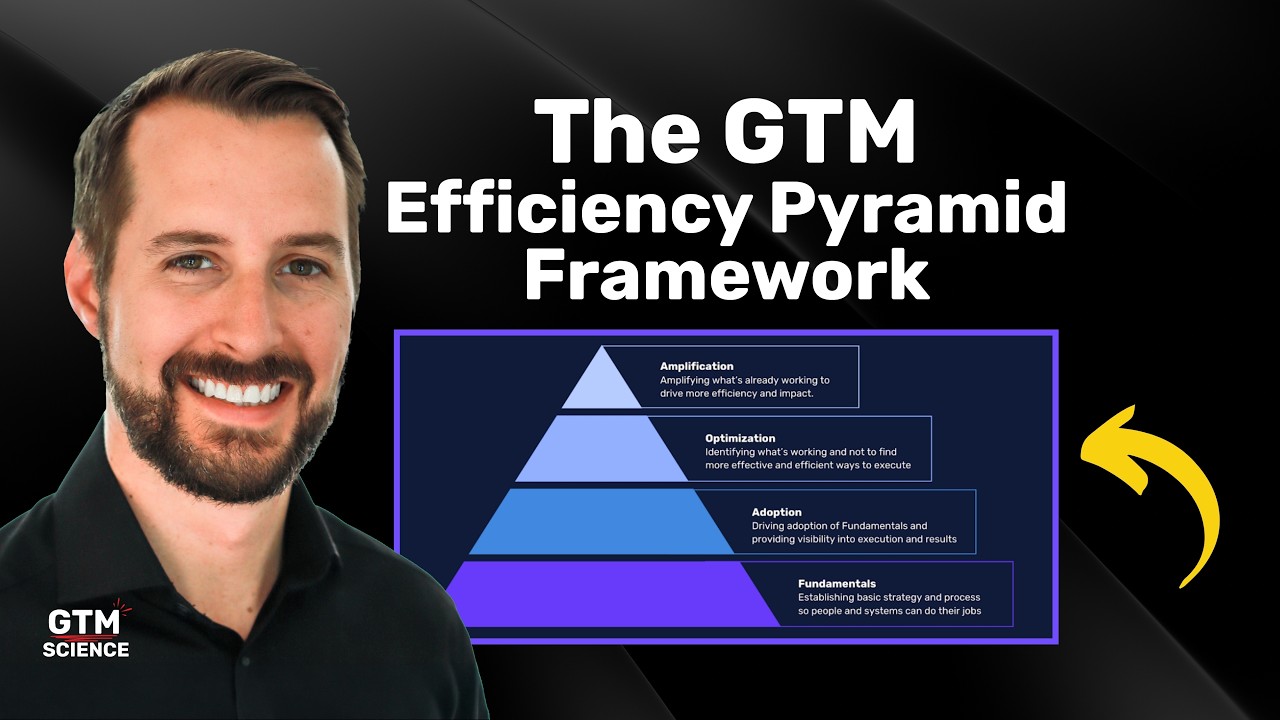
EDDIE2:23And it just made your head spin, right. I'm standing for this whiteboard and I've got all these problems outlined. And I left the meeting feeling like it was a waste of everyone's time. We needed a way to figure out how to prioritize things. And so we developed this go to market efficiency pyramid with four layers. Where we're looking at this and saying like what is the foundation of go to market.
EDDIE2:42And that foundation, the first layer is called fundamentals. And the second layer is called adoption. The fundamentals are basically what are the definitions and process of the go to market, process that your team needs to execute. So for example, who's your ICP and your buyer personas? If we're talking about outbound, what are the basic steps to run outbound prospecting?
EDDIE3:04And then how can we build that into our tools? That's the fundamentals of the go to market efficiency pyramid. Adoption is getting people to actually go and execute that consistently. Training and enablement. Having reporting. So you can see that people are doing the things that they're supposed to be doing. And then having a regular cadence of management review.
EDDIE3:22So we looked at this and we said, okay, if we identify all of these problems, we now have a framework where we can say like, what are those problems that are at the foundation of go to market that we need to fix first before we go fix other things. So the other two layers are optimization and amplification, and that's where all the fancy analytics and the AI lie.
EDDIE3:44And we set that at the top of the pyramid, because we want to make sure we get the foundation in place before moving on to those more advanced things that take more time and have more complexity and don't work if you don't have the foundation in place.
RACHAEL3:56Awesome. And and for me, I, I know we started off with the pyramid being like a visualization for someone's good work IT ops maturity level. But for me, it's kind of evolved into a way to find quick wins in go to market ops and like illuminate those gaps that you have that might have been overlooked while you're trying to optimize things, while you're trying to implement AI and kind of take a step back and get down to the basics and then rebuild from a better place that you can scale from.
EDDIE4:26That's exactly it. And so we're on version three right now. And so I want to answer the second part of your question, which was, you know what's different about version three. Why have we updated the go to market efficiency pyramid now a third time? Well, what I described the go to market efficiency pyramid that I described was the way that we originally built this.
EDDIE4:45I described a couple tweaks there, but the original, version of this was just one pyramid for all of go to market. In version two, we broke this down into different areas of go to market inbound, outbound pipeline management, and then customer success. And so what that allowed us to do would be to go in and talk to a CRO and say, if you could improve one area of your business and only one area, what would it be?
EDDIE5:10Would it be your ability to generate pipeline B outbound, or would it be your ability to close deals that you've generated from outbound or inbound or whatever channel? And this is really helpful because we would narrow in on that. And the Sierra would say, well, I really, really want to fix my outbound program. And we could focus in on that particular pyramid and we can say, here are the fundamental things that you need to have an efficient outbound process.
EDDIE5:34And here's how we drive adoption. And then if we get past that, here's how we optimize that and amplify that. That was really helpful. But we were missing some key go to market motions. We were missing ABM all bound, which we created a pyramid for, but we hadn't yet added it to the framework. We were missing partners and channel, and we're still missing Plg and community.
EDDIE5:56But we added that and we touched on it in the framework. But we didn't build out those pyramids because we don't have a lot of expertise there and don't spend a lot of time working with our clients on those particular go to market motions. We also wanted to break down CSS because CSS is so big, and so I kind of wanted to break it down into into onboarding and implementation, into retention and then into expansion.
EDDIE6:15We don't spend a lot of time in onboarding and implementation. We're not necessarily experts there. So I wanted to skip over that kind of included in retention or touched on it. And then we have retention and expansion. And so those break down separately so that we can really think clearly. For example, if we want to improve our expansion efforts, what are those specific elements in fundamentals adoption optimization and amplification.
EDDIE6:37And so now we've got seven different pyramids. We went back to the first pyramid and we said how do we make this more standardized. What are the standard elements across all of go to market that we need. And so we redid that. And that's probably where we'll go next. And I have we now have a framework that I'm really excited about because that gives us the ability to look holistically across all go to market and also zoom in on one particular area of go to market with extremely specific and tangible examples of things that we need to make that particular motion work.
RACHAEL7:08And before we get into each of these, maturity stages, and you could quickly explain, like why we structured the framework in this way and why, you know, fundamentals comes before adoption, which comes before optimization comes before amplification.
EDDIE7:23Let's just use a tangible example. Right. So everybody's excited about all these fancy new AI tools. People have been excited about analytics and using data and analyzing the data to find ways to improve go to market for a long time. And so we put both of those things at the top of the pyramid. And the reason for that is those things don't work if you don't have the foundation in place.
EDDIE7:42So, for example, let's say that I want to use AI to analyze my pipeline and like look at our close rates and try to forecast, well, if the data in our our pipeline is junk, if our reps don't know what a qualified ideal is or when to enter it into the CRM, if they're not moving things through stages in the right way, if they're missing steps and losing deals because in their sales process, they're not saying and doing the right things, then when we layer AI and analytics on top of that, we are going to have, you know, very limited benefits, right?
EDDIE8:18Like the AI is not going to be able to magically predict what our forecast is going to be if we're feeding it bad data, if we're doing more basic reporting, we're not going to be able to understand what's working and not working when our team is not even executing our sales process consistently. And so the first step and go to market is to say, like, what are our basic steps?
EDDIE8:37And this is something we run into, maybe because we talk about it a lot, but we have zero after zero come to us. And I said, like we're having trouble with outbound. And we ask, do you have these fundamentals in place? Do you have the team consistently executing these things? And the answer inevitably is no. And we say, okay, great.
EDDIE8:54Like there's all kinds of things we can do, all kinds of fancy tools that we can, you know, put in place. But before we do that, we need just figure out what these basic things are and get those in place. And the good news is, depending on the size of the team, you can get the stuff in place really fast, really, really fast in weeks or months, depending on the size of the team.
EDDIE9:13And then you can go through each area of go to market and have that in place. And now and this is also where you get the majority of the benefit. You know, it's like the 20% of the work in the 80% of the benefit by getting these, this foundation in place, because now you've got your team like executing consistently and you're just not dropping balls that you would otherwise drop, because people are just skipping steps that leadership knows they shouldn't skip, but they just haven't been able to, like, create a repeatable process that people are executing consistently.
RACHAEL9:39And I want to make it clear, like when we say getting these fundamentals in place, we know that most companies and most people listening to this are working at a company where, you know, they have fundamentals in place, they know their ICP, they kind of know their personas. They have processes most likely if you're 30, 50 million plus, our, our company.
RACHAEL9:59But I think a lot of companies miss that we find is, they've never gone back and looked at these things again or looked at them by product or by segment, or talked to their customers and talked to their sales team and, you know, customer success and really found out, like, is this our actual ICP? Is this our actual buyer persona?
RACHAEL10:21Are we targeting them the right way, or even do we have these processes written somewhere that anyone can go look up and reference if they need to? Are these processes built into the CRM? Like maybe we have them and everyone kind of knows what it is, but it's not built into the CRM. So there aren't any of these guardrails, keeping your reps in check and making sure that they're following the criteria before they can physically move, you know, on to the next step in Salesforce.
EDDIE10:48I think that's true in many cases. But I also think what's also true is that these companies don't have that stuff in place. As an example, let's say that we go to five sales reps and we ask them, what is our ICP? What are our buyer personas? What does it mean for a deal to be qualified to enter pipeline?
EDDIE11:05What are the stages in our sales process and what do you need to do in each stage? We could also just literally look at like a close report. And I've done this myself and I've looked at companies we've worked with where one rep has an 85% close rate and another rep has a 10% close rate. What does that imply?
EDDIE11:20What does that mean? Nobody is so good. They're closing 85% of their deals. What's happening is, is that Rep is entering deals. Once they have a verbal. So they either don't know when a deal should actually be entered into pipeline, or they just are simply not doing it. The other rep is basically taking every single person they meet with and throwing them into the pipeline, whether they're qualified or not, because they either don't know or don't follow any type of qualification criteria.
EDDIE11:47And we see this again and again and again. And so when you think about that problem, then you say, well, we have $50 million or $100 million of pipeline. Doesn't mean anything. Nobody trusts it. All. You're $100 million is a combination of Jane over here, who doesn't put anything into the pipeline until it's ready to close, and Bob over here who like, puts everybody that he speaks with in the pipeline.
RACHAEL12:08All right, so let's go through these stages step by step. Now, I know we already kind of talked about fundamentals and, well, we talked a little bit about each of them, but let's go into a little bit deeper. And then we can just breeze through the rest of the seven pyramids because a lot of things, carry over and are the same among each kind of area and go to market that we look at with some key differences.
RACHAEL12:29So, Eddie, first let's dive deeper into fundamentals.
EDDIE12:32So and and keep in mind like these are examples. So when we do like a diagnostic with a client we have over 150 different things we look at at this point with seven pyramids. A lot of those hundred and 50 things are on here, but we try to pick three bullet points per layer, so it's not all inclusive like some of these are examples.
EDDIE12:48There's definitely stuff that's missing, but it's a it's a pretty good like it covers things pretty well. So for fundamentals the go to market efficiency pyramid has three things in the fundamental stage ICP and buyer personas. By product. So if you're selling different products to different types of buyers, we need to know who the buyer is for each of those products.
EDDIE13:10We then need to map out our customer journey and our go to market process. What is the step by step process to deliver the customer journey that our customers want? And then lastly, how do we build that process into the systems? Or I really should say that we have built that process into the systems in order to say we've got the fundamentals in place.
EDDIE13:28next stage is adoption. Adoption is just getting our team to actually execute that process consistently. So first we need to provide training, enablement. Then we need full reporting and dashboards to first see if our team is actually executing. And then secondly to see if that's working. And then thirdly, we need a regular cadence of management to review those reports and those dashboards to hold the team accountable and drive them to execute consistently.
EDDIE13:54That's the adoption phase. And when we have that foundation in place, and we have the reports that show that, for example, let's talk about our pipeline or we're doing pipeline inspection on a regular basis and we can confidently say the pipeline might not be perfect, but for the most part, reps know what a qualified deal is. They have the right deals in the pipeline.
EDDIE14:13They know when to take deals out and close loss them out. And when we say we have $50 million in pipeline, we have $50 million in pipeline. That's a prerequisite to moving into optimization, which is the next layer. And optimization is really just using our data to figure out what's working and what's not, and then trying to find ways to optimize our go to market motion based on what the data is telling us.
EDDIE14:35So that starts with go to Market Insights, that requires that foundation, that we have data we can trust. And then it also requires that we have an individual with the right skills and experience and the right time and focus to sit down and go through the reports and try to understand what's working and what's not, and translating those into insights.
EDDIE14:54In a best case scenario, that's your VP of go to market strategy and operations. That's also your CRO. They're both doing that. They're both living in the data and they're looking to see what's working and what's not working. You then have a go to market council meeting where the VP of Go to Market Strategy and Operations would organize and run this meeting, and they would bring the CRO, CMO, you know, head of customer success.
EDDIE15:18Possibly the CFO, product leaders. And they would go through the data and they would say for each different motion like, this is what's working. This is what's not working. We're generating this much pipeline, we're closing this many deals. We're retaining and growing customers in this way. Here's what we are seeing in the data is working or not working and what we recommend doing about that.
EDDIE15:37And then the the leadership team can decide what actions do we want to take coming off of this meeting. That can be an incredibly powerful meeting if it's done right. And then lastly, to have a third bullet point, I think there's a few examples we could have included in here, but I laid this out as attribution and forecasting.
EDDIE15:54Depending on what part of go to market we're talking about, this might be where we start to get our marketing attribution in place. Or for example, with our pipeline. This might be where we start to have a formal forecasting process. A lot of people want to start here, but like, what is the point of having attribution if you can't even get your reps to follow up on leads, how are you going to forecast if you can't even get your reps to keep their pipeline clean?
EDDIE16:15So I think that's why we have that foundation in place. You have to have that in order to do attribution and forecasting. So that's the optimization layer. And then lastly we have amplification. And the reason we retitled this as amplification is because what we are looking to do is to amplify what is presumably already working. Right. So this involves automation, AI, data analytics, a genetic AI workflow.
EDDIE16:41And we can come up with dozens if not hundreds of examples. A lot of this is going to be automation in AI where we say, okay, like we got this go to market motion working. We've even looked at the data and started, you know, find ways to optimize it. How can we amplify this? How can we use machines to help do more of this and do it better?
EDDIE17:00And the prerequisite for that is we need to know what good looks like. We can't ask AI to write an email for us if we don't first know, like what a good email looks like. If we haven't tested that, sent that out to the world and gotten good feedback on it, right? Once we've done that, now we can start to ask, well, how might we use AI to help our reps write an email?
EDDIE17:21Do we need reps to review those emails? Are we saying that automatically? I probably wouldn't advise that. But if we know what good looks like, we can get there. If we don't know what good looks like, we're going to end up amplifying something that's not working. We're going to cause a lot of problems.
RACHAEL17:36I think is not not just what good looks like, but also what creates revenue impact. What is having the most, you know, impact on our close rates, our win rates. You know, there could be something that we're doing. Maybe we have, a specific type of demo space. I was talking to somebody on the podcast a little while ago.
RACHAEL17:57Their company, used customized demo spaces. Took eight hours for them to create it manually. Then they were able to later on use AI to cut that down to two minutes instead of eight hours. So they found the thing that was like a huge differentiator in their industry and the thing that was closing most of their deals, and then they were able to amplify that.
RACHAEL18:16But if they didn't know that that was what if they didn't, like, figure out how to create that demo space, first of all, and figure out how to optimize it and know who it's for and how to do it. They wouldn't have been able to then amplify that and make it such a huge, you know, winner with AI.
EDDIE18:33Well, let's use as a as an example. I actually think we're saying the same thing. That's what I mean by what good looks like. So we have this demo space where we're spending eight hours delivering a demo. So fundamentals what is the process to run a sale step by step. And what's the step where we give a demo and what's like how do we give a good demo.
EDDIE18:53Like what does that process look like? Okay we've got that in place. We've got the tools built out to do that. We train the team on how to do that. We have reporting that shows how we're managing our sales process when we've done a demo, etc. management is reviewing that, getting giving feedback and coaching to the team. And now we we move into optimization and we start to look at our report and we say, okay, we're doing eight hours per demo.
EDDIE19:17How often are we closing deals? I mean, eight hours is a massive investment. So when we are at the demo stage where we spent eight hours on it, we should see a 50% win rate, 60, 70% win rate. If we're looking at 10% win rates, I would really ask, you know, how are we justifying the expense of an eight hour demo?
EDDIE19:35Is this $1 million sale that we're making? Like there's something really wrong here. So before I want to go and say, well, let me figure out how to do this demo in two minutes with I, two minutes might change that. You know, obviously like that's a different scenario, but are we winning these deals? Right. Presumably the scenario you were talking to was winning those deals.
EDDIE19:56And so now we've optimized this. We got that 50% win rate after the demo. This is great. Now we moved to amplification and now we've got a 50% win rate on a two minute demo. That's amazing. And that's what I'm talking about here. But the opposite. If we say, well, we've defined the process for a demo and now let's use AI, and then we're getting like a 5% close rate on our entire qualified sales pipeline.
EDDIE20:22That's a real problem. We don't want to amplify that.
RACHAEL20:25All right. So now let's take a look at each of those seven pyramids that we were talking about and kind of break them down
RACHAEL20:32pyramid by pyramid, area by area. And what's different across each area. All right, Edie, let's start with outbound. What are the fundamental components that need to be in place before anything else can work?
RACHAEL20:44That's kind of specific to outbound.
EDDIE20:47So before I get to help on, one of the things that I'll say is, is that you're going to see a lot of things repeated across these pyramids. For example, the go to market counsel is going to show up everywhere. ICP and buyer personas is going to show up everywhere. Implementing the process into systems is going to show up everywhere.
EDDIE21:03The things that are going to be unique for each motion is going to be. What does it mean to define the process? It's going to be? We shared tangible examples for that. We also shared tangible examples for like kind of reporting you should you be looking at with some of these. And then I think under the amplification there are different examples for automation in AI that are going to be, you know, more common use cases for each of these.
EDDIE21:26Right? Those are going to be the major things that stand out. Now, going back to answer your question, what's different about the outbound efficiency pyramid or what's unique about the outbound efficiency pyramid. So we have our ICP and buyer personas by product. Once we've defined that, we need to define the outbound process. And that starts with building a capacity based territory plan.
EDDIE21:48Meaning we understand how many calls a rep can make in a day, whether they're an eight or an SDR. We understand how many contacts we want them to reach out to in a given account, how many times they want to reach out to each of those contacts. And then we do the math to figure out how many accounts we need to assign to them in a territory.
EDDIE22:08The reason this is so beneficial is if we know the number of accounts that a rep can cover, then we can use data to pick the best accounts. So if they can cover 200 accounts in a year, we find the best 200 accounts. Instead of giving them 2000 accounts and letting them try to figure out who to call.
EDDIE22:25That is like game changing for most outbound organizations. Then we want to build and segment that list. So if we have different types of buyers, in that list of 200 accounts as an example, and X number of contacts and those accounts, how could we segment different types of buyers so that a rep could spend an hour a day, a week solely focused on calling one type of buyer with one type of messaging?
EDDIE22:51They're going to be both faster and more effective at converting prospecting activity in the meetings if they're, you know, working on the same message for the same buyer. And then we have to define that prospecting sequence. Is it, you know, we send an email on day one and then we wait three days and then we send another email, and then we wait four days, and then we do an email on a call.
EDDIE23:11You know, do they need to go to the website? Do they need to read the annual report before they write the first email? Like, what is that step by step process for them to reach out to these prospects? That's really important that we define that, and then we build that process into the system, just like we would in any area.
EDDIE23:28The go to market efficiency pyramid, we go into adoption. I'm just going to be pretty similar to what we already described. We look at, you know, reporting such as, you know, how many activities, how many meetings, how much pipeline was generated, what was closed. We might also want to look at specific account coverage, how accounts are moving through the funnel, who we've called in each account, how we're covering different accounts and different, you know, roles in those accounts, etc..
EDDIE23:54And then we move into optimization and we start looking at what's working and what's not, what messaging is working, what's not. And have our go to market council meeting finally under amplification. The three examples that I thought were most relevant right now and this could change tomorrow. We're automated trigger based cadences, having AI driven, tailored or personalized messaging, and having AI driven account research and account scoring to help us identify which accounts to call, what we should know about these accounts, and how do we personalize this messaging so that we can maximize our conversion rates?
RACHAEL24:27I think outbound is one of the most one of the easiest examples of people jumping ahead of the pyramid and going right to amplification before they do the first steps in the beginning, because then we get spray spray marketing. I think everyone's gotten, you know, spammy outbound cold emails in their inbox where, you know, you just got blasted.
RACHAEL24:47You're on a list somewhere. And they did no research into you whatsoever. Maybe they don't even know what their ISP is, let alone that you're a part of it.
EDDIE24:55Well, the worst part of it is it's like, let's say I've seen stats before where,
EDDIE24:59company did like personalized, targeted outreach. And they got, I think this was more than one company. I think it was a study across many companies and the personalized emails converted 7% of the accounts they went after, and the more like spammy stuff was 0.5%.
EDDIE25:13Right? I mean, that's a massive difference. It's a 14 x difference. Now, if you think about it and you say, okay, like what does that mean? Okay, we reached out to the first 1000 accounts and we get 70 customers out of it versus, five customers. Okay. So then if we got five customers out of the first thousand accounts, we need to move to the next thousand.
EDDIE25:33Now our conversion rates are going to be lower. So maybe it's four accounts instead of 5 or 3. Then we move to the next thousand. Next thousand. We end up like in a race to the bottom where we're on like account number 10,000 to 11,000, and our conversion rates are virtually zero because we burn through all the people that are really, truly in our ICP.
EDDIE25:55And now we're left reaching out to people that are not a fit for our product, and we're getting zero conversion rate because of that. So the solution is, is like, and then we have to do more and more volume. And it's like this vicious race to the bottom. If we're really thoughtful about targeting, we go back to that first batch of a thousand or maybe it's 10,000, like, you know, whatever that number is.
EDDIE26:14I'm not trying to prescribe that for like, you know, any company, it's not one size fits all. But we really figure out who are ICP is and what our capacity is and reach out to the right people with the most effective messaging. Not only are we going to, like, win more customers with less effort and cost, we're also going to retain those customers more and expand those customers more.
EDDIE26:32And it has a trickle down effect all the way across. Go to market.
RACHAEL26:36Absolutely. That was just about that was what I was just about to say also. But yeah, you nailed it. All right. Moving on to inbound. So you outlined six core components to the process. What are those and how are they different from our other processes?
EDDIE26:50All right, so with inbound, the first thing that I think we should do and you could argue would do this with outbound as well, that is to do a customer journey map. And the reason I think this is important, a lot of people are like, oh, we don't want to spend time on this. We need to move forward and start generating revenue.
EDDIE27:03You can do this exercise as fast as you want, even if you spend an hour or two hours doing a customer journey map, it's better than not having one because it forces you to think through like, what are the steps that folks want to follow to become our customers and to stay as our customers? That will then define like, how do we define an mql?
EDDIE27:21What is the speed to lead that we need to have? So for example, somebody goes to our website and says, I want to demo. How fast do we need to respond to them in order to win that deal? Usually the answer is really fast, like five minutes. And then that leads us into like, what is our inbound capacity planning?
EDDIE27:38Same question. Like at the end of the day, when we do all the math, how many leads or accounts can a follow up with in a given period of time? That'll then inform you know, how our lead routing process is done, and then we need to figure out our lead follow up sequence. Are we going to fall five times or ten times on a lead?
EDDIE27:58Is it email. Is it phone. Is it LinkedIn or are we going to send them a care package in the mail? We have to figure out all of those things, and we figure out all those things. Like by definition, those are the things that we need to do to maximize our conversion rates of leads.
RACHAEL28:12And I like that distinction you made in the beginning with, the journey that they want to have. It's not the journey that you think that they should have, but the journey that they, you know, instinctually need to go on in order to come to the realization that they want to be your customer.
EDDIE28:28Yes. And it's the journey they want to have and how you deliver that journey profitably. Right. So there are definitely customers out there that like what they want is unprofitable for you to give that to them. So you have to balance those two things.
RACHAEL28:45Yeah, that's a good point.
EDDIE28:47the inbound efficiency pyramid what we have for the amplification layer is I lead enrichment and scoring. I think this is incredibly powerful. So we've got like our foundation in place. We've optimized that we got our attribution in place etc.. And now we look at like could we ask less of our customers when they visit our website by doing lead enrichment, whether it's just like Plain Jane, old automation or we're using AI, how do we improve the way that we're scoring leads or scoring accounts?
EDDIE29:17The next thing is I campaign and channel analytics. So when we did our interview with Scale Ventures, they said that this is one of the biggest things they're seeing in their portfolio. Companies that are doing this well are having massive ROI on their investment in AI, because AI is helping them to understand how their campaigns are performing.
EDDIE29:38And I added in like channel analytics because I think it's just obvious. Think about how powerful that can be. If you can get AI to help you understand, like what's working and what's not working. And then lastly would be like the AI assisted lead response or follow up. So let's say I go to the website and I say I want a demo.
EDDIE29:57How amazing would it be if I get an AI email that's like gone to my website, researched my company and said, hey, thanks so much for reaching out. Based on what we can see on your website, this is how we think we can help you. And by the way, like if you would like to talk to like Bob tomorrow here at like times that he's available, let me know and I'll send you out an invite.
EDDIE30:19What we want is a human to do that within 30s. Right. And if a human can't do that in 30s, I think there's an incredibly,
EDDIE30:27powerful use case for having I do that.
EDDIE30:30Quick pause. If you're getting value from this episode, I want to ask you a small favor. Take 30s right now. Open up the app you're listening to this on and give it a five star rating.
EDDIE30:39It sounds small, but it's the single biggest thing you can do to help us get conversations like this in front of more revenue leaders.
EDDIE30:44While you're there, hit follow so you never miss an episode.
EDDIE30:47Okay, let's get back into it.
RACHAEL30:49All right, moving on to ABM slash all bound, in the framework that you mentioned that it requires mastering both inbound and outbound and making them work together seamlessly. But what does that actually mean in practice as we look through the pyramid?
EDDIE31:02Well, I honestly do not think there's a big difference or really any difference between inbound and outbound, with one exception. Let's take our hand razor leads. We have people that come to our website that are in our ICP and say, I would like a demo, and they fill out a form and that comes in here, let's separate that out.
EDDIE31:18Right. That's pure true inbound. And the way to address that is, is that you need to respond to that lead as fast as humanly possible and get them on the phone with the sales rep. So they can get that demo that they wanted to see.
EDDIE31:30Beyond that, all other inbound is nothing more than a signal that, a person in an organization that does not want to talk to sales or is not asking to speak to sales, might be willing to talk to sales and enter a sales cycle.
EDDIE31:47So when we look at inbound, we are basically asking a question of who could we call that doesn't want to talk to us right now? That might be open to a conversation and might enter into an evaluation cycle. That's the same question we're asking with outbound. Who's out there that doesn't know who we are, isn't asking to speak with us, isn't engaging with our content that we could call, that we might have a high likelihood of converting into a sales cycle.
EDDIE32:14It's the same exact question. And so I beg the question of like, what is the difference between inbound and outbound in that regard? I don't really think there is. So if we move into like an ABM or an all bound model, especially if we focus on accounts instead of you know, individuals, then we're just trying to answer the question of whether that account has engaged with our marketing or not, whether they're showing up in third party intent.
EDDIE32:36So with third party and set intent signals, or whether they just happen to like, fit our ICP and just be the best account that we want to go after, how do we prioritize all of those accounts and prospect into them? And so we need to have the elements that we just laid out in both inbound and outbound. In order to do that, we need a customer journey map.
EDDIE32:54We need capacity and territory planning. Most of all, we need to figure out how we would score these accounts and assign these accounts and prioritize them with all these different signals. Right. Some accounts are going to show up in this list because like, they just they're the right company in the right industry with the right revenue. And we know they would be the perfect customer for us.
EDDIE33:13Others are going to show up because they've engaged our marketing. Others are going to show up because, you know, they have third party intent signals coming out of tools like Sixth Sense. And then there's a combination of all three, right? So we got to figure out which accounts we want to call in and how we prioritize those accounts.
EDDIE33:28We have to of course figure out what is that sequencing process to reach out to them. And then of course, the speed, the lead. How fast do we need to respond or reach out to these folks, especially those engaging with our marketing or trigger, you know, triggers or anything else that is going to show up in our scoring methodology?
EDDIE33:45How important is it that we move fast on those signals? Those are the big things, I think for the process for ABM are all about the next piece that I think is a little bit unique to this pyramid is what is the reporting for ABM and all about? One thing I think that we need to look at is what is our account coverage reporting, especially if we are looking at an account based motion.
EDDIE34:08I personally think like the most powerful thing we can be looking at is like, okay, if sales and marketing is focused on this set of accounts, how are those accounts moving through the funnel? Which of those accounts are targets? Which of those accounts have engaged with our marketing or our sales? Which of those accounts have moved into an active like evaluation cycle, etc.?
EDDIE34:27I mean, you can pick different stages based on what you feel is most relevant to your motion, but I think it's really powerful to look at one report and just see, like, okay, we have a thousand target accounts or 10,000 target accounts, whatever it is, or maybe ten target accounts. How are those accounts moving through the funnel? We then of course want to see like what the conversions are in each of those accounts, how much pipeline we're generating.
EDDIE34:47And then, of course, how much revenue we're generating from this, ABM are all about program those I think, are the big things that are sort of unique to this. The optimization is very similar attribution ABM insights and go to Market Counsel. And then with amplification, you know, a lot of similar things here. The I account enrichment or scoring, I think that's actually really central to this AI campaign and channel analytics.
EDDIE35:10And then the AI assisted lead response follow up, I think just like inbound, all those things are relevant to ABM.
RACHAEL35:16All right.
RACHAEL35:17we're gonna keep moving along, to our last bit, area in pipeline generation, for the pyramid
RACHAEL35:25partners and channel. So, you know, partners and channel, they can look very different from one organization to another. But what are the fundamentals that should be applying across the board here?
EDDIE35:37Sure. Well, let's clarify how they might be different, because I think, like when you think partners, partners could be something like what we do, which is we partner with private equity and venture capital firms and they refer us into their portfolio companies. We're not paying them for this. They don't have any kind of like financial incentive. They just want to help their portfolio companies.
EDDIE35:56And we want to convince them that we can help those portfolio companies. On the complete opposite side of the spectrum, you have channel where you're paying another organization to help sell your product. But I think the common thread here is that
EDDIE36:09you can't have a partner or a channel program if you don't. A find somebody and meet with them and then convince them to become, you know, a partner, and then b nurture that relationship and turn that into a stream of revenue.
EDDIE36:22Right.
EDDIE36:22Like unlike other areas of go to market with partners and channel, it's an ongoing relationship. You don't have like a one time cycle and then you're done and you've either won or lost the deal. It's ongoing. You're trying to continue to get these deals out of these partners or channel partners. And so in order to do that, well, it kind of starts with an outbound motion.
EDDIE36:43Unless of course, you have marketing which brings in partners, which ironically, we do we have partners that come to us about 5050 through marketing and through direct outreach. But you first want to say, see, like, what's your capacity and territory plans? How many partners can we cover? You need to build and segment those target lists. And then most importantly, you need to define the partner engagement process.
EDDIE37:04So after that initial meeting, what are we going to do for the next year or two years, five years to nurture and grow that relationship so that we can get referral after referral? Or in the case of channel partners, closed deal after closed deal. And so that can be like a big thing to unpack. But that, you know, ultimately I think is the thing that you need to answer before you enter into like this particular motion.
EDDIE37:29The rest of this, I think, is going to be pretty consistent with what we've already shared. And the amplification is very similar to what we shared with outbound. Like there might be a trigger base sequence where a partner has suddenly become ripe for us to reach out to, using AI to help tailor and personalize messaging.
EDDIE37:45I think, like with partners, that can be even more powerful because you're talking about a bigger, more complex relationship. How can I, like, go through the website and analyze it and help you write messaging that's going to say, hey, I think the reason why you might benefit as a partner is we could help you out with all of these things.
EDDIE38:00And then the last thing which is unique here is AI driven partner deal summaries and feedback. So my personal experience, you know, building a partner channel for the last nine years here at us is partners want feedback and updates. And they want it in like a very concise, efficient way. If they preferred one of their portfolio companies to us, for example, they want feedback and the call go did we win them?
EDDIE38:22Did we lose them if we won them? Like what's going on with, with that customer? How are we helping them? And we have a lot of customers that we've worked with for 2 or 3 or 4 or 5 years that the VC firm has referred to us. And it's difficult to like, say, like, how often should we update them?
EDDIE38:36How can we keep them in the loop on like what's going on and how we're adding value to their portfolio? And I think that's really important in like a, an evergreen relationship.
RACHAEL38:45And I think it's especially important in our case because you know, pretty much all the time when a partner company refers us to one of their, portfolio companies, it's because, you know, they have stakes in that portfolio company. They want us to help that company increase their revenue.
EDDIE39:00So yeah. And the thing I've always said about partners is you need three things for a partner. Like, number one, they have to be working with your ICP and your buyer personas. Number two, they have to be talking about the thing that you do on a regular basis. And number three, they have to benefit directly from what you do.
EDDIE39:16Now that could be a financial incentive. Like you're going to give them some kind of a kickback or they're going to sell your product and they're going to make money off of it. Or in our case, hopefully we help the company improve their their revenue production. And the private equity firm makes more money because now they have a, a bigger, more profitable company.
EDDIE39:35But if they're not benefiting from the relationship, they're not going to put any effort forth, you know, to help you. And the same thing is true with channel partners. I'm not going to sell your product if I'm not making good money on it. Right. Like if I have a suite of products to sell and your product is tough to sell, and I'm not talking to the right buyer, etc., then like, I'm not going to sell your product.
EDDIE39:56And so these are things that I think are critical to think through when you're building out a channel or partner program.
RACHAEL40:01Absolutely. And that might mean you have to look at your ICP again when it comes to partner channels.
EDDIE40:06Oh, that's one thing we missed is it's not ICP, it's IP.
RACHAEL40:09What is your IP profile? There you go. Yeah.
EDDIE40:12And it's really important. Like we we have an ICP and an IP defined in a document written down that we all like, know and agree on because it's so, so important. But anyway we got to be conscious of time. Let's move to pipeline management
EDDIE40:25pipeline management is this, point that is between generating pipeline and then having a customer. So that'd be customer success, right? It's also the point between generating expansion opportunity and closing and expansion opportunity. So when we think about pipeline management, it could be new business.
EDDIE40:43It could also be expansion to a lesser extent. It would, you know, maybe apply or influence the renewal process. When I was at Salesforce, I did both new business and existing business, and we had the exact same process for both. We have the same stages, same qualification criteria, same questions we asked. It was pretty much exactly the same.
EDDIE41:00In other organizations, you're going to have a very different sales process from new business to expansion. But what's unique about this pyramid and what we need to think about is this, like, what is that process and specifically what sales methodology do we subscribe to, and what is the sales process associated with that sales methodology? So how do we figure that out?
EDDIE41:19Well, first we pick a sales methodology. And here you ask we don't necessarily try to recommend one over the other medic or med pick is obviously very popular right now. But you have to then translate that into the sales process. So let's say that we're going with medic. Right. Well, for your particular organization, for your sales process, what does that mean for qualification criteria.
EDDIE41:41Which questions and medic do you want to ask and when and how does that influence you to decide when a deal is eligible to enter pipeline and when it's not yet ready? We need to think about what our sales stages are. When you think about the entry and exit criteria to move a deal from one stage to the next, and then we need to think about the steps and the questions by stage.
EDDIE42:02So going back to medic, which of those questions do we ask? At what stage? What do which of those questions do we have to have answered before we move to the next stage that is unique to each business? And then when do we walk away and close out a deal? This is really important. If we don't answer that question, we end up with a zombie pipeline.
EDDIE42:20It's inflated. We say we have $200 million in pipeline and we know that we don't. We have to have that in place. If we have that in place, we now have the structure that we need to set up the tools and then to have the right pipeline reports and know what to expect in the pipeline so that we can make sure that it's clean and accurate.
RACHAEL42:39Absolutely. And pipeline management is also incredibly important because, you know, a lot of companies and Cros, they want the new shiny thing, they want the new logos, they want more and more pipeline generation. Maybe they have, you know, numbers they have to hit. And the board hovering over them saying, you know, get us, get us more, pipeline acquisition.
RACHAEL43:01But if your sales process has holes in it and your people can't close that pipeline, then there's no then you can't you can't, shovel. You know, you can shovel as much dirt as you want to into a bucket. But if there was a giant hole in the bottom of it, you're not going to collect anything.
EDDIE43:17That's the exact problem that we see. So I talk to zeros every day. And nine times out of ten, when I asked them what their priority is, they center in on new business and then specifically pipeline generation, usually some form of inbound and outbound. And they say, well, look like if we don't know what a qualified deal is, if we can't get our team to follow this process, then first, any amount of you know, time and money we invest in generating more pipeline is going to have, you know, a lower ROI.
EDDIE43:42And then secondly, like we don't know what good looks like. So we can't actually validate what's working and not working for inbound and outbound, because we don't know whether or not like that work to generate pipeline. And we just lost the deal because we dropped the ball in pipeline management or vice versa. You know, if we extend this to marketing, when we talk about inbound, this is a real problem.
EDDIE44:04You know, if marketing is saying, well, we need to generate $100 million in pipeline, but we can't agree on what pipeline is, or they're being held accountable to revenue and saying what the sales team isn't following up on these, you know, deals. We need to fix that first. And the good news is you can get those fundamentals and adoption in place really, really fast.
EDDIE44:25You might have like a 12 month sales cycle, and it's going to take a long time to see the fruits of that labor. But you can get the sales process down and get reps following that sales process pretty quickly. And then you can go and say, okay, well, now we got the basics in place for pipeline. Now let's move into outbound.
EDDIE44:41Now let's move in inbound. And so oftentimes when we're working with clients, you know the first 90 days will agree with the CRO. And we'll say let's do pipeline and outbound or pipeline and inbound. And we're going to get the fundamentals and adoption in place so that you're not losing deals by letting things slip through the cracks. We get those, you know, the foundation in place, and then we can come back and either and optimize or amplify either those motions, or we might move into another area of go to market and try to get the foundation in place their first.
RACHAEL45:11So going on to Customer Success. First up we have renewals Eddie. All right. So let's get into the big differences with renewals.
EDDIE45:20this was a hard one to put together. I mean the key difference here is of course going to be the process. And there's a lot that goes into renewals, especially considering the fact that we're kind of trying to lump in onboarding implementations together. So first we go back to capacity planning. There are a lot of jobs to be done, and we need to know how long it takes to do those jobs.
EDDIE45:38And if we have enough of the right people in place, there's no point in having a process for onboarding implementations or retention if we don't have enough people to run that process, right, like we're going to drop the ball because we don't have enough people. And this is a common problem in CSE. Next we need to think about account assignment.
EDDIE45:55So based on that capacity what CSE, SMS or if we have renewals managers or other roles are going to be assigned to what accounts, then we need to like define that step by step process for retention. What is the handoff and onboarding process? If we have an implementation process, what does that look like? What is the customer health monitoring process like meaning like how do we know which customers are healthy and not healthy?
EDDIE46:21What do we need to do to figure that out? What is our process to address unhealthy customers? And so like let me just touch on some examples here. Right when I was at Salesforce, we had the early warning system. We had this data just piped into Salesforce showing the usage of our customers. And I could literally just like see my accounts red, yellow, green.
EDDIE46:38So the process for identifying an unhealthy account was very simple in other organizations. Like the only way to access that is to like log into like the back end database to powers their product. Or maybe they needed to go to somebody and get a report. What is that process going to be for us to identify unhealthy accounts, then the process to actually address unhealthy accounts, do we reach out to them?
EDDIE47:00Do we have a cover in my case, it's Salesforce because I was quota carrying. The way it worked for me is I would look at an account and I would say, okay, I'm probably not going to be able to sell anything to move there. Unhealthy. What I can do as a sales rep is I can try to kick the door in and call an executive and say, hey, like, it looks like you guys are having troubles with Salesforce.
EDDIE47:18I want to bring the right resources in to help you guys turn things around. Can we make that happen? And then whether that worked or didn't work, I would hand the account off and move on. And then I try to come back three months later and see, like, did we turn that account around? Is this now something that I can sell to?
EDDIE47:32And then separately, we had, you know, customer success managers that would independently reach out and try to do the same thing. But since these weren't salespeople, sometimes they didn't have as much success kicking the door in and getting in front of an executive that really had power in the organization to make change. Okay. What next? So we want to have a process for QBR or other regular engagement.
EDDIE47:52And then of course, we obviously last need the process to initiate and run the renewal itself. But I think we all know that if your renewal process is starting at 90 days or 30 days before the end of the contract, and you haven't done any of this other stuff ahead of time, it's too late to change anything. You can't turn an unhealthy account around in 30 days and get them to renew their contract when they're not getting any value, so it's so critical to have all these processes documented and in place.
EDDIE48:19And then of course, like built into the systems. The other thing that's unique about this pyramid is the amplification. So automated health scoring. I talked to you about how like we, you know, had our system and we've done this for clients where they're like, we've got our usage data in a back end database. How can we integrate this into Salesforce or some other tool where our team can see it?
EDDIE48:40That's obviously really powerful. We've also worked with folks where, hey, like that's a massive undertaking. Could we even just start with like a red, yellow, green? You want to have somebody like log in to the database and mark every account red, yellow, green and manually go into Salesforce and market it's, you know, pretty rudimentary. But it's better than not having that right.
EDDIE48:57The next piece is AI assisted CSS and playbooks. So how can we use AI to help our CSM figure out exactly what to do in different situations? You have to keep in mind when we're talking about an existing customer, we have a lot of data potentially, and when we have a lot of data, that's where I can really shine.
EDDIE49:15By analyzing all of that data and helping CSM to, you know, come up with conclusions and insights much faster than they would be able to do manually. And then, of course, AI driven customer risk signals. So how can I analyze our customers, both their usage, their customer support tickets, etc., to identify risk signals for churn that we need to address?
RACHAEL49:38And I want to touch on the optimization part just real quick, because just like pipeline management, you know, optimizing this area of go to market has ripple effects to outbound inbound ABM partners, all of it. Once you can see in CSS, like who are the types of customers that are actually using this, who is getting the most from this?
RACHAEL50:01Who are champions? You can have, you know, that feedback to you that the top of your funnel and the people working in pipeline generation like target more of these types of customers. And you need to have that, that connective tissue and those feedback loops all working in tandem. So you can continuously be optimizing through the entire go to market organization.
EDDIE50:21Absolutely. And that's one of the real powers of having a true go to market council meeting, where if we've got the right people in the room and they're saying, hey, these customers are renewing with us, these customers are churning, these customers are really difficult to make happy. And ideally, if we have a CRO that spans new business and customer success, that's where that CRO can make a decision and say, okay, we need to shift focus on new business and try to land more of these customers that are easier and cheaper to, you know, retain and make happy.
RACHAEL50:51All right, moving on to expansion, Edie, let's talk a little bit about expansion. I have a feeling there's going to be a lot of similarities with outbound ABM.
EDDIE51:00There is, because if you think about expansion, expansion is two things. It's first pipeline generation and then it's pipeline management. So if we have an expansion opportunity, we are either going to follow the same exact process that we do for new business, or we are going to answer the same questions we answered about new business pipeline management and just have slightly different answers.
EDDIE51:22We might have slightly different stages, we might have different qualification criteria, etc. but if anybody is listening to this and they want to pull up the framework and try to understand, well, how do we figure out how to manage our expansion pipeline, you just go to the pipeline efficiency pyramid and all the questions that you need to answer are right there.
EDDIE51:40So when we think about the expansion pyramid, I'm really thinking about like expansion pipeline, pipeline generation. Right. And so we obviously need to know our ICP and our buyer personas by product. And we're that's like specific like I'll show you a tangible example at Salesforce is like, okay, well our ICP was, you know, these industries. And then within that, like, well, the sales leader bought Sales Cloud and the service leader bought Service Cloud and the marketing leader bought marketing cloud.
EDDIE52:05Like kind of obvious, right? But like, if it wasn't obvious, it's important to know that. And I'll say like, actually, one thing that wasn't obvious is, it's a little bit misleading because what we found is, like our buyer persona for Service Cloud was actually not the head of, you know, customer success. It was oftentimes the CIO, for whatever reason, was the head of customer success.
EDDIE52:26Like, unfortunately, oftentimes gets neglected and have as much power in the organization to drive buying decisions. And we found that it was a lot easier to go to the CEOs. So what do we need to know in order to do this? Specifically, how do we define the expansion process? We look at customer journey map capacity and territory planning, account scoring and assignment, the account sequencing process.
EDDIE52:51And then the last thing is product and stakeholder whitespace. Let me dig into that a little bit. So a lot of these things are repetitive. But I think the account scoring an assignment is going to be really critical. Like how do we take all of these signals and figure out which accounts we want to go after? It could be as simple as, hey, we've pulled up our backend database, we've gone through, you know, who's using our product, and we've identified a set of green accounts, and we've done that manually.
EDDIE53:18And like, we're going to go after those green accounts and try to see if we can expand them. It can be much more complicated than that. But that's a good place to start, right? Once we've done that, you know, how do we want to reach out to them? Do we reach out to one person, to five people in the organization?
EDDIE53:32When I was at Salesforce, there are probably about eight people in an organization that I would reach out to on a regular basis. And then that leads us into product and stakeholder whitespace. Which products does each customer have? Which products does each customer not have? That's a common thing, but also what's our stakeholder? Whitespace. When I was at Salesforce, we would oftentimes have a good relationship with the VP of sales of the CRO, but oftentimes not necessarily with the CMO, with the head of customer success, especially not with the CFO, CEO, SEO, or Salesforce admin, etc..
EDDIE54:06And so if you have these relationships in these accounts that we're like, or these people in these accounts that you don't have relationships with, it can be really powerful to map that out and work to change that.
RACHAEL54:18All right. So we have covered a lot in this framework. And I know it might sound a little bit overwhelming to get through all of that, but where should revenue leaders actually start?
EDDIE54:28I think the first place to start is like so we've given seven different pyramids and a lot to inspect. The first place to start is with prioritization. So we're going to turn this into a framework. It's currently a newsletter the go to market ops decision tree. It starts with the basic question if you could improve one thing in your business over the next 90 days, would it be new business or net revenue retention?
EDDIE54:49I should say one thing and go to market, not in the business. Would it be new business or net revenue retention? Okay, let's say it's new business. Next question. If you could improve one thing in new business over the next 90 days, what would it be? Would it be generating more pipeline or closing more of the pipeline that you're already generating on
EDDIE55:06near side, I would say, is that retention or is it expansion?
EDDIE55:09And then we drill a layer deeper, right. So with pipeline generation if that's what we landed on, is it one of these channels that we mentioned. Is it inbound. Is it outbound. Is it ABM all bound. Is it partners or channel or is it the ones we didn't cover. Plg or community? Which one is it?
EDDIE55:31When you center in on that, then you can pull up the pyramid and you can say, okay, we've landed on pipeline management. And outbound is our top two priorities for the next 90 days. Do we have the fundamentals in place? Do we have the adoption in place? Can you answer those questions really quickly. And you translate that into a go to market operations roadmap.
EDDIE55:51And you say these are the specific things that we want to improve over the next 90 days.
EDDIE55:57So what does that mean? The way we like to do a go to market operations roadmap is we say on the left, what are our OKRs or objectives and key results. For example, we say we want to generate $120 million of pipeline.
EDDIE56:14Okay. In order to do that, we need to better define our ICP and our buyer personas. We need to let me go back to our, outbound pyramid. We need to do a capacity plan and a territory plan. We need to build out and segment our target lists, and we need to define our prospect sequencing process, assuming that we have none of the stuff in place or none of it's good, right?
EDDIE56:38Okay. Like our objective is to generate. I don't remember what I said, $100 million in pipeline. And in order to increase our chances of being able to do that, these are the initiatives we need to take down and go to market operations. We put this all on one sheet of paper, and you can find this on our website.
EDDIE56:54And then we present this to, you know, the leadership team. And they say, yep, we agree with this or we would change this in this way. And then we all commit to say for the next 90 days, this is the top priority. If anything else comes up. It's like literally like the house has to be burning down or the answer is no.
EDDIE57:12We need to focus on this. And that's really, really powerful. It's so common that operations gets like inundated with these inbound requests. And then we had the best intentions to go like improve our outbound engine, but we never made any traction on it because operations got distracted or because we got the fundamentals in place. But management never drove adoption management never committed to getting the team to execute the process consistently.
EDDIE57:38And so it's really important that we get this all in one page and get everybody to agree and sign off on it and then go work on it. And then like lastly, at least the way we work, we do biweekly sprints. And so it's nice to break that 90 day plan down into a two week sprint and say, okay, over the next two weeks, we're working on the capacity and territory plan.
RACHAEL57:56And having this air cover of like, you know, a plan that, you know, that the CEO and the rest of your CXOs have signed off on, you know, somebody else on your team comes to you and they're like, oh, I need you to work on this other thing instead. It's an emergency. It's super urgent. You can come to them and be like, okay, well, you know, is it more urgent than this thing that the CEO has signed off on as being most urgent, or is it, you know, something that can be kicked down a bit, kicked down the road a little bit for like a week?
RACHAEL58:24So it's easier to triage stuff when you have that air cover.
EDDIE58:27It's very important. I would say it's probably even more important when we think about first line management. Right. So if, for example, our roadmap is that we're going to fix pipeline management and outbound, we need management to inspect those reports and drive the team to have the pipeline clean and well managed and to execute the outbound process. That's a big ask right?
EDDIE58:49So we need everyone aligned. We need the CFO behind it saying, I'm going to work with my frontline management team. Or maybe the CRO is frontline management and I'm going to commit that. We are going to do this and we're going to drive our team to adopt this process that we're going to define.
RACHAEL59:03All right this.
EDDIE59:04Year or break for go to market.
RACHAEL59:06Yeah. Or your coming.
EDDIE59:08Are you going to say exactly.
RACHAEL59:10Yeah. We're right at the time. So yeah. If any. Thank you guys also for, for making it this far. If you want to see the framework, with your own eyes, you can go to Uni Square consulting.com/frameworks or find the link in the show notes. That is the go to market efficiency pyramid framework 3.0.
RACHAEL59:28thank you so much Edie.
EDDIE59:30Thank you for doing this and all the hard work that you put into putting this whole thing together and asking these questions. I'm very excited to, release this, and I hope that people got a lot of value out of it. I will also plug one more thing. If anybody's listening to this and you're saying I would like some help figuring this stuff out, we have a go to market efficiency workshop, and either I or our head of, delivery would run this.
EDDIE59:57And you can go to our website and you can book a session. It's a pretty significant investment of time for us. It's free, but you have to be a chief revenue officer, or you have to have your CFO there in a company with 50 to $500 million in IRR. And we will spend an hour doing a free diagnostic and assessment of your entire go to market.
EDDIE60:20Or we'll end up centering in on one thing that's specific and most important to you, and help you leave with some tangible action items that you can take to improve your go to market efficiency.
RACHAEL60:31And we will have the link to that workshop in the show notes as well. Or you can find it on our website. At the time of this recording it's under resources and free workshop.
EDDIE60:40Awesome, Rachel. Thank you.
RACHAEL60:42Thanks very.
EDDIE60:43Thanks for listening to the episode. If this resonated, please give us a five star rating and a follow. It helps us reach more people, and you get our latest and greatest content without having to search for it.
EDDIE60:53And if you're looking for hands on help and go to market strategy and or rev ops, please reach out to us. We help our clients with everything from annual planning to improving processes and go to market, implementing systems to support those processes and go to market. I
EDDIE61:07We're always happy to offer a free consultation to help you identify the best opportunities to improve your go to market engine, with or without our help.
EDDIE61:14You can find us at Union Square consulting.com and the info will be in our show notes.