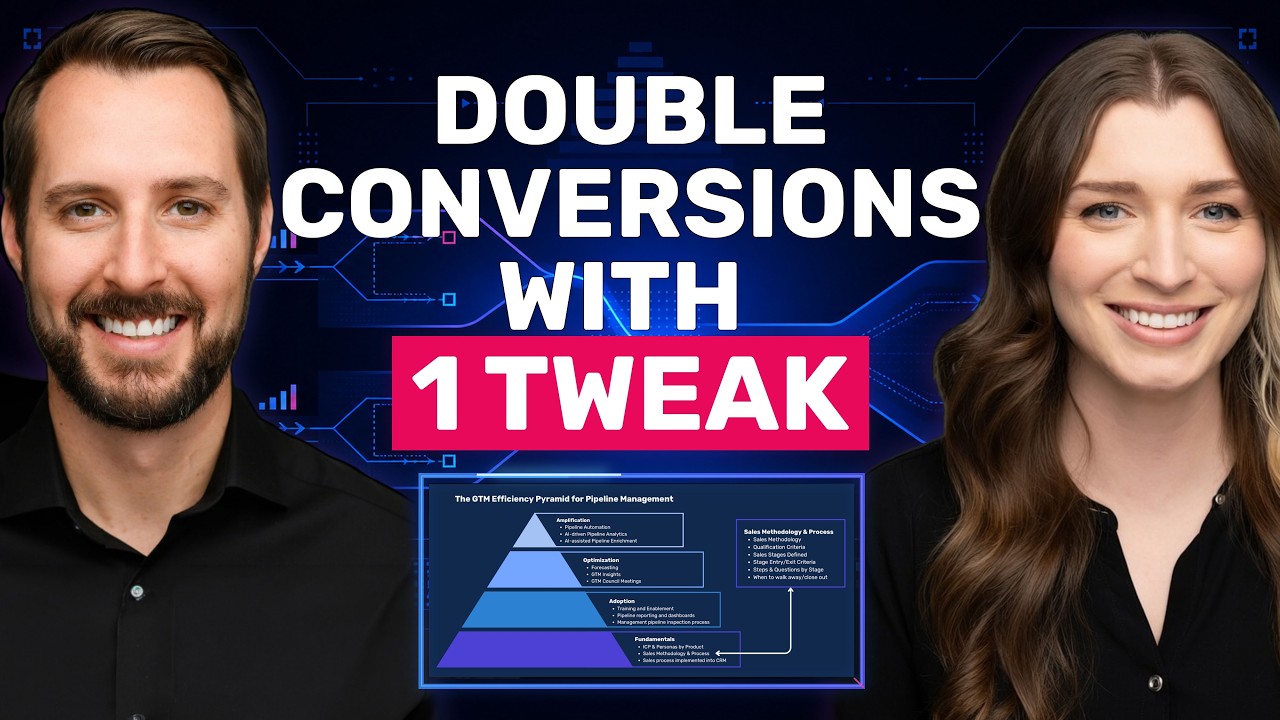
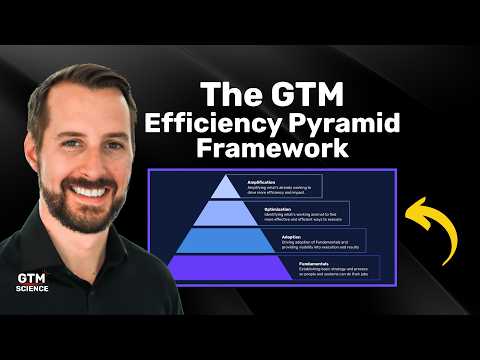
EDDIE0:00I think, like our core pillar framework is the pipeline efficiency pyramid.
EDDIE0:03I think the cornerstone of that is pipeline management.
EDDIE0:06everybody wants to generate more pipeline, but it's so much easier to close more of the deals that you're already
EDDIE0:11generating.
EDDIE0:11If
EDDIE0:12the pipeline management engine isn't dialed in.
EDDIE0:15we see so many companies where
EDDIE0:16they're trying so hard to generate more pipeline,
EDDIE0:19and they're losing deals that they could win and chasing deals that they will never win.
EDDIE0:22it's this massive inefficiency that's a lot easier to fix than doubling the amount of pipeline that we generate.
EDDIE0:27And then optimization becomes this ongoing thing where we're constantly just tweaking and trying to get that extra 1%.
EDDIE0:34the first time we do it. It might not be an extra 1%, it might be an extra 10% or an extra 100%
EDDIE0:39because our fundamentals are so broken and so far off,
EDDIE0:42our MVP was such a miss that we've got to go back to the drawing board and redo
EDDIE0:54actionable playbooks from the trenches working as go to market strategy and rev ops consultants for our clients here at Union Square. Consulting and candid conversations with revenue leaders in the market that have been there. Now let's get into it.
RACHAEL1:09Almost every revenue leader will tell you their number one priority is generating more pipeline. But that can be sometimes the worst place to start. If the pipeline you're you already have is leaking. More volume just means you lose more deals, only faster. So today we're we're walking through our pipeline management framework layer by layer. Our version 3.0 of the pipeline management framework.
RACHAEL1:33And this is our system for turning a messy pipeline into something that runs more like a machine. If you feel like you've been dumping resources into go to market, nothing's moving. This one's for you.
RACHAEL1:42Hey, Eddie, how's it going?
EDDIE1:43It's going well. I'm excited to dive into this again and share all of the updates that we have made on this as we refined it over the last year since we did this podcast about a year ago. It's one of our top performing podcasts, so clearly the message is resonated with people and it's cornerstone to what we do.
EDDIE2:02I think, like our core pillar framework is the pipeline efficiency pyramid. And then we've broken that down into each different area of go to market. And I think the cornerstone of that is pipeline management. And to your point, everybody wants to generate more pipeline, but it's so much easier to close more of the deals that you're already generating.
EDDIE2:19If the pipeline management engine isn't dialed in. And we see that so often, we see so many companies where they're trying so hard to generate more pipeline, and you're and they're losing deals that they could win and chasing deals that they will never win. And it's this massive inefficiency that's a lot easier to fix than doubling the amount of pipeline that we generate.
EDDIE2:39So I'm excited to dive into it with
RACHAEL2:40Yeah. And there's even parts of this pipeline management process as you go through it. If you go through it with your own company, that can affect how you generate pipeline as well, specifically the foundations. So it's definitely an area to focus on first. If you're thinking that you need to increase revenue from your pipeline and pilot pipeline.
EDDIE3:01I think that that's a great point, Rachel. And it's not just that some of these things will segue into pipeline generation, but also the ability to measure your pipeline generation and whether or not it's working. And so, sure, we can look at how our ad campaigns or our outbound sales are taking us from initial activity or add all the way to closed one, but it's a lot harder to optimize that engine if we don't trust the data in our pipeline, in the sense that we don't trust how much pipeline we are generating from each of those channels.
EDDIE3:30If we can do that, if we can dial our pipeline management in to see two things. One, what pipeline are we really generating? And two, are we closing that pipeline because we haven't skipped any steps. That then informs us much better on what's working with pipeline generation. And we're now able to say, we know we generated X amount of pipeline because we qualified it well, and we're doing all the right things to close those deals, and we don't have to wait for revenue to see what's working and what's not.
EDDIE4:00And we don't have to doubt that revenue figure and wonder, was it that this channel didn't work to generate pipeline, or was it that we could have won the deal and we lost it?
RACHAEL4:09Absolutely. So, Eddie, when you get on a call with a new team that you're going to work with, what are the initial symptoms that tell you that the problem is most likely pipeline management rather than lead generation?
EDDIE4:21Well, the symptoms oftentimes are either coming out of the metrics or just the messy pipeline or the inability to forecast. And so we can talk about the fundamentals that we'll talk about here, about how we don't have a sale, sales methodology and sales process defined qualification criteria, et cetera, etc.. I'm sure we'll get into that in this podcast, but there's a couple of things that I'll look at just really quickly to try to make a quick assessment or questions I'll ask.
EDDIE4:45One question would just be what's the average sales cycle and how many deals sit in our pipeline today that are more than 1.5 x or two x that sales cycle? The reason I asked that is that we know that if a deal has gone more than two times the average sales cycle, the chance of winning it is almost zero.
EDDIE5:03Every once in a while we win those deals, but if that's half our pipeline, we can pretty quickly assess that our pipeline is an absolute mess and we can't trust it. We can also just ask about forecasting. And I think most crows that we talk to know when there's a problem with their pipeline, because they have to go to each rep and go around the horn, deal by deal, rep by rep, and try to figure out whether or not that deal actually has a chance of closing.
EDDIE5:26And they have to do this in a way that is extremely time consuming, because they don't trust what they see in Salesforce.
EDDIE5:32Another symptom of this is that deals are constantly being pushed out. So we're forecasting steel to close this quarter. And it gets pushed in the next quarter. And it happens with a large number of deals quarter after quarter after quarter.
EDDIE5:43That is an obvious symptom that pipeline management is not, you know, dialed in. Because what that means is that reps either don't really know when their deals have the potential to close, or they're just simply not updating the pipeline. And so from a management perspective, maybe they have it in their head, but that's not translating to the organization wide knowledge base that drives forecasting and drives decisions in the organization.
RACHAEL6:08And another telltale sign, I think, is if there's drastic gaps between the close rates of different sales reps. So some sales reps or one sales rep has 80% closed rate and other sales are 13% closed
EDDIE6:21That's a great point because there's no salesperson on Earth that has an 80% close rate of any normal product. Maybe we're selling, you know, Covid masks in April of 2020 to hospitals. Sure. Other than that, no sales rep in the history of sales has ever had an 85% close rate. And so we know when we see that, that that means they're sandbagging and they're waiting for that verbal.
EDDIE6:45Equally, if the close rate is 5%, ten, whatever, there's a good chance that that rep is taking every single meeting that they have and just putting it in the pipeline, because they want to show that they have a large pipeline. And one of the biggest problems we'll see is we'll say we need three times pipeline coverage, we need three times pipeline coverage, but that doesn't work if your close rate is 15%.
EDDIE7:06I mean, just do the math on that. What is three times 15%? That's 45%. So you are going to be at 45% of of your number instead of 100%, like that's not that's not going to work.
RACHAEL7:18So let's get into the framework. All right. So the framework is built out like our typical go to market efficiency pyramid. We have fundamentals on the bottom. And then adoption optimization application amplification at the top. So before we go layer by layer Eddie why does the order matter so much for listeners who haven't heard yet about our go to market efficiency pyramid?
EDDIE7:38Well, the fundamentals are basically just the definitions and process, right. So it's when we think about pipeline, it's who should be in our pipeline and how should we manage it. What is that step by step process. And we'll get into a little bit more detail on what that means. But if you don't know what that is, then your team can't execute.
EDDIE7:55And adoption is the next stage is getting our team to actually execute it. So in the fundamentals, we've defined the process and we've built out the systems and an adoption. We're doing a couple things to get our team to actually go and execute that process on a consistent basis. Without that, obviously it's impossible for us to have clean pipeline.
EDDIE8:12But what we often see as organizations that try to get the execution in place, I mean, there's no sales team on earth where the sales leader is not saying, hey, like, we need you to update your pipeline. We need you to follow up on your deals. We need you to do this on the other. But how well defined is that process?
EDDIE8:26And if we don't have that process well-defined, then, you know, we're not going to implement the systems very well because the systems are going to reflect how we've defined that process. Then the reps get in there. They don't even have a place to put the information that they should be putting into the system to update their pipeline, and the whole thing falls apart.
EDDIE8:43And then what you have is you have a bunch of reps chasing deals, and each one of them has their own unique process, their own way of doing things. And then that does not translate into following all the steps that we as an organization know lead to winning deals. Another way to say this would be is what is the sales methodology in the sales process?
EDDIE9:03It's nothing more than reverse engineering why we win and why we lose. So a very common thing with like matic for example, would be who's the decision maker and what's the decision making criteria. Why are we asking that question? We're asking that question because in many types of sales, it is extremely common that deals get lost in the rapids at the 11th hour.
EDDIE9:24And they don't know who the decision maker is and or haven't spoken to that person and or do not understand how that person is going to make a decision, and as a result, they lose that deal or they chase that deal to the the the 11th hour without ever realizing that they never had a chance to win that deal in the first place.
EDDIE9:40And so methodologies like matic have been created to say, look, we've seen these deal cycles. We know why we're losing them, why we're winning them, what steps we have to take in order to win these deals. How do we codify that and then train our team to make sure that they follow all those steps? So we make far fewer of those mistakes.
EDDIE9:59And then when we do that in aggregate across an entire sales team, we have higher close rates, larger deal sizes, shorter sales cycles, and more importantly, maybe not. More importantly, but equally importantly, we can forecast accurately. And without that, we can't.
RACHAEL10:12And then once we have all of that consistent and accurate data from having these fundamentals in place and having everyone on our team adopting it consistently, then we can actually start to optimize, which is why the pyramid, like goes up in those layers in that specific order. So you can't optimize a system that's, that doesn't even have a foundation in place, or the people in your organization aren't even running that foundation at the same time.
RACHAEL10:38Anyways,
RACHAEL10:39yeah.
EDDIE10:39Here's a great example of this. Right? So for many, many, many years, I've always heard people talk about,
EDDIE10:44you know, stage entry and exit criteria and like how we're converting from one stage to the next. So let's use a concrete example. How is each of the rep reps on our team or teams plural doing after the proposal. So they've done a demonstration and they've given a proposal.
EDDIE11:02And then what percentage of those deals are they winning and losing. And that could be very different from rep director rep. If we have really dialed in process and really dialed in data, a manager or a leader could go in and sit down with a rep and say, look, I see that you are losing a lot more deals after this stage than the rest of the people in the team.
EDDIE11:23And let's talk through this and let's coach you on how you could do a better job, either in the presentation or following up on the presentation or before the presentation to improve this outcome. The problem, though, is, is if we don't have these fundamentals in place. First of all, whatever we're seeing in Salesforce, like the stage conversion rate, it's meaningless because the only reason it converts that way is because Bob moves deals from stage three to stage four when this happens and Jane does it when that happens, and we have no way to benchmark against other people, we have no idea what good looks like.
EDDIE11:53It's just very, very difficult to figure that out. And so front line management is stuck jumping on sales calls, listening to gong recordings, and having 1 to 1 chats with reps, trying to figure out where they're succeeding and where they're failing and how to coach them instead of being processed, driven and data driven. And so we can't get to that optimization layer where we start to use data to identify what's working, what's not working, and how we can improve it if we don't have the fundamentals and adoption in place to begin with.
RACHAEL12:23And then the final very top layer of the pyramid amplification, that's your all of your AI, all of your, you know, anything that you're using to amplify the stuff that you're already doing. You know, of course, if everything that comes before that is not in place or it's not optimizer, it's broken. You're just amplifying broken, unoptimized things.
EDDIE12:41Yeah. So some classic examples for this would be like we all want to save reps time. And everybody is talking right now about how to use AI to make reps more efficient and more effective. So what's one way to do this? Well, we take the gong recordings or we use a tool like Attention or Momentum or what have you.
EDDIE12:57And we take the call transcripts and we use AI to translate that into our medic fields in Salesforce. Right.
EDDIE13:03So we look at the call transcripts and we ask who's the decision maker, what's the decision making criteria, etc., etc.. Well, if we haven't sat down and figured out what our sales methodology is, when we should be asking those questions, what stage deals should be in where we ask those questions, and whether or not they should move to the next stage if those questions haven't been answered or for reps are unclear on what the process is, etc. etc., etc., then how are we going to build the AI to do that?
EDDIE13:30Like literally, what do we tell the AI? Which fields do we have in Salesforce and how do we update those fields in Salesforce? And even if we could figure out the answer to that, how meaningful would that be? Because the trap that people can fall into is it's it's going to be really, really easy to just build a bunch of fields and Salesforce until the AI listen to the call transcripts and update all this stuff.
EDDIE13:52But how meaningful is that going to be? How is the sales manager going to go in and review the pipeline and ask pointed questions to reps? If they haven't thought about what are the most important things for us to know? What answers are we going to get to the from the AI to questions that the rep never asked that on topics that were never discussed.
EDDIE14:12Right. So we've got to have that foundation in place. And what I will say is, is that we put optimization before amplification primarily just because, you know, if you've got something working and you've got the team actually adopting it and executing, it's a logical next step to immediately look at the data and just ask what's working and what's not working right.
EDDIE14:32We don't have to do that for any period of time before we start to implement AI. It's just a little bit easier to say, oh wow, looks like half our team, they're close rate is 10%. Now that we have our pipeline cleaner we can trust the data. What's going on here? Maybe we have to go back to the fundamentals and fix a few things before we can really say that we've got our fundamentals and adoption dialed in.
EDDIE14:53Right. And then optimization becomes this ongoing thing where we're constantly just tweaking and trying to get that extra 1%. But the first time we do it. It might not be an extra 1%, it might be an extra 10% or an extra 100% because our fundamentals are so broken and so far off, and our MVP was such a miss that we've got to go back to the drawing board and redo it.
EDDIE15:15We don't want to layer AI on top of that shaky of a foundation, but once we've got stuff like reasonably well dialed in, doing something like grabbing call transcripts and updating Salesforce is like a logical next step. It's going to have a massive impact on the organization, as well as using AI to analyze the pipeline and ideal red flags and risk factors, and helping us to forecast more efficiently and more accurately.
RACHAEL15:39All right. Let's go through the first layer fundamentals.
RACHAEL15:42We're going to motor through this so that we can cover everything within an acceptable amount of time. But if you want to read the full framework you can find the link in the show notes. And that's at Union Square Consulting frameworks the pipeline management framework. All right. So fundamentals.
EDDIE15:59Rachel, before we dive into this I just want to add some color for the audience. It's like why are we doing this right. Like we've already written up the article. People can and should go to the website and read this in full detail. The link is in the show notes. By the way, we've got some amazing visuals we put together.
EDDIE16:12You don't need to listen to this podcast to understand what's in the article. It's self-explanatory. So why do we do this podcast? One because maybe you're driving to work or you're on the train or what have you, and you're just like, listen to the podcast and that's awesome. Thank you for listening. But two, we're spending an hour on this podcast so we can go deeper and add more color.
EDDIE16:29So my hope is in an ideal world, you read the article, you see the infographics, it all makes sense. And we can add important color at each point along the way as well. That we couldn't put in a 5 to 10 minute read article.
RACHAEL16:42Absolutely. All right. So getting into fundamentals. So the fundamentals starts with ICP and personas by product. And most teams especially if they're bigger you know typical audience between $50,000,500 million in R. They already have an ICP. But what are they usually getting wrong. Especially once you get bigger and you have more and more product?
EDDIE17:05So for the purposes of pipeline management, ICP should first and foremost drive who makes it into pipeline and who doesn't. And I think one of the gaps that a lot of companies have with ICP, which is its own big topic that we won't go too deep on today, is that it's just not defined well enough. It's too broad.
EDDIE17:21It's this set of industries, this broad revenue range, this geography being North America, Europe, and that's about it. And that is not an ICP. That's a total addressable market. And what we want from a pipeline management perspective is to look at the deals that we want and lost and identify where we win most and where it makes sense to pursue deals.
EDDIE17:44And the types of deals are the types of companies where we have deals, where we just lose them so often that it's not worth pursuing them. That is, I think is really, really important. And then also by extension, we want to look at our net revenue retention and how we are retaining customers and expanding customers and ask ourselves, do we really want to win that account?
EDDIE18:05If this type of company has such high churn rates and low expansion low, enter low, you know, CSat, NPS, and poor word of mouth advertising. If we're thinking holistically about the business, we really have to ask ourselves if we want to win those customers. And so the more that we can identify and define ICP in a really granular way to drive our qualification criteria for both pipeline as well as inbound leads and who we go outbound to and anybody that we're trying to get into pipeline, the better that we can do.
EDDIE18:37I could even extend this to say, like when we're talking about, you know, generating and closing expansion deals. I can drive who we want to sell to within our, our customer base, because maybe we have customers that aren't really in our ICP, and we know it's going to be extremely hard to expand them. So we might want to question whether or not we want to waste energies trying to do that if it's going to be mission impossible.
RACHAEL19:01And we just did a whole podcast episode on ICP and IP also, which will be out by the time that this podcast is released, will have the links to those episodes in the show notes. If you really want to go deeper on this topic, but just for the sake of this episode, I wanted to just cover Eddie, the concept you talked about in that episode of The Fuzzy points.
EDDIE19:25The fuzzy point.
RACHAEL19:27Yeah. So there's a lot of we had a checklist also, of all the different metrics and points of data that you can collect in trying to brainstorm and define your ICP. And a lot of these points you can get from online databases or AI or first party information. But there is there is these like the fuzzy points that you find that you can't really get from a data base.
RACHAEL19:52It's kind of it just has to come from a person looking at this account and being like, oh, I think an example you had was a company that doesn't create or put a lot of effort into their website, isn't going to want to spend a whole bunch of money on whatever. I can't remember whatever product you were trying to sell.
EDDIE20:09Yeah. So when I, when I worked at Salesforce and I was selling part of their competitor to HubSpot, which has now been renamed like 16 times, you trying to sell a product for $24,000 a year, and you go to a website that looks like they spent $500 on it ten years ago. And you really have to question if they're going to invest $24,000 in an email marketing tool, and that is going to be something that is in a way difficult to get from programmatic tools.
EDDIE20:34Sure, we've got tools that will give us like a whole tech stack. So maybe in some ways this is a bad example. And we could just see that, you know, they just don't buy a lot of tools. And so they're probably not going to buy a marketing tool. We may be able to get, you know, data on how much they spend on advertising this that and the other.
EDDIE20:48But it seems to me that there's always some gray area where we have used tools like zoom, info, clay, etc. to get all the data that we possibly can to figure out who we should sell and market to and how we qualify inbound leads and outbound prospects, etc. but then as it goes into an actual opportunity. This is where reps are having actual conversations with people and they are researching things on the website, etc. some of those things are qualification criteria that need to be asked, like who's the decision maker?
EDDIE21:23What's the decision making criteria? Do we have the opportunity to meet that decision maker? How will they play a role in the evaluation. That's qualification but and discovery. But another part of qualification is also understanding are we talking with the right company. And that fuzzy data is this sort of gap there where it seems to me that every every product or service I've ever sold, there's always this sort of fuzzy criteria that can really make or break a deal that is not something that is going to come out in like a tool, like zoom info.
EDDIE21:56And that's where I think it can be really valuable to define what that is in your ICP and then say, okay, this isn't stuff that we can filter out at the top of the funnel. It's going to be stuff we have to filter out in our actual sales process.
RACHAEL22:09And I want to specifically talk about this one, because it just seems like one of those things that
RACHAEL22:14isn't common. You wouldn't commonly think about it, and also something that could really help you differentiate amongst your competitors. So all of your competitors, you all kind of have the same database data points and everything, right? But this is something that you have to kind of think creatively outside of the box and will really help you target better than how your competitors are targeting, because they might not have thought of these things.
EDDIE22:38ultimately, what this is, is, again, we're reverse engineering when we win and lose, right? So if we were to say in this example, we're selling part order HubSpot and we go and we sell to all these different companies that have never invested anything in their website, and then we lose 99 out of 100 of those deals and we win one of them.
EDDIE22:54So we've got this story about how we have like the best sales rep ever. And they convince this company that spent $500 on their website ten years ago to drop $30,000 on an email marketing tool. Cool. Great story. But does it really make sense to invest money chasing the next 100 deals like that? So what we are trying to do in the very beginning stages or in qualification stage of the sales process, is try to figure out who is worth investing our time in aggregate as an organization and who would we be just better off, better to walk away from?
EDDIE23:26And this is something that I saw at Salesforce, where the best reps and the organization as a whole was so good, so mercurial about walking away from deals that weren't going to pan out. And this is what enabled them to grow at the rates that they grew. When I worked there to forecast within 5% accuracy and for reps to hit really astronomical quotas with extremely small territories.
EDDIE23:50Everybody thinks selling Salesforce is really easy, but it's not. When your territory is like two square blocks in Manhattan, it was having to like walk away from deals really fast. And I see other companies that don't have this rigor where reps just waste half of their selling time chasing deals, that they have almost no chance at winning. And every once in a while they get lucky and then tell themselves, like, I should keep doing that.
EDDIE24:12It's like, no, if you repurposed all of that time on the right deals, you could sell twice as much.
RACHAEL24:17Absolutely. And I was just thinking this. I was like, oh, people might be listening, going ICP, you know, that's that's more pipeline generation. Like ICP starts in the pipeline generation, part of the funnel. And it's like, well, no, it's it does. Absolutely. But also, you know, if, if non ICP people get through and you're working pipeline, you need to be able to walk away from non ICP accounts and be able to identify them when they show up.
EDDIE24:41Well. And like I said, I don't want to harp too much on net revenue retention because so many organizations unfortunately still have like new business and existing siloed. But I mean it's so incredibly important. And if you can get your organization aligned and say, we are only going to sell to the customers where we have a reasonable chance of success on the back end with them, the company just becomes so much more valuable for obvious reasons.
EDDIE25:04But anyway, we can keep going.
RACHAEL25:06Yeah, yeah, I don't want to spend too much more time on this because we have a lot to get to do. So the next one is sales methodology and process, and this is still in the fundamentals section. So a lot of teams adopt something like medic or medic or whatever. And they figure that they're done. What's the real difference between having a methodology and having a process.
RACHAEL25:24And why do so many teams stop at the methodology?
EDDIE25:27So like I said, Rachel, I think most companies have picked a sales methodology like medic, med pick, etc. but those always need to be translated into an actual sales process. So there's a number of questions that we want to ask even once we've identified our sales methodology.
EDDIE25:42First I would just say, how does that sales methodology adapt to our company and to each individual product? And we might have a different sales process for different products. We might not. When I worked at Salesforce, we basically had the same sales process for everything. But that might not always make sense, right? So when we first want to ask like what's qualification criteria for each product, how do we qualify whether or not we have a real opportunity here?
EDDIE26:05And it might be different from product to product. We need to define our sales stages. Do we have five, six, seven what? Stage one two, three, four. And I don't even think it matters so much what those sales stages are, what you call them, or how many of them that you have. What's really important is what is the stage entry and exit criteria, and what steps and questions do we need to ask in each of those stages.
EDDIE26:27So as an example, to what extent do we need to run discovery before we do a presentation. This is sales 101 right. Like everybody who's been in sales for more than like three days knows that you need to ask discovery questions before you start presenting solutions. But what does that look like for our customer and our product? And it may be wildly different between SMB, mid-market enterprise from this product to that product, from the US to Europe.
EDDIE26:52You have to determine that for your organization. But what do we need to do in the qualification stage? In the discovery stage, before we go to a presentation, what do we have in place before we're willing to invest time going and doing the big reveal? And so when I worked at Salesforce and this is not uncommon, obviously one of the major things was like once we gave that big demo, we did a custom demo, we showed them all the exact things they wanted to see in Salesforce, which was extremely time consuming.
EDDIE27:22They didn't need anything from us anymore, right? So it would be very easy for our champion to just check out and literally just start ghosting us because they wanted to see how X, Y, Z would work in Salesforce, and now we've lost all of our leverage. If they're not ready to make a decision to buy to bring in the next stakeholder, what have you, we've lost all that leverage.
EDDIE27:40And so we lose that deal, and now we reverse engineer that deal. And we say, well, before we give that demonstration, we want to make sure that we know who's making the decision. We want the opportunity to run discovery with them. We want to make sure that they're going to be part of that demonstration, and we want to get a chance to give them a demo that's going to resonate with what they want to see, because we've done proper discovery right now.
EDDIE28:04We could also sort of, you know, meet that customer halfway and say, well, we're going to do a mini like disco demo with them first, and then we're going to earn their trust to bring in the other stakeholders to ask them questions and then give that demo all before we give the proposal. And the proposal shouldn't be a surprise to them, because the pricing is on our website and we've discussed it, and we didn't do all of this work to find out that they had a budget of $5,000 when representing something for $50,000.
EDDIE28:29This is the whole reason why we need this sales process dialed in. And then this informs like how we build this in Salesforce, what fields we have. And then I would ask a question if I if I'm a manager and I'm inspecting a deal and I see that it's in stage three, how do we know that it should be in stage three without or before asking the rep?
EDDIE28:49Because if I have to go every single deal and ask every rep, every deal that they're working on just to get like a high level overview, it's a huge waste of time. So what? Like instead of asking reps the same exact questions again and again and again, why don't we put a few of those questions in Salesforce on the opportunity page layout, maybe use AI to help populate that, but have a human in the loop to verify it.
EDDIE29:11And now we've got clean pipeline and now I can ask really pointed questions. Hey, I see that this is your decision maker and their criteria and what stage you're in and your next steps. And I have a couple questions about that. That can be a monumental shift for an organization. And then lastly I would ask when do we walk away.
EDDIE29:31At what point in time in the sales process, what has to happen for us to just say we're done? We're walking away because as I mentioned earlier, I think that is so important. A good example of this would be again, going back to like the Salesforce example, if I'm working with a champion and I know that they're CRM and their CFO are going to sign off on this decision and they need to see X, Y, z, but they are not willing to come to the table.
EDDIE29:58They won't talk to me. I can't run discovery. I'm supposed to give this big custom presentation to my champion, and then they'll make a decision and I will never speak to the Crow CFO, etc. then I might make the decision. Or the organization being Salesforce might make the decision to say, we've got a 1 in 10 or 1 in 100 chance at winning this deal, because we know that every time we've run a deal like this, we've lost almost all of them.
EDDIE30:23Let's just walk away and then I'm sorry, sir, like, I can't help you. Like I am not able to give you this custom demo if I can't even speak to the people that are making this decision, and then somebody super upset, and it's a really uncomfortable conversation. But it's better than wasting 2030 man hours going down this process, bringing my in, bringing my manager and doing all these different things to appease this person who literally won't even bring one of their decision makers into an initial conversation.
RACHAEL30:50Absolutely. And that's just all about protecting seller time is what it all boils down to.
EDDIE30:56Well, it's not just that. It's also using leverage when you have it right. Like there are multiple reasons why we want to get in front of that decision maker. One of them is that we want to make this customer successful. And at least as far as Salesforce goes, I can tell you that not only do those deals not close, but those customers, when they do buy, they fail on Salesforce because those executives are not willing to be part of making Salesforce a success.
EDDIE31:21And so it's just all of these negative outcomes. And if I wait until the 11th hour to ask for that, I've given up all leverage. And now my champion is like, I got pricing, I got the proposal, I got the demo. I don't need anything from you. I have absolutely no reason to give you what you're asking for.
EDDIE31:38If I ask that in the beginning, when the champion is saying I need the damn, I need the pricing, I need the proposal, I need the discount, then I have some leverage to negotiate with them and say, that's great, I'm happy to give you all of that. But but this is what I need.
RACHAEL31:53Quick pause. Everything we talk about on this show. Diagnosing go to market ops. Prioritizing projects for revenue. Impact processes. Metrics. Insights. Building a predictable go to market engine. We've built frameworks for all of it. They're free and undated on our website. Union square consulting frameworks. The link will also be in the show notes, so make sure you check that out.
RACHAEL32:15All right. Back to the episode.
RACHAEL32:18So before you kind of perfectly explain the last part of fundamentals, which is getting the process built into the CRM. So I don't think we need to go over that again. But this kind of leads also into adoption, because that all sounds great to management, but it sounds a bit like a straitjacket to a rep having to input everything into CRM, especially if there's like a lot of fields and stuff.
RACHAEL32:41How do you implement this and have sales teams adopt it without the team revolting or trying to game it?
EDDIE32:49I just fire people. I find that really super easy. I mean, I say that jokingly and I'm also serious about it. So the first thing I would say is that when I joined Salesforce, I was deathly afraid of this. I was like, this is the best tool ever to micromanage people. And I'm going to go in there and I'm gonna have to update 15 fields every time I get off of a sales call.
EDDIE33:08And this is going to be awful. And I was genuinely afraid of this. That's not what I experienced at all. And we have had customers that asked us to build that for them. And then not only did that fail miserably, but we ended up getting fired and they got fired. They being the key stakeholders. There's one particular customer we worked with many years ago and finance was running this like, do I need to say more?
EDDIE33:30And the CFO and the controller were telling us they needed all these like 35 fields filled out every time an opportunity was updated so that finance could do their thing. And then, yeah, we got fired and the controller got fired and the CFO got fired because the whole sales team revolted, right? Because you can't sell in that kind of an environment.
EDDIE33:48But when I was at Salesforce, like there were like 3 or 4 fields we had to update. And sure, when you have a big strategic deal that's in like the later stages and there's like 10 or 15 other fields you should update. And sure, like if I asked an S to come in and just for context, like at Salesforce, we had like an S covering like 30 different reps.
EDDIE34:06So they were like this really scarce resource and we could only get them on the big strategic deals. And we're like, hey, like I set up a meeting for you on Thursday. I need you to like, prep to like run to help me run discovery or do a demo or whatever. And they're like, I don't see any of the fields updated in Salesforce.
EDDIE34:22Well, I updated those three minimum fields that I'm supposed to update. They're like, no, I'm not sitting down with you for an hour. So you verbally tell me all like the drama that's going on with the deal. And I like, try to write it all down on a piece of paper and then translate that into like, how I'm going to run discovery.
EDDIE34:36No, go update Salesforce and stop wasting my time. And like esses would say that like word for word because it's just not a good use of time. So what we would see is, is like, what's the dollar amount? What stage is it in, what's the closed date? What are the next steps. Maybe what is the mutual closed plan.
EDDIE34:55And that was kind of it. And then as a deal got bigger and more strategic, you get this expectation from management from Sears, etc. they're like, okay, this deal is in like stage three, stage four. It's the biggest deal I'm working on. I could sit down for 20 minutes and really think through the deal and think about who are my decision makers, what's their decision making criteria, what are the risk factors, et cetera, etc. and it's worth doing that.
EDDIE35:17And the thing that I would say to any rep if they were pushing back on me, and there's a lot of this takes so much time, like the time you're taking is the time that you're using to think through that deal. If we've done our job of designing the process in the system correctly, what we're doing is we are helping you to win more deals and waste less time chasing deals.
EDDIE35:35You won't win by asking extremely pointed questions. This is not just CRM admin. Now we have the ability to use AI to look at the call transcripts and look at the email and help fill all this stuff out. But if the rep doesn't, like, act as human in the loop and look at this and actually decide like, is this really the risk factor in this deal, then they're not doing their job, especially on a bigger strategic deal.
EDDIE35:59Now, if we're talking about like ultra SMB reps that are selling like $5,000 deals and they're just like closing a deal a day, find whatever. Like we don't necessarily need all that. Let the AI fill it out, you know, show some red flags. And like people need to move fast. But when you are trying to close a deal that's like half your quota for the month of the quarter, you probably should take some time to sit down and think through how that that deal is going to work.
EDDIE36:25And my pushback to most people is like, what's the solution? That it's like, literally fire people. Seriously. When I worked at Salesforce, it was abundantly clear that if you didn't do this, you would not be working there anymore. Now, I say that with some hesitation, because I do know, and I have spoken to crows that are out there and they're like, yeah, sure.
EDDIE36:43But like, Bob brings in $5 million a year, and if I fire Bob, I'm getting fired myself. The next day, I get that. Then you got to sit down and try to work with Bob and try to figure out how you guys can have some, like, Happy Medium. And what I would say is like, really try to show that person how like, I understand that you're crushing it, but this can help you be even more successful.
EDDIE37:02This can help you get more visibility into the risks in your deals, and try to find this happy balance between how do we help the rep close as much and make as much money as possible? And how do we forecast accurately and ensure that we're running things right as an organization? And if we have these legacy reps that have been around forever and they're crushing it and they do everything in their head, it's very tough.
EDDIE37:22So it's easier if you hire new people and just say, do it this way or you get fired. But if you're not in that boat, it's a little bit harder.
RACHAEL37:30And so a big part of adoption is the pipeline inspection process. What's the proper way that this should be done to ensure that reps are adopting the processes properly, and that the coaching that needs to be done to do this is being done.
EDDIE37:44So I think there's a number of different ways to approach this. Right. And again, I'll go back on what I saw and what worked at Salesforce.
EDDIE37:51The first thing that I saw management do, and this was every layer of management. And you can imagine there's lots of layers in Salesforce. So I had my manager, his manager, his manager, his manager and his manager.
EDDIE38:01I think there were five different levels that would actually go through the pipeline, and what they would do is they would just stack, rank it like they'd look at, here's all the deals that are closing this month or this quarter. Here's the biggest deals. And they would just go one by one through the deal and they would just start calling stuff out.
EDDIE38:15Hey, I see this is in stage three. It's a huge strategic deal and it's set to close next week. What's going on here like that doesn't make any sense right. And so I think the first pass is let's just look at the stuff that seems like massive gaps. Right. The next steps aren't updated. We've got big deals late stage or early stage.
EDDIE38:37And they're not like they're supposed to close tomorrow. That doesn't make any sense. We have deals that have been sitting there for twice, you know, the average deal cycle, what's going on there. And there's just all these red flags that we can either identify manually or we could use AI to identify programmatically. Right. But then I think the next piece is going into those bigger strategic deals and looking at the deal and looking at the answers to those key questions and trying to wrap your head around it, and then it ultimately translates into the one on one.
EDDIE39:06And this is where I think there's real power and management, leveraging AI and leveraging everything that we're talking about to go into the one on one with extremely pointed questions. Hey, Bob, I was reviewing this deal. I see that this is the decision maker. This is their criteria. You know, this is the challenge that they're facing. These are the red flags that you outlined.
EDDIE39:26I have a few questions about this deal. Maybe I can help you. Or maybe I have some ideas for how I could help you close this deal instead of. Hey, Bob. So tell me what's going on with your pipeline this week.
EDDIE39:38But I think the key here is, is just to have a pipeline inspection process because we're all human. We all get lazy, we all forget to update things. And if we rely solely on the AI to do it, I mean, I can't move a deal from one stage to the next. Yes, we can program the tool to do it for us, but we're not going to be able to trust that data.
EDDIE39:59All of a sudden. We've got all these like stage seven opportunities that are set to close and you're like, yeah, sure. Like we've got our next meeting set up and we've got the decision maker and we know what their criteria is. But like my gut tells me, based on the way that they're talking to us, that we're not going to win this deal, I'm fairly sure that they're going to go with their competitor because they already like they worked with them in the past, and maybe the AI could pick that up.
EDDIE40:22But there's always this nuance and I don't want to over automate this. I want the rep to actually say, I think that this is where this deal stands and what we need to do to win it. And the more that we can do that, the more that we can improve our close rates when bigger deals and forecast more accurately, and when those deals faster.
RACHAEL40:40Yeah, leave the leave all the internal administrative like stuff filling out the CRM based on sales call stuff to the AI and then leave the taste and judgment calls to the people.
EDDIE40:50Yeah. And I think the taste and judgment is what stage should this be in? And like, does this update reflect what's really going on in the deal or do I need to modify it? Like, is this truly the decision making criteria or did I hear something different?
EDDIE41:03Are these really the red flags in this deal or have I seen something different?
RACHAEL41:07All right, so moving on to optimization. Once the team is executing consistently the next layer is optimization. Starting with Go to Market Insights. What does an analysis that actually surfaces something useful look like for you?
EDDIE41:23Well once you have that data dialed in the first question is is this even working somewhat right. So if we do all of this work on our close rate is 10%, then that tells me like something's wrong with the process and or the ICP, right? We're either selling to the wrong companies or selling the wrong way. So we want to get that close rate up to, I would say, at least 20, 25%, if not higher.
EDDIE41:46Our close right here at USC, despite the fact that we're this tiny professional services firm no one's ever heard of, is 40%, which is just crazy to me. And it's always been 40% since the day I started this company. So I don't think this is about like having the world's best, sexiest product and like brand name this, that and the other.
EDDIE42:06It's just about knowing the difference between a deal you can actually win and one that you can't, or one that you haven't gotten there yet with. So that's like step one for me. If you then get your deals into like this 20% category, the next thing I would want to do is look rep by rep and team by team, segment by segment, product by product.
EDDIE42:24So okay, cool. Like on average our deals are closing at 2,530%. But we've got a few reps over here that are only closing at 10%. How can we help fix that? Maybe we still have a rep over here. That's 85% because they're sandbagging. How can we help fix that and get real visibility into our pipeline? You know, just looking for like that low hanging fruit.
EDDIE42:45But assuming that we've got every single rep, like dialed in there at 20, 25% close, close rate across every product, every team, etc., then the question is like, how can we get a little bit better? And that's where we're looking for just that 1% improvement. And I think that that's going to be really unique to each rep and each product and each sales cycle.
EDDIE43:05But we might look at where our where things falling off. I always find this crazy. But like this is an example that we saw at Salesforce because they obviously had a lot of this stuff dialed in. They had this process where the STR would take the inbound lead off the website, talk to the customer and then hand it over to the the sales rep.
EDDIE43:25And I don't know if we consider this pipeline management because these weren't qualified as pipeline yet, but they hand the opportunity over and then they follow up with an email after the call and they say, thank you so much for your time. I'll introduce you to Eddie. Would these times work over the next three days to to meet with them and talk more about Salesforce?
EDDIE43:45Pretty straightforward process, right? Well, this is no like I popping like insight. But they said what if we just ask the stars to book the call right on the call. So now all of a sudden it's just like, thank you so much for your time. I've booked the meeting with you for Eddie at 3:00 tomorrow. Conversion rates went up by like 100% the next day.
EDDIE44:02This is an example of something small and fairly simple that you can do once you've got the other basics dialed in, and then you start to see, like, what knobs can we like turn to get just like an extra 1%? Or in this case it was way more than 1% uptick in results.
RACHAEL44:20And so next under optimization is forecasting and specifically optimizing the forecast so that it is as accurate as possible. Eddie what's the biggest challenge here. You know after we have the foundations in place. And optimization is all good.
EDDIE44:36I don't know. I mean I think that is the biggest challenge right. Like let's just talk about how companies forecast. Right. So you have like a weighted average forecast. You have like a call your shot forecast.
EDDIE44:45You have an AI assisted forecast. Right. And they're kind of like all different flavors of the same thing. The weighted average forecast is just saying, like we expect to close X percentage of every deal that's in this stage.
EDDIE44:56Well, if your deals aren't in the right stage, then your way to average forecast is broken. Your call, your shot forecast is kind of based on the weighted average forecast, like the rep is either saying in their head or in the CRM. It says this is in a stage three. And I think I've got like X percentage chance of closing this deal.
EDDIE45:13And so like this is how I'm going to forecast. And then the AI is just attempting to do exactly the same thing. So I think that the biggest difference that we can make is getting this stuff dialed in and really knowing like what deal should be in pipeline and not and what you're in what stage and what the risk factors are.
EDDIE45:32And then we can graduate to this like AI assisted forecasting where we're still going to have some human input. But we've really dialed in the foundations of being able to trust our data and trust our process. I don't have like some like Magic Silver Bullet for making it even better. I think that that gets us really, really far.
EDDIE45:53The only other thing I would say is, is that like the law of large or small numbers is going to have an impact. And so like this is all great, but if our pipeline is, you know, five deals, you're going to have some volatility. If our pipeline is 5000 deals and you're going to have some smoothness, what we're trying to do is to say, okay, if our pipeline is 100 deals, can we make it smoother than it would be otherwise?
RACHAEL46:16All right. So the last piece of optimization is the go to market counsel. And this isn't for everyone. There's a size threshold somewhere north of I think 150 people. We were saying before it really becomes valuable. So Eddie, what starts to break in a company at that size threshold that a go to market counsel can help come in and fix?
EDDIE46:36Well, first I just say it's interesting. Don't know where 150 people came from.
EDDIE46:39Might have come from like one of our past past team members. But I think like the go to market council is really beneficial when you have enough people to fill the room that this conversation isn't already happening sort of naturally and organically. And what this conversation is, is you sit down with the data.
EDDIE46:58Ideally, somebody like a VP of ops has analyzed all the data, and they're coming to the table with the head of sales, the head of marketing, the head of product, head of finance, maybe the head of the STR team, etc. and then talking about what's working to generate and close pipeline and what's not across new business and or existing business.
EDDIE47:17So pipeline management is just a piece of that. And so if you've just got like one single sales team and you know, you've got a crow or a VP of sales running that sales team, and you don't really have much in the way of marketing, and you're only doing outbound. And, you know, maybe they like they also cover expansion.
EDDIE47:34Then I don't know if you necessarily need a pipeline council meeting. Maybe that's just like a conversation between the VP of robots and CRO and call it a day. But at some point you sort of hit this inflection point where you just have like a lot of cooks in the kitchen, and it's really helpful to sit down and say, look like we analyze this data really carefully, and this is what we're seeing.
EDDIE47:51And now as a team, we need to make decisions on how we are going to shift. So here's a concrete example of this that you a conversation you and I had Rachel, we were in 2024. We were generating all these opportunities for marketing and we were just closing none of them. And you and I sat down and we looked at the data, and then we made an assessment and we made a decision.
EDDIE48:12And it sounds stupid, simple, but it worked that we were just going to change our content, and we were going to speak to people in the companies that we actually wanted to work with. Crazy thought. I know, huge insight. And we did that, and we literally just changed what we said in our content. And like overnight, our lead conversion in our closed rates with inbound deals just skyrocketed, right?
EDDIE48:35And so when I talked about our close rate being 30, 40%, that's historic over ten years. And that includes like a lot of partner deals that we've worked. But specific to inbound leads, there was a period of time where we went from not generating leads to generating a bunch of leads, but not closing any of them to generating a bunch of leads and closing a high percentage of them.
EDDIE48:55And that is something that could have happened in a pipeline Council meeting if we had a bigger team. But since we didn't, it was a conversation you and I had and we took action on it. And that's the key here is like, come out of that meeting with clear like action items and go take action with the goal of trying to improve one of those metrics.
EDDIE49:14In our case, it was our lead, you know, conversion rate and our win rate on inbound opportunities that we wanted to improve. And the action we took was to change our content. And it worked.
RACHAEL49:25Yeah. And we're also seeing that on the customer success side as well. We had some clients that we didn't have any access to the crow or the crow just didn't, you know, care to be involved. And they they were a little bit more difficult to work with because we didn't have the authority to change things that would actually help impact the revenue in the way that we wanted to, because CRO just wasn't involved and they were the ones that held the keys to that.
EDDIE49:51That's kind of one of those fuzzy things, right? Like, is there a crow? Yeah, we could get that from zoom info. But is the crow committed? And like, does the crow sort of like, follow our religion? Right. This is something I've talked about for a long time is like in this space Rev ops I don't want to change someone's religion.
EDDIE50:10If you believe the best way to go to market is to hire a bunch of salespeople and put out a bunch of ads, bang the phones and just more equals more, then I'm not your guy, and I don't know how to ask zoom info or Clay who those people are, but I know when I'm in a sales cycle with those people that, you know, I'm either not going to win the deal or if I do, we're not going to be able to do our best work.
RACHAEL50:32Absolutely. And that's, you know, one of those things we're talking about, ICP, just creates a domino effect through everything. It's so, so important. It goes right down to the end.
EDDIE50:41CS yep. What's next.
RACHAEL50:45All right. Next we are doing amplification. So that's the top of the pyramid automation AI or AI agents all that stuff. This is where everyone wants to start especially these days. Everybody's talking about AI and all the things you can do with AI. So, Eddie. Why? I mean, we already touched on this a little bit earlier, but why is AI actually the last thing a team should focus on?
RACHAEL51:08And why does layering it on a broken foundation make things so much worse?
EDDIE51:11So first I just want to point out that amplification is not just like AI. It's also automation. Right. It's basically anything that can amplify what we are doing today.
EDDIE51:20Now, you know, we literally just did an article on how you can use AI to improve your ICP definition.
EDDIE51:28So to some extent AI can be layered throughout the entire pyramid. But what we're also trying to say is, is that before we go and do AI assisted forecasting and all this, you know, advanced stuff, let's get the fundamentals in place. Let's make sure they're working, and let's at least take the first crack at trying to optimize them by just looking at our data and see what's working and what's not.
EDDIE51:49Then we can jump into amplification, right? And there are limitless examples of how we could use automation or AI in pipeline management and everywhere else in go to market. But the three that we've sort of picked is, you know, AI assisted pipeline enrichment, right? So we can use a combination of tools like zoom info and Clay as well as, you know, tools like Momentum and Attention or using Claude, you know, with with Gong or with any other call recording tool to try to update our pipeline and say, okay, do we have all the, you know, Fermor graphic data and the techno graphic data to have all the demographic data of our buying personas?
EDDIE52:32Are we pulling information from call transcripts to understand like our qualification criteria? You know, our sales methodology, all the things that we've mentioned. And as we mentioned, you can't do that without the foundation in place. And we're big believers that you need to have a human in the loop, their AI driven pipeline analytics. How are you going to do AI driven pipeline analytics?
EDDIE52:56If a you don't have clean pipeline and or B, you haven't even done human driven pipeline analytics yet. I guarantee that if you try to do analytics on your pipeline the first time, after you've cleaned it up, you're going to identify all of these issues. And every time I've ever done this, the first issue you identify is where did this number come from?
EDDIE53:16Where did this data come from. And you identify that there's actually still problems with the fundamentals and the adoption. Because we didn't put this data in the right way. We didn't ask the right question. We didn't structure this right. Oh man. Like we need to go back and like redo this thing. So if you just dump this into Claude, you're going to have diminished returns versus, you know, doing the first pass or to manually and then cleaning up all the messes that you identify before you try to, like, build some AI driven analytics tool.
RACHAEL53:46And so I think we touched on some of these examples of AI amplification we can use.
RACHAEL53:53I'll just go over them quickly. Again, we've got AI run pipeline reviews, automated CRM updates and removing internal friction, which I thought was a really interesting one because we had Jonathan GA Ford. I think I'm pronouncing.
EDDIE54:07The car. Ford. Yeah, looks.
RACHAEL54:10Yes. Jonathan Ford aka the coach. We had him on our podcast and he shared his own data on this, that more than 70% of what stretches a sales cycle is internal and not the buyer. So the deal is ready to move and then the team gets in the way. So cutting out that internal friction and helping to shorten the cycle and hand reps through selling time back.
RACHAEL54:31So out of those three use cases that we show in the framework, which of them do you feel is the most underrated right now or has the most potential?
EDDIE54:40I don't know if it's underrated, but the one that I think has the most potential is like, I just want to get the foundation in place so badly. And for me, that is, you know, enriching the data in the CRM, which can be more automation, but there's definitely a place for AI as well. And then taking those call transcripts and updating some of the key fields in Salesforce, this can save reps a ton of time.
EDDIE55:02It can give them greater insight than if they did this manually. And on top of that, if reps actually spend a little bit of time with this, they can have much, much better insights into whether or not they have a chance of winning these deals and what the red flags are and the obstacles they need to overcome. In addition to supplying the crow and the rest of the leadership team with a greater ability to forecast accurately and understand what's working and what's not working like, we put this at the top of the pyramid, but in some ways you could argue it's I mean, it just reinforces the base of the pyramid, right?
EDDIE55:37No wrap wants to spend all day updating Salesforce, and no CRO wants to have their Salesforce not updated. So how do you balance this? Well, the more that you can use AI to help with that, the better.
RACHAEL55:48All right. So we've come to the end of the each pipeline layer in the framework. And so a lot of the really fast wins here live in the fundamentals and adoption side. And
RACHAEL56:01fixing fundamentals. Adoption depending on the size of your org can take a matter of weeks or just a couple of months. And it doesn't take, you know, two, three, four quarters usually to fix these things.
RACHAEL56:13Eddie, what's a quick win that surprises a lot of teams with how fast it can hit once we start working with them?
EDDIE56:19I don't know if it necessarily surprises people, but I think like the the trap we always get pulled into is, well, you know, this is going to take forever because we have an enterprise sales cycle and it's 18 months. Okay. Sure. Like are we going to see close rates improve in 90 days? No. But can we see that we have a clean pipeline in 90 days?
EDDIE56:41Can we see that those those 18 month sales cycles are all in the right stage? We've got the right data updated. Our reps have a much clearer picture of what they need to do next. That's entirely possible. And now we have this pipeline that we can actually trust, and it might take some time to see the close rates improve, the sales cycles improve to get some of those insights that we talked about with those long sales cycles.
EDDIE57:05But we can do the thing that going to have the greatest impact on our ability to close deals and maximize our reps time in a much shorter period of time.
RACHAEL57:14And even like even if your sales cycle is 18 months long, just being able to trust your forecast and trust all the data within the next quarter or two. I mean, that's going to significantly, significantly improve your chances of increasing the revenue that you see 18 months down the road. And the longer you wait to see that data and make see those insights and make those changes to your go to market motion, the longer it's going to take to see that revenue down the line as well.
EDDIE57:43100%.
RACHAEL57:44for a revenue leader who knows their pipeline's a mess and doesn't know where to start first, what's the one place you tell everyone to start?
EDDIE57:54I would just look at the existing pipeline, and I would try to assess how many deals in our pipeline today should not be in our pipeline. I would start with the deals that have been in pipeline for far too long. I then look at deals that are in early stages that have been there for too long. We probably don't have the data to look at like stage duration, but like deals that are stuck in a certain stage for a long time.
EDDIE58:16If that's not being updated, then it's not going to be super relevant. But those are a couple key things that I would look at. And then the next thing I would ask is is, okay, you're already going to your reps and you're asking these same questions. Hey, Bob, tell me what's going on with this deal. Who's the decision maker?
EDDIE58:29What's the decision making process? What's the pain that they're experiencing? Heads budget approval. Like okay. Like stop asking those questions verbally again and again and again. Figure out how to put some of those fields in Salesforce and have your reps update them so that you can then review that in your own time and make better use of your time and their time.
EDDIE58:47The next time you're doing a pipeline review or a one on one and ask some pointed questions that can literally be done in one day, I've done it. I can literally remember that, like in the early stages of starting this company, I was brought in to manage the sales team. That's exactly what happened. And then we had our team meeting and I like went through the entire pipeline to prep for the team meeting, and it was just a mess.
EDDIE59:10And I just walked in the meeting and I was like, guys working. I'm canceling this meeting. I didn't have anything to go by. I have no idea what to ask you, and I'm not going to sit in this meeting. Just go around the horn and ask you stupid questions about every one of your deals. Please fill this stuff out.
EDDIE59:23We're going to meet again tomorrow. At the same time, if this is not filled out by the same time tomorrow, we are going to have a very unpleasant conversation. That was it. Yeah. And the next day it was all filled out. And then I was able to, like, get in there and actually, like, talk about real stuff in the deal.
RACHAEL59:40Or else they'd all get fired.
EDDIE59:42I didn't have the ability to fire them, but that threat seemed to be enough.
RACHAEL59:46Yeah, yeah. And another thing to point out is that this framework and this system, it it works. And it helps a lot, even if your pipeline isn't a complete mess. Like, you can have a pipeline that's running fairly smoothly, and maybe you're hitting your numbers and everything looks great, and you can still run the system and run this framework and find areas where you can improve it even more, and you never know what revenue you're leaving on the table, because you have these little breaks and little leaks and unoptimized parts of your pipeline management system that you just never looked at before.
EDDIE60:21Yep. That's exactly the goal of this is like, I oftentimes think about this like a Formula One car.
EDDIE60:27Those cars perform the way they perform because their team is constantly testing the cars and iterating on them. And I just learned this the other day. And forgive me for any F1 fans that know more about this than I do, but I heard that there actually are some teams that maybe if they win the race or they just perform really well that are prohibited from improving the car before the next race, so all the other teams can go and tweak and modify their engines and their cars and the team that won or whatever.
EDDIE60:56I don't know what the rules are, can't because I want to make it fair. I also do know that there are only allowed to spend so much money, and they're only allowed to iterate so many times. So like in F1, they're literally saying like, if you do these things too much, it's unfair to the competition, so you can't do that and go to market.
EDDIE61:14We don't have those rules. You can iterate infinitely many times. Your only limitation is your budget, your resources, and most importantly, where you prioritize those budget and resources. And so to me, it's get the basics in place and then spend a decent amount of time tweaking so that you can get that extra 1%. And then you hit a point of diminishing returns, and every organization is going to grow.
EDDIE61:38And then all of a sudden it's going to be like, okay, we've got this new channel, we've got this new product, we've got this new Geo, and that's where the focus is going to go. And that's probably why this stuff is so broken. Just getting like the basics in place makes a monumental difference.
RACHAEL61:52Absolutely. And remember that this can also expand into or extend into your expansion motion as well. And your expansion pipeline management is not just about new business pipeline management. Yep.
EDDIE62:07Well cool. Rachel.
RACHAEL62:08Yeah. And that is all we have for you guys today on this topic. If you need help executing or strategizing any of the things that we talked about in this episode, this is literally what we do day in, day out. So yeah, give us a shout. Let us know if you need help with any of this stuff. We also have launched a new program, The First 90, which we walk you through the first 90 days of optimizing your go to market operations.
RACHAEL62:33We do target it towards people who are new in their role. New cross of rev ops, heads of Rev ops, MOS, anyone like that who has go to market operations as a part of their job description and just helping you stand up faster and hit the ground running there. But it it's not just for those people. If you're already if you've been in your seat for a year or more, you can still find benefit from it.
EDDIE62:59Cool. Thanks for plugging that, Rachel. We've gotten a lot of positive feedback from it. Yeah, but at the end of the day, it's all the stuff we've been talking about on this podcast today. It's just getting these fundamentals in place, driving adoption and then trying to optimize it and amplify
RACHAEL63:12And we'll have the link to the first 90 program in the show notes, as well, as well as just the link to go to our booking page and talk to us if you want to do that. But for anyone just listening their cars just Union Square, consulting the first 90 and realizing now when I created that slug, I should have just left the dashes out.
RACHAEL63:31But.
EDDIE63:33Always learning and improving. Yeah, I would just go first 90. But anyway, we should wrap here. So thank you everybody for listening.
RACHAEL63:39Yeah, thank you so much.
EDDIE63:40Thanks for putting this together, Rachel.
EDDIE63:43episode. If this resonated. Please give us a five star rating and a follow. It helps us reach more people, and you get our latest and greatest content without having to search for it. And if you're looking for hands on help and go to market strategy and or rev ops, please reach out to us.
EDDIE63:57We help our clients with everything from annual planning to improving processes and go to market, implementing systems to support those processes and go to market AI. We're always happy to offer a free consultation to help you identify the best opportunities to improve your go to market engine, with or without our help. You can find us at Union Square consulting.com and the info will be in our show notes.