
The GTM Ops Decision Tree Framework
Read time: 9 minutesWritten by:
-

Eddie Reynolds
Founder & CEO
Resources mentioned in this Framework:
GTM Ops Decision Tree Worksheet: Get editable copy
The First 90 Program: Learn more
The effects of poor GTM Ops sneak up on you.
You hire smart people, launch new programs, rebuild dashboards, and try to scale. From the outside, it looks like progress. The team is growing. There’s more structure, more reporting. Hopefully revenue is even up.
But internally, things are breaking. Ops is stuck playing whac-a-mole between fixing dashboards, handoff workflows, and attribution reporting. Everyone’s busy, but nothing meaningful is changing.
- Churn keeps blindsiding CS
- No one believes in the forecast
- Sales doesn’t trust leads from Marketing
- Reps are losing deals they should be winning
Suddenly, you realize your internal operations have become a bottleneck to revenue growth.
Since you still have a number to hit, you need assurance that any resources allocated to GTM Ops will have a fast and direct impact on revenue.
This is why we created The GTM Ops Decision Tree; a framework to help teams prioritize, align, and commit to the one thing that will drive real impact this quarter.
Here’s how it works.
Prefer to listen instead? Check out the podcast episode we did on this topic on Spotify here or Apple podcasts here.
Ready to Drive More Revenue for Your Org?
Apply for The First 90, an intensive GTM Ops program for newly appointed CROs and revenue leaders. See results tied to revenue in 3 months.
The GTM Ops Decision Tree: How We Find Focus

Get the GTM Ops Decision Tree worksheet here to follow along.
The Decision Tree acts more like a filter than an actual roadmap. A way to hone in on the highest-leverage GTM improvement you can make over the next 1 to 3 months.
It’s built on the same foundation as the GTM Efficiency Pyramid, but where the pyramid helps you assess maturity within an area of GTM, the Decision Tree directs which area to focus on first
Run the Decision Tree to find the priority, then run the Pyramid inside that priority to figure out what to build.
The process is simple, but it takes discipline. We’ll walk through it step by step.
Step 1: New Business or Net Revenue Retention?
First question:
If you could improve one thing, and only one thing, in the next 90 days, would you improve your ability to drive New Business or Net Revenue Retention? What would drive more short-term or long-term impact in your business?
There’s no perfect answer. Long term, retention creates more durable growth. Short term, that might not be your biggest opportunity, or what you need to hit your number.
If your NRR is above 100% (thanks to a strong expansion engine), you grow with zero new business, and every deal layers on top of an expanding base. Below 100%, every new deal gets eroded by the base leaking underneath it.
At 70% NRR, a $100M base drops to about $34M in three years. At 90%, it holds around $72M. For reference, healthy B2B SaaS NRR runs from 140% between $1-10M of ARR, decreasing to 120% for $10-100M+ (Source: Bessemer Venture Partners), so 70% is a serious issue.
There’s another reason to consider focusing on retention: your NRR data is what tells you who your ICP actually is. Which customers are the cheapest to land, serve, and grow. GTM Ops that neglects the post-sale inevitably means poor data. If you can’t see who renews, churns, and expands, you can’t define ICP honestly.
Still, it doesn’t always break toward retention. If NRR is already at 100%+, but some basic fixes could take new business from $20M to $30M, that’s the easier win. Run the rough numbers and pick the bigger, more realistic opportunity.
Step 2: What’s Broken Inside That Branch?
Once you’ve chosen New Business or NRR, drill deeper.
On the new business side, you’re deciding between pipeline generation and pipeline management. On the NRR side, you’re choosing between retention and expansion.
Unfortunately, the most common knee-jerk answer for the New Business path is pipeline generation. In our experience, pipeline management often needs to be fixed first.
Throwing more leads into a poorly managed pipeline just accelerates the waste. It also prolongs forecasting issues, which are almost always fixed on the pipeline management level.
The same goes for expansion. If your accounts are unhealthy, upsell campaigns won’t help.
Say you’re generating $100 million in qualified pipeline and closing 15% of it. That’s $15 million. Get the close rate to 25% and it’s $25 million. Following an optimized process also shortens the sales cycle, and deals that close faster win at a much higher rate, so call that another $2 million. It also lifts average deal size. A 10% bump on a $50,000 deal adds close to another $3 million. Now you’re at roughly $30 million.
You doubled new business without adding a single lead.
So the question is simple. Is doubling your qualified pipeline, at the same conversion and deal size, easier than fixing the gaps in pipeline management? Sometimes it is, and then you go generate more pipeline.
Related: The Pipeline Management Framework
Step 3: Pick a Motion
You’ve prioritized New business or NRR. You’ve then drilled into the next layer. Now it’s time to pick a motion, if applicable.
If you’re working on pipeline generation, is your best opportunity for improvement outbound? Inbound? PLG? Partnerships? Or do you need to drive more NRR by generating more expansion pipeline?
If you’re working on pipeline management, is that different for inbound, outbound, PLG, partnerships, or expansion? If so, decide what type of deals you want to manage better first.
Often we prioritize fixing one motion and pipeline management together. This means we generate and close more pipeline, and forecast more accurately, via one specific motion. Within 90 days it’s often possible to do this, at least for one segment of the business (i.e. SMB vs. MM vs. ENT)
Related: The Outbound Efficiency Framework
Related: The Inbound Efficiency Framework
Step 4: Pick a Segment and/or Product(s)
If you have multiple segments in your GTM (SMB, MM, ENT) and/or multiple products with radically different pipeline generation and/or pipeline management processes (or that should have different processes) it’s important to prioritize which to fix first.
Often, updating a process from SMB to MM and then to ENT isn’t as big of a lift as starting from scratch, but it is additional work and should be prioritized accordingly.
Step 5: Diagnose the Issues
Now that we’ve drilled down into the specific area of GTM we want to improve first, we need to diagnose the issues.
If you’re working on pipeline management, for example, answer these questions to determine how much you can trust your current numbers:
- Do you have a clear ICP and personas?
- Do you have a sales methodology defined?
- Is there a defined sales process with entry and exit criteria built into the CRM?
- Do you have pipeline reviews where managers hold reps accountable?
- Are there fields on your deals that show why each one sits where it does?
- Would 5 reps give the same answers to these questions?
If the answers are all yes, the pipeline data is probably clean. If any are a no, you don’t need to open the report to know the data can’t be trusted, and you’ve just found your work.
Related: The GTM Ops Diagnostic Framework
Step 6: Build the Roadmap and Lock It In
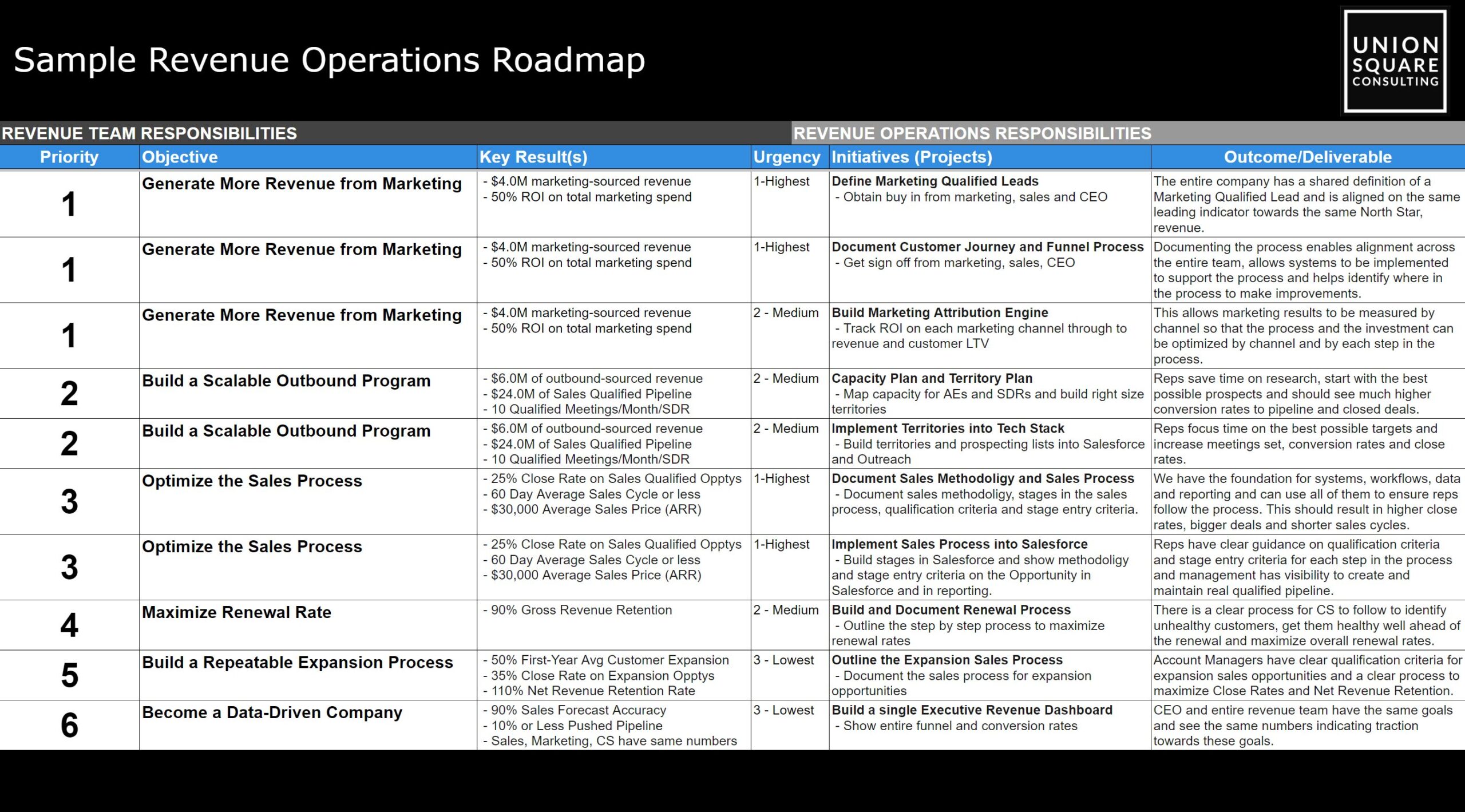
Once you’ve identified the initiative, turn it into a plan. Write a one-page GTM Ops Roadmap. Define OKRs. Map the initiatives. Assign owners.
For an inbound priority, that might read:
- Objective: Improve Inbound Lead Conversion
- Key Result(s):
- Lead conversion grows from 11.2% to 15.0%.
- Average lead response reduced from 2 days to 1 hour.
- Initiatives:
- Redefine the lead response and lead follow up process.
- Drive adoption of the process to see consistent execution in reports.
- Outcomes (Deliverables):
- Documented lead response and follow up processes
- New processes implemented into Salesforce w/ updated reporting
- Management inspects lead reporting daily to drive execution
- Reports reflect consistent execution of the new processes
Here’s a simple example of what that might look like:
Step 7: Get Alignment
And then you get signoff.
Don’t stop until the CRO, the CEO, the CMO, and everyone else with a stake agree this is the priority. Otherwise, you’ll get derailed by the next fire drill.
Once you have that alignment, everything else becomes easier. You can say no to distractions, track progress in pipeline council meetings, and keep every team rowing in the same direction.
Related: Create Strategic Alignment with a Pipeline Council
Related: The RevOps Roadmap Framework
Quick Summary
You don’t need to fix everything at once. And it doesn’t need to be perfect. You just need to take it from “broken” to “good enough.” If you’re churning customers because your onboarding process is “broken” then getting it to “good enough”, where most customers are onboard and happy with your product, is a monumental shift.
Here’s how:
- Start at the top: New Business or NRR?
- Next constraint: pipeline generation vs pipeline management, or retention vs expansion
- Pick a specific motion
- Pick a segment (SMB, MM, ENT) and/or Product(s)
- Diagnose the issues
- Build the roadmap and assign owners
- Align every stakeholder and say no to anything that doesn’t serve the plan
Then, do it again next quarter.
Ready to Drive More Revenue for Your Org?
Apply for The First 90, an intensive GTM Ops program for newly appointed CROs and revenue leaders. See results tied to revenue in 3 months.